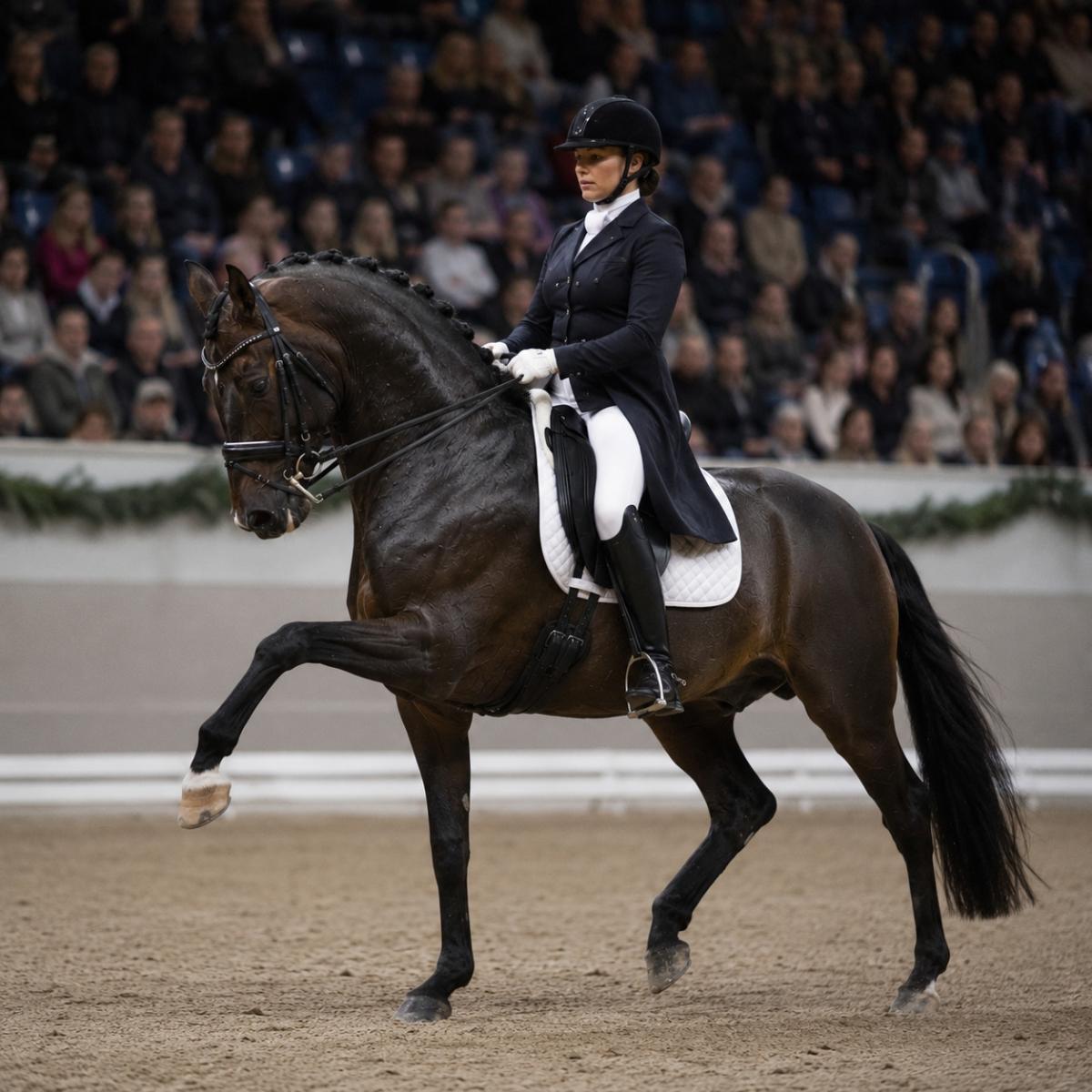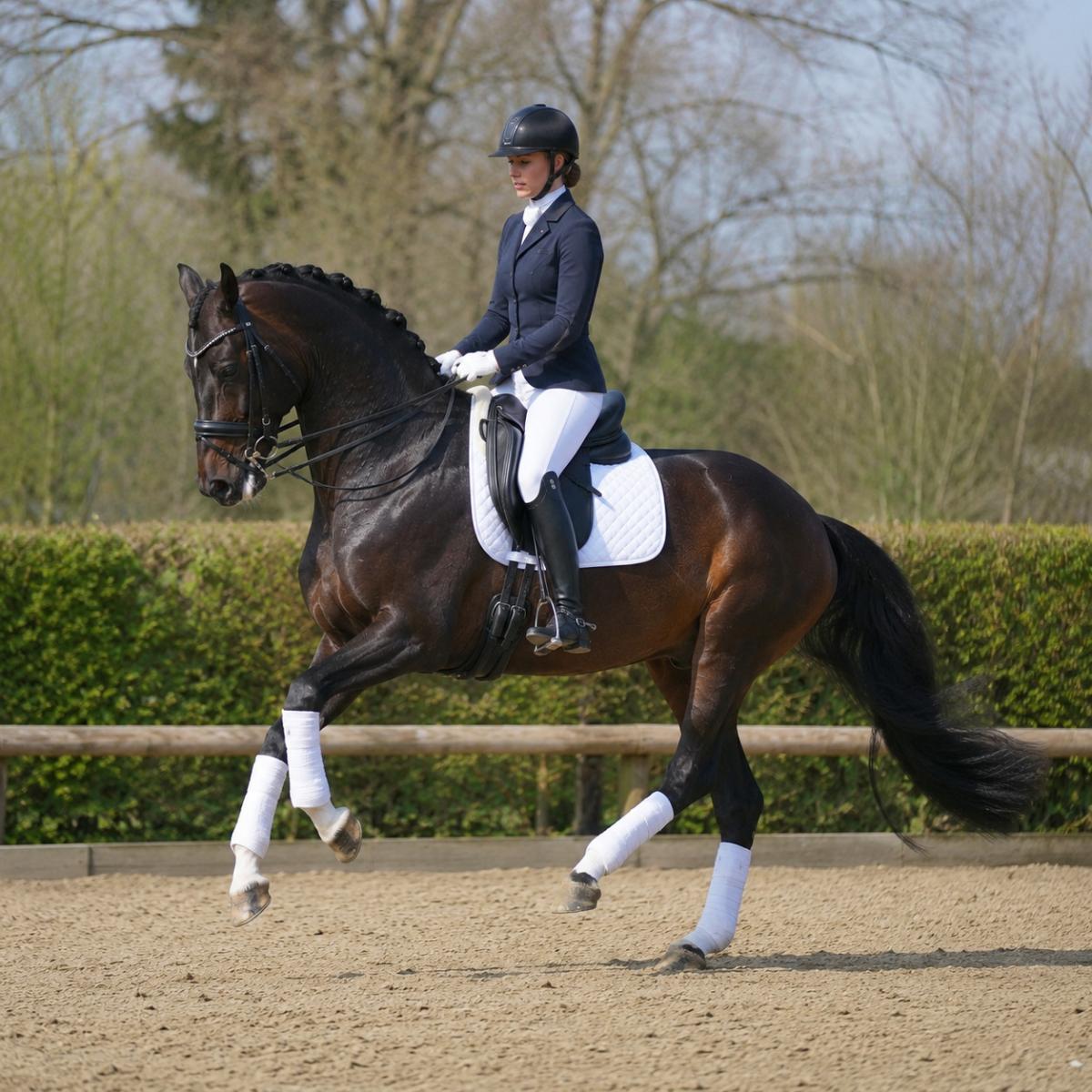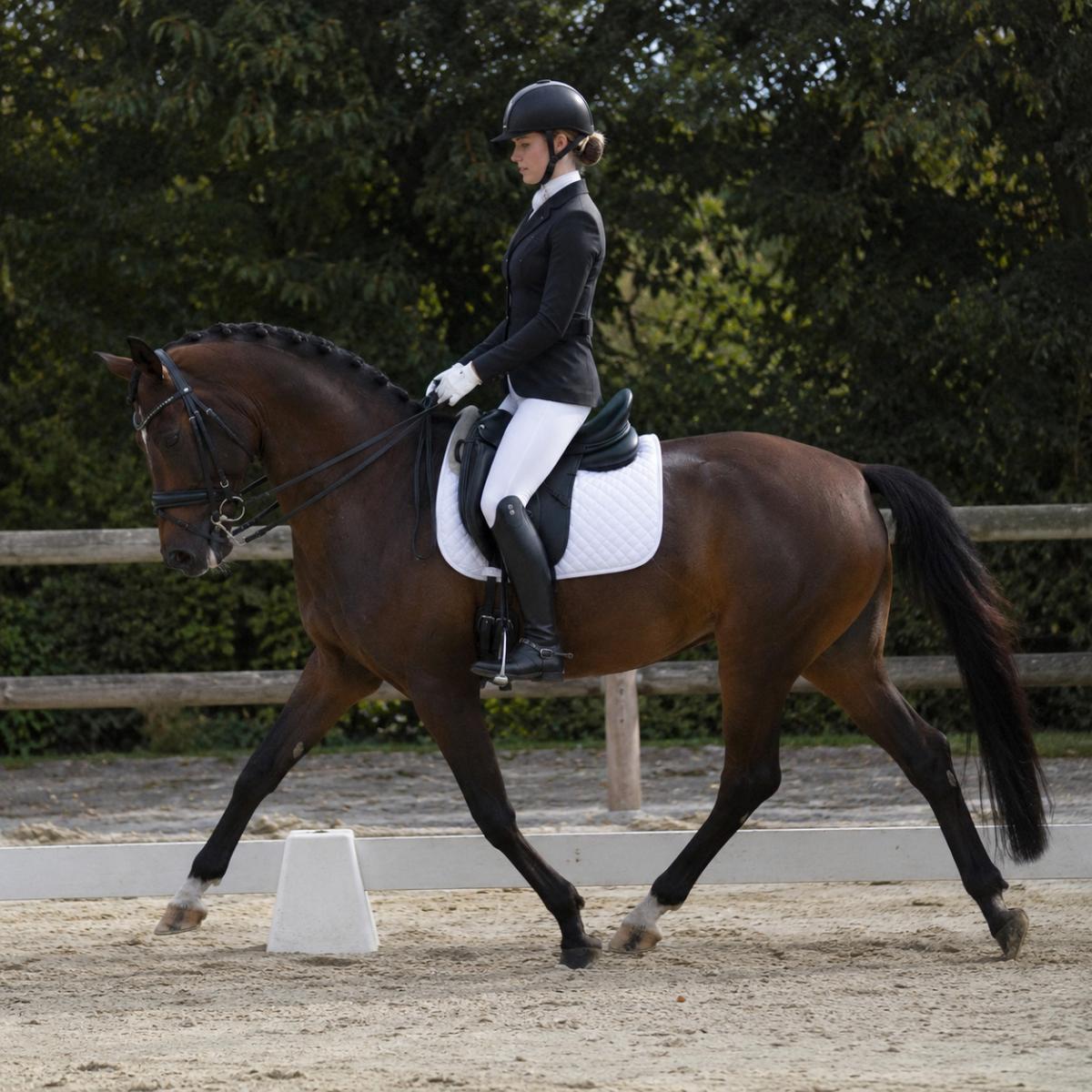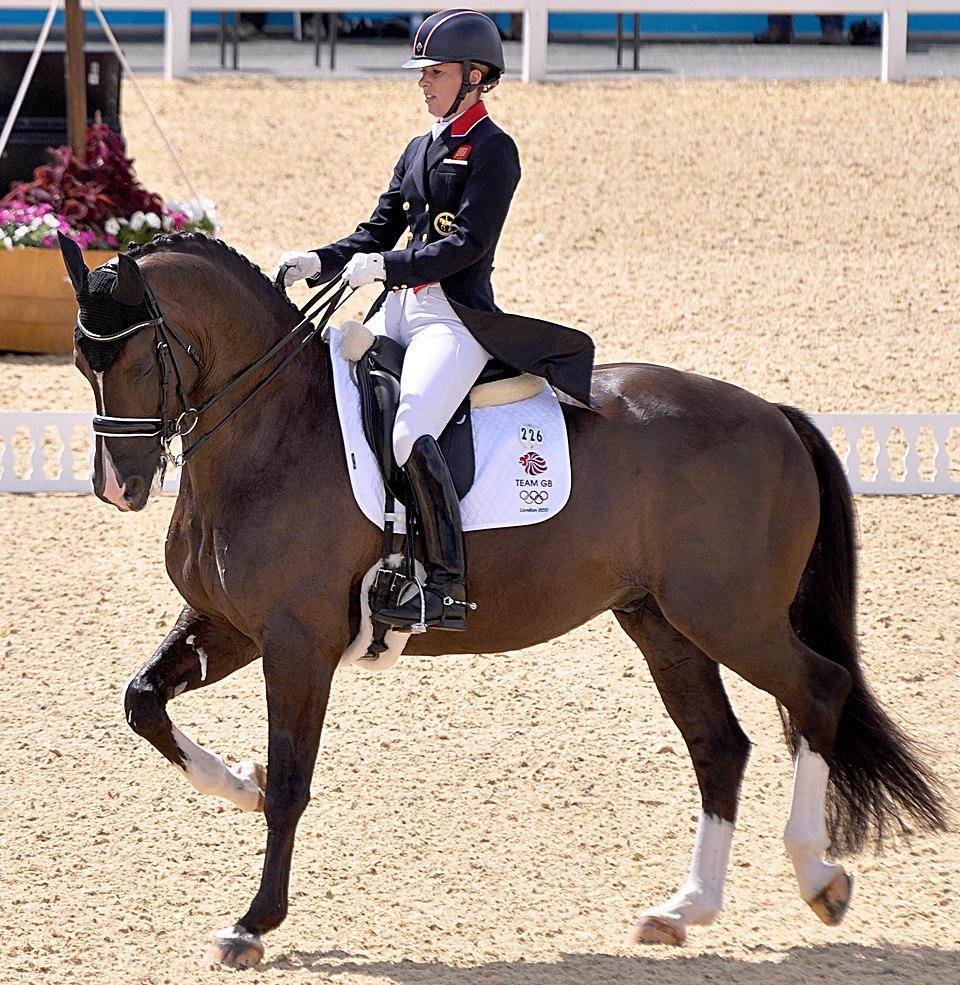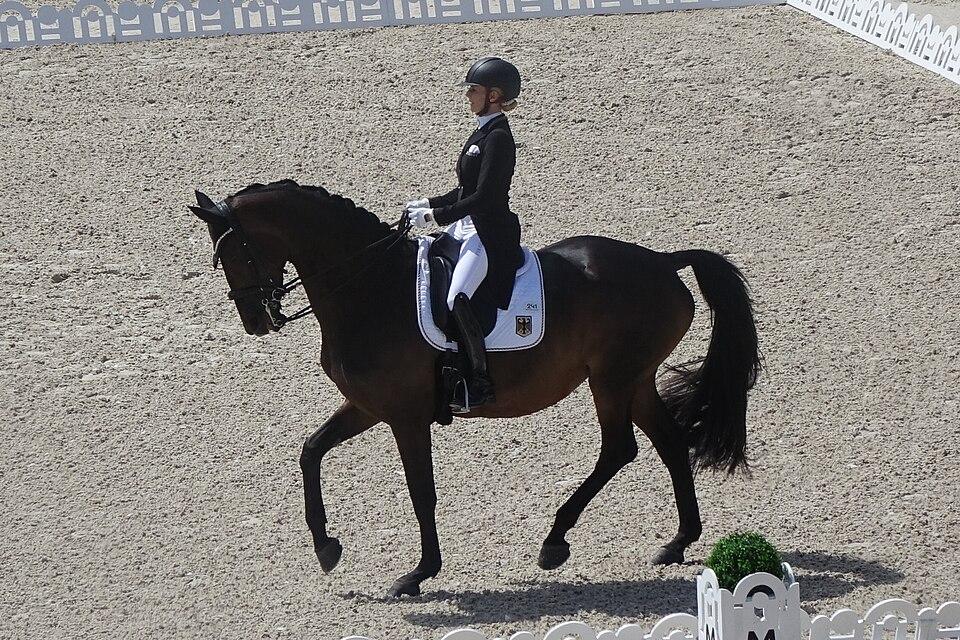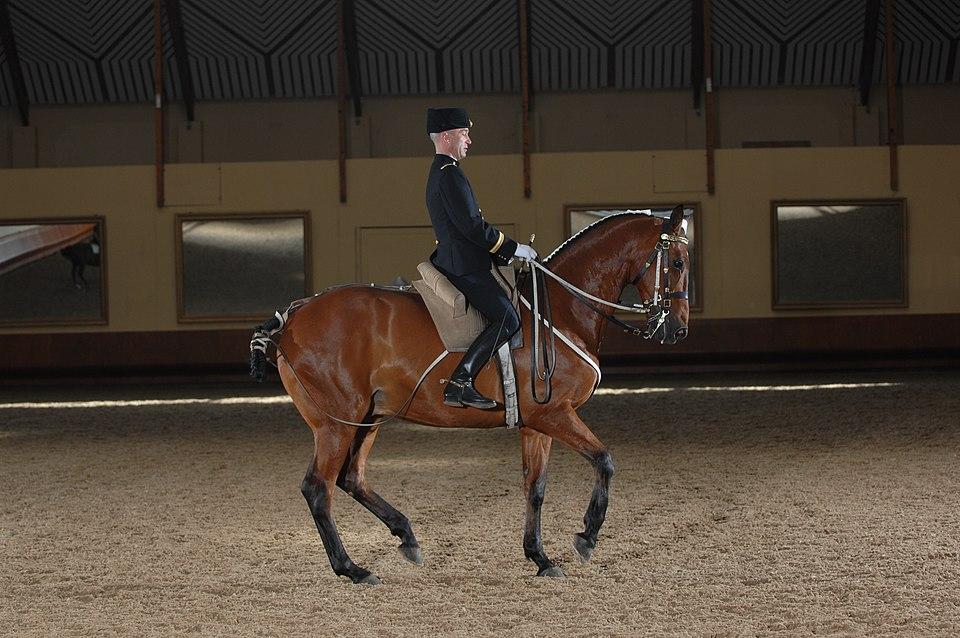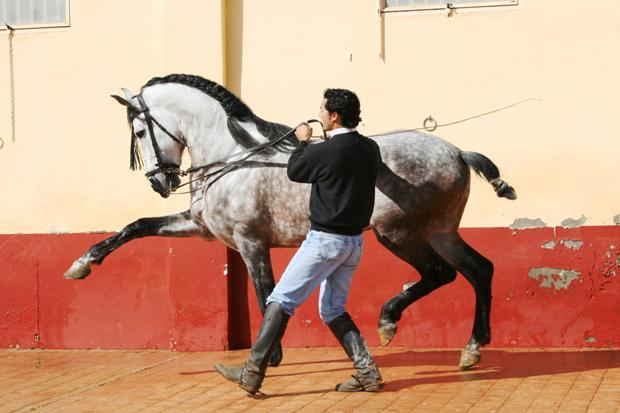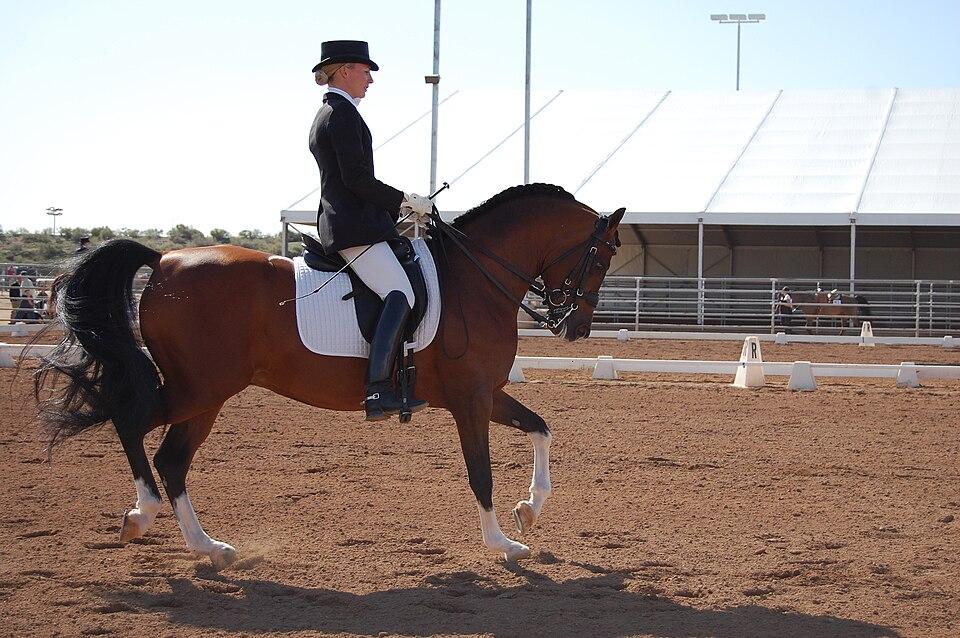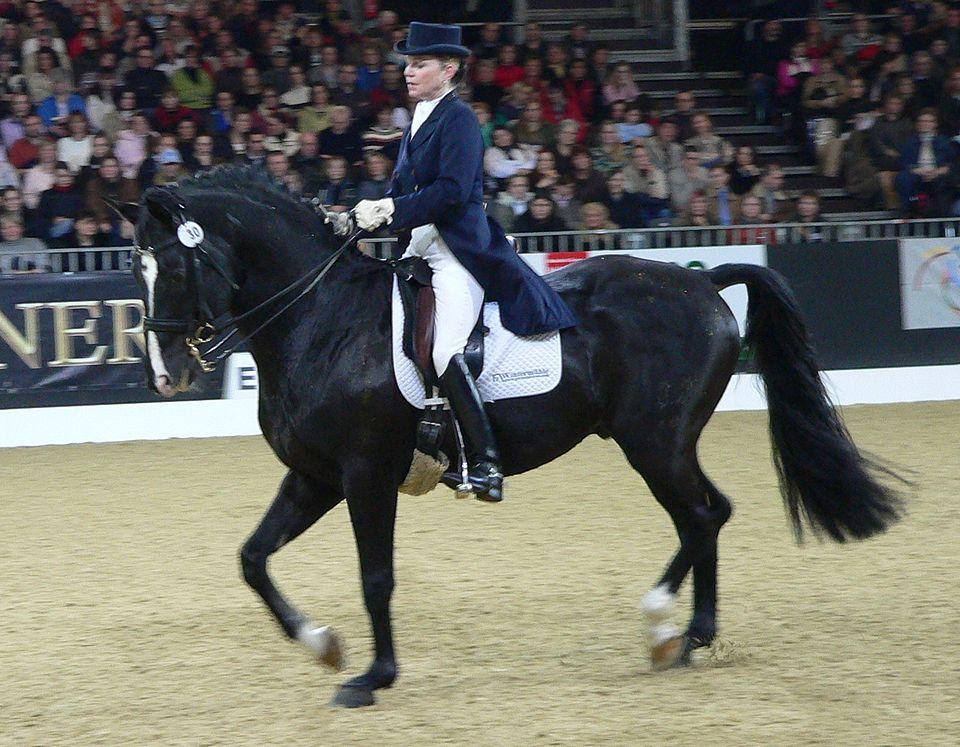
Passage is one of the most characteristic movements of high-level dressage. With its elevated strides, pronounced cadence and relatively slow forward progression, it can give the impression that the horse is bouncing or even “dancing”.
This distinctive appearance is not simply the result of slowing down the trot while asking the horse to lift its legs higher.
The Fédération Équestre Internationale defines passage as a measured, highly collected, elevated, regular and cadenced trot, characterised notably by greater flexion of the limbs and elasticity of movement. Its purpose is to demonstrate a very high degree of collection, cadence and suspension at the trot. (FEI – Dressage Judging Manual)
Biomechanical studies also show that passage has a distinctive locomotor organisation. Compared with trot, speed, stride frequency, vertical movement and the way forces are applied to the ground are altered.
Passage is therefore better understood as a highly specialised form of collected trot rather than simply a spectacular trot.

Julia Chevanne and Puschkin 11 performing passage at the 2016 Grand National Dressage at the Haras de Jardy. Photograph by Eponimm — CC BY-SA 4.0 — Wikimedia Commons.
Passage remains a diagonal gait
Passage retains the fundamental organisation of trot.
The limbs work in diagonal pairs: one forelimb moves in association with the opposite hindlimb, followed by the other diagonal pair.
The FEI requires each diagonal pair to be alternately raised and returned to the ground with regularity and cadence. (FEI – Dressage Judging Manual)
This diagonal organisation makes its relationship with trot recognisable despite the movement's distinctive appearance.
Passage is therefore not an entirely separate gait invented by dressage. It represents a highly developed transformation of the horse's diagonal locomotion.
Passage is not simply a slower trot
Visually, the horse travels considerably more slowly in passage than in ordinary trot.
Measurements confirm this impression.
A biomechanical study involving six Grand Prix horses compared their locomotion at trot and passage on an instrumented treadmill. During passage, the horses travelled on average 43.2% more slowly, while stride frequency decreased by 23.6%. (Weishaupt et al.)
The difference is not limited to speed.
Impulse per stride increased by 31%, while vertical displacement of the centre of mass became greater.
Passage therefore simultaneously modifies stride duration, forward speed and the vertical component of locomotion.
It is this combination that produces its distinctive appearance.
Why does the horse appear to bounce?
One of the most obvious visual characteristics of passage is its vertical movement.
The horse appears to rise and fall more with each stride than during ordinary trot.
Measurements performed on Grand Prix horses confirm an increase in the vertical movement of the centre of mass during passage. (Weishaupt et al.)
The limbs also display greater flexion.
A scientific review of collected trot, passage and piaffe highlights increased compression of the hindlimbs during the most collected movements. Their mechanical behaviour can be compared to a spring system, capable of storing and subsequently returning some elastic energy during the stride. (Clayton & Hobbs)
The visible “bounce” of passage therefore corresponds to genuine mechanical changes in locomotion.
Suspension does not tell the whole story
The regulatory definition of passage mentions a prolonged moment of suspension, which corresponds to its appearance and to the qualities sought in dressage.
However, this equestrian description needs to be distinguished from biomechanical measurements.
In the study by Weishaupt and colleagues, the relative duration of suspension was not significantly different between trot and passage, despite the much more suspended appearance of passage. (Weishaupt et al.)
These observations are not necessarily contradictory.
Stride frequency decreases during passage and total stride duration increases. Locomotion also becomes more vertical.
The horse can therefore give a much stronger impression of suspension without the proportion of the stride spent without ground contact necessarily increasing to the same extent.
The suspended appearance of passage results from several interacting phenomena, rather than simply from the horse spending much longer in the air.
Collection transforms locomotion
Passage is inseparable from collection.
Collection is sometimes oversimplified as the horse “transferring its weight onto the hindquarters”.
The phenomenon is more complex.
As collection increases, stride length decreases, speed falls and the joints of the hindlimbs show changes in flexion and function.
The biomechanical study of passage found a relative change in impulse distribution: the proportion borne by the forelimbs decreased by approximately 4.8% compared with the trot examined, representing a relative shift towards the hindlimbs. (Weishaupt et al.)
This does not mean that the hindlimbs suddenly support most of the horse's weight.
The forelimbs continue to experience considerable forces.
Collection should therefore be understood as a progressive reorganisation of balance and locomotion, rather than simply shifting the horse's weight backwards.
The hindlimbs play a particular role
The hindlimbs contribute substantially to the mechanical characteristics of passage.
Compared with trot, the study by Weishaupt and colleagues found an increase in propulsive impulse from the hindlimbs. (Weishaupt et al.)
Their flexion and compression also contribute to the horse's vertical movement.
This helps explain why preparation for passage progressively develops the horse's ability to maintain activity as the strides become shorter and the movement increasingly collected.
However, referring only to “hindlimb engagement” is not enough to explain passage.
The movement depends on the organisation of all four limbs, the trunk, the back and displacement of the centre of mass.
Passage requires activity while slowing down
Much of the difficulty comes from an apparently paradoxical requirement.
The horse must greatly reduce its forward speed without simply reducing its activity.
Ordinarily slowing the trot could produce less active strides or eventually a transition to walk.
During passage, the horse must instead maintain energetic locomotion while producing slower, more elevated and highly collected strides.
The FEI therefore requires lively and pronounced impulsion despite the reduction in forward speed. (FEI – Dressage Judging Manual)
This is one reason why correct passage cannot simply be produced by slowing the horse with the reins.
Regularity remains fundamental
Spectacular elevation of the limbs alone does not constitute good passage.
The movement must remain regular.
The FEI identifies several significant faults, including:
- irregular strides;
- lateral swinging of the forehand or hindquarters;
- jerky limb movements;
- trailing hindlimbs;
- and certain disturbances in diagonal rhythm. (FEI – Dressage Judging Manual)
A horse lifting its forelimbs very high is therefore not necessarily performing high-quality passage.
Cadence, balance, regularity, elasticity and coordination matter just as much as the visible amplitude of the movement.
Passage does not depend on a single muscle group
Passage is sometimes explained through the development of the abdominal muscles, back or hindquarters.
These structures clearly contribute to the movement, but none operates in isolation.
Passage involves measurable changes in limb kinematics, stance duration, forces applied to the ground and movement of the centre of mass.
It therefore involves an entire locomotor system combining muscles, tendons, joints, skeleton and neuromotor control.
This is also why its preparation is progressive.
The horse must develop sufficient coordination and physical capacity to maintain movement quality as the demands of collection increase.
How does a horse learn passage?
There is no universal method for teaching passage to every horse through exactly the same progression.
It belongs to advanced training.
Before it is introduced, the horse will normally already have developed sufficient training to maintain collected trot, respond to changes in stride amplitude and preserve balance through demanding transitions.
Training can then progressively seek greater cadence and elevation without losing activity.
Methods may vary according to equestrian tradition and the individual horse.
The underlying principle, however, is not to confuse producing a spectacular gesture with developing an organised movement.
Artificially lifting the limbs is not enough to create the mechanics of passage.
The rider directly participates in the movement
Passage is also a movement of the horse-and-rider combination.
The rider must accompany locomotion whose dynamics differ considerably from those of ordinary trot.
A kinematic study of high-level dressage riders showed that their movement patterns changed according to the degree of collection at trot.
During passage, the phase relationship between certain movements of the horse and rider changed, which is consistent with more active use of the rider's seat in this gait. (PubMed)
The apparent stillness of the rider therefore does not mean that the rider is doing nothing.
One of the aims of advanced dressage is precisely to maintain effective communication while making the aids as discreet as possible.
Passage and piaffe are not the same movement
Piaffe is closely associated with passage, but the two movements should not be confused.
Passage retains clearly directed forward progression.
Piaffe, by contrast, gives the impression that the horse remains almost in place.
Both movements rely on diagonal coordination and a high degree of collection, but their mechanics are not identical.
A biomechanical review of these gaits even describes piaffe as displaying an unusual combination of characteristics: some kinematic properties resemble walking, while ground-reaction forces and movement of the centre of mass retain characteristics associated with running gaits. (Clayton & Hobbs)
Piaffe is therefore not simply passage with all forward movement removed.
Passage-piaffe transitions are particularly demanding
In high-level dressage tests, the horse may transition directly from passage into piaffe and then return to passage.
These transitions are particularly revealing of training quality.
The horse must reduce its forward movement almost entirely and then regain it without losing cadence, activity, balance or diagonal coordination.
The FEI pays particular attention to these transitions when evaluating Grand Prix work. (FEI)
A horse may therefore be capable of performing passage and piaffe separately while experiencing greater difficulty when transitioning directly between them.
Passage belongs to high-level dressage
Passage is now associated with the most advanced levels of international dressage.
The Fédération Française d'Équitation describes it as a stylised, slowed and highly cadenced trot, seen at the highest level of the discipline. (Fédération Française d'Équitation)
It appears in advanced international tests and is one of the emblematic movements of Grand Prix dressage.
Its presence at this level reflects the many qualities it allows judges to assess simultaneously: collection, regularity, activity, coordination and response to the aids.
Its spectacular appearance is therefore only one aspect of what judges observe.
Passage belongs to a long haute école tradition
Passage did not originate with modern competition.
It belongs to the history of European haute école, within which different equestrian traditions developed over several centuries.
Historical sources on haute école horsemanship document passage among the repertoire of advanced movements, alongside piaffe, lateral movements and various airs above the ground. (BnF / CNAC)

Passage illustrated in François Robichon de La Guérinière's École de cavalerie, 1733 edition. Engraving by Charles Parrocel — public domain — Wikimedia Commons.
However, the history of the movement should not be presented as a simple and perfectly linear development.
French, German, Austrian, Italian, Portuguese and Iberian equestrian traditions underwent their own developments and influenced one another.
Modern competitive passage belongs to this historical heritage while now being defined by precise criteria in international dressage rules.
Can horses naturally produce something resembling passage?
It would be just as inaccurate to describe passage as completely “unnatural” as it would be to claim that a wild horse spontaneously performs the regulated passage of a Grand Prix test.
Horses can naturally produce highly cadenced, elevated and expressive trots, particularly during states of excitement or heightened arousal, which may visually resemble certain characteristics of passage.
Dressage therefore draws upon locomotor abilities already present in the horse.
Competitive passage, however, is a trained movement.
The horse must learn to reproduce this organisation on request, maintain its regularity and direction, respond to the rider's aids and integrate it into precise transitions.
An occasional natural movement and Grand Prix passage are therefore not equivalent.
Does breed influence passage?
Some horse populations have been selectively bred over several generations for dressage or particular locomotor characteristics.
Hanoverians, KWPNs and Oldenburgs are strongly represented in modern competitive dressage.
The Pura Raza Española (PRE) and Lusitano come from different breeding histories and are also used extensively in collected work.
This does not, however, demonstrate that any particular breed automatically finds passage “easier”.
A study comparing four Dutch Warmbloods and four Lusitanos during collected trot and passage found some differences in ground-reaction forces between the two groups. The sample was far too small, however, to establish a general rule applying to entire breeds. (PubMed)
At the individual level, the ability to develop passage depends on numerous factors, including conformation, natural locomotion, physical capacity, health, learning and quality of training.
Spectacle alone does not define good passage
Passage naturally attracts attention.
A horse with pronounced forelimb elevation can produce an extremely spectacular movement.
But visible amplitude represents only one part of the exercise.
The FEI also looks for regularity, collection, cadence, elasticity, activity and stability in the contact. (FEI – Dressage Judging Manual)
This distinction is important in discussions surrounding modern dressage.
Highly expressive movement does not automatically demonstrate good biomechanics, but neither is it, by itself, evidence of incorrect training.
Passage must be evaluated as a complete movement, rather than solely according to the height reached by the limbs.
Why does passage make the horse look as though it is dancing?
The impression of dancing ultimately results from several characteristics acting together.
The movement remains governed by the diagonal rhythm of trot, but forward progression decreases considerably. Strides become longer in duration, vertical movement of the body increases and the limbs display greater flexion.
The highly visible cadence creates a regular sequence of movements that can naturally resemble choreography.
This impression becomes even stronger during freestyle tests performed to music.
Behind this apparent lightness, however, lies complex mechanics.
Passage combines collection, diagonal coordination, altered ground-reaction forces, vertical movement of the centre of mass, muscular activity and interaction with the rider.
It is precisely this contrast that makes passage so distinctive: a demanding and highly organised movement that, when correctly performed, can appear almost effortless.
Image credits
Julia Chevanne and Puschkin 11 performing passage
- Photographer: Eponimm
- Date: 10 April 2016
- Location: Grand National Dressage, Haras de Jardy, France
- Source: Wikimedia Commons
- Licence: Creative Commons Attribution-ShareAlike 4.0 International — CC BY-SA 4.0
- Modification: no modification to the original image in this version of the article.
Passage in École de cavalerie
- Work: École de cavalerie, 1733 edition
- Engraver: Charles Parrocel
- Original source: François Robichon de La Guérinière, École de cavalerie
- Digital source: Wikimedia Commons
- Copyright status: public domain
- Modification: no modification to the original image in this version of the article.
Sources and references
- Fédération Équestre Internationale – Dressage Judging Manual
- Fédération Équestre Internationale – Dressage Rules
- Weishaupt et al. – Kinetics and kinematics of the passage
- Clayton & Hobbs – A Review of Biomechanical Gait Classification with Reference to Collected Trot, Passage and Piaffe in Dressage Horses
- Ground reaction forces of elite dressage horses in collected trot and passage
- Differences in rider movement pattern between different degrees of collection at the trot in high-level dressage horses
- Fédération Française d'Équitation – Dressage at the 2026 World Championships
- BnF / CNAC – Haute école