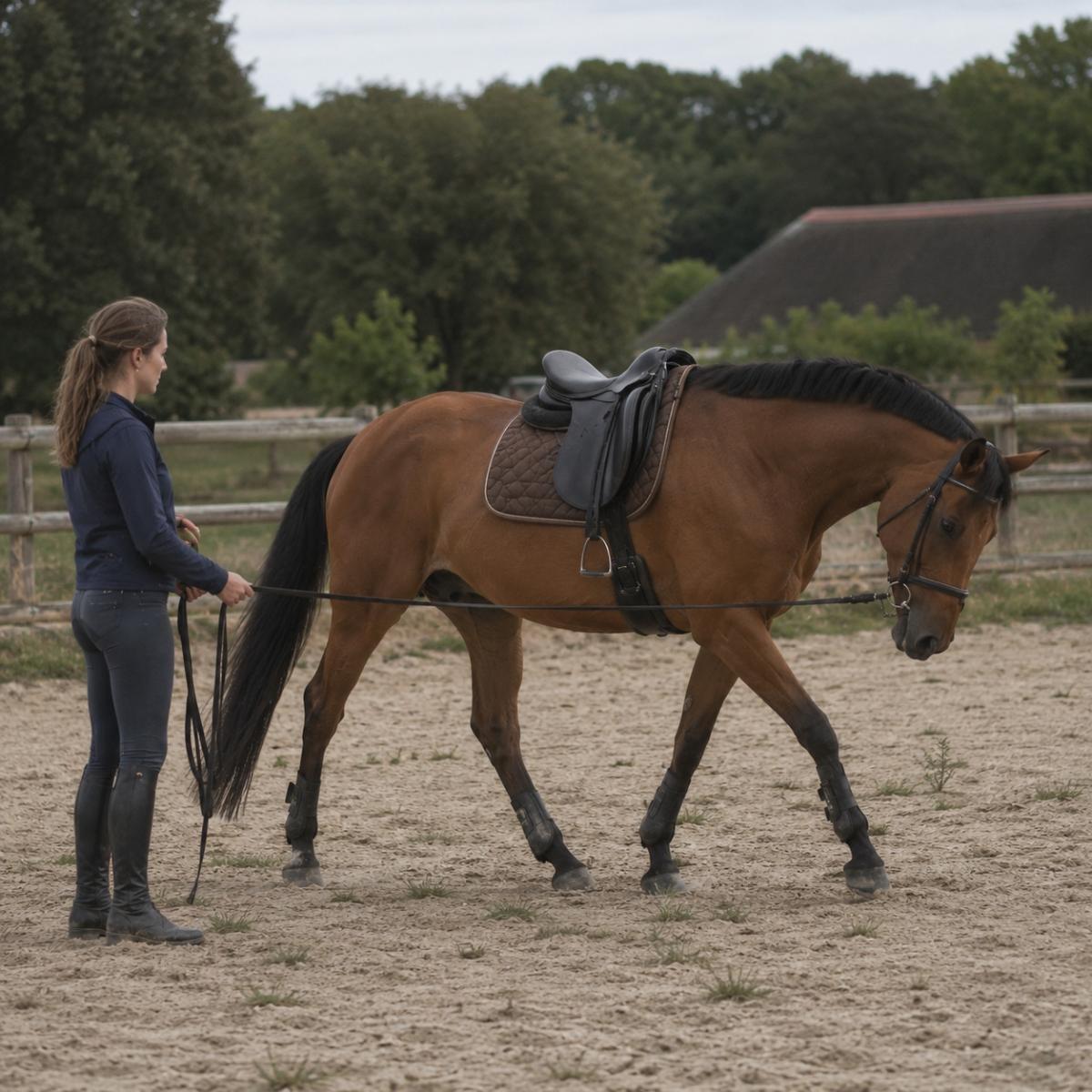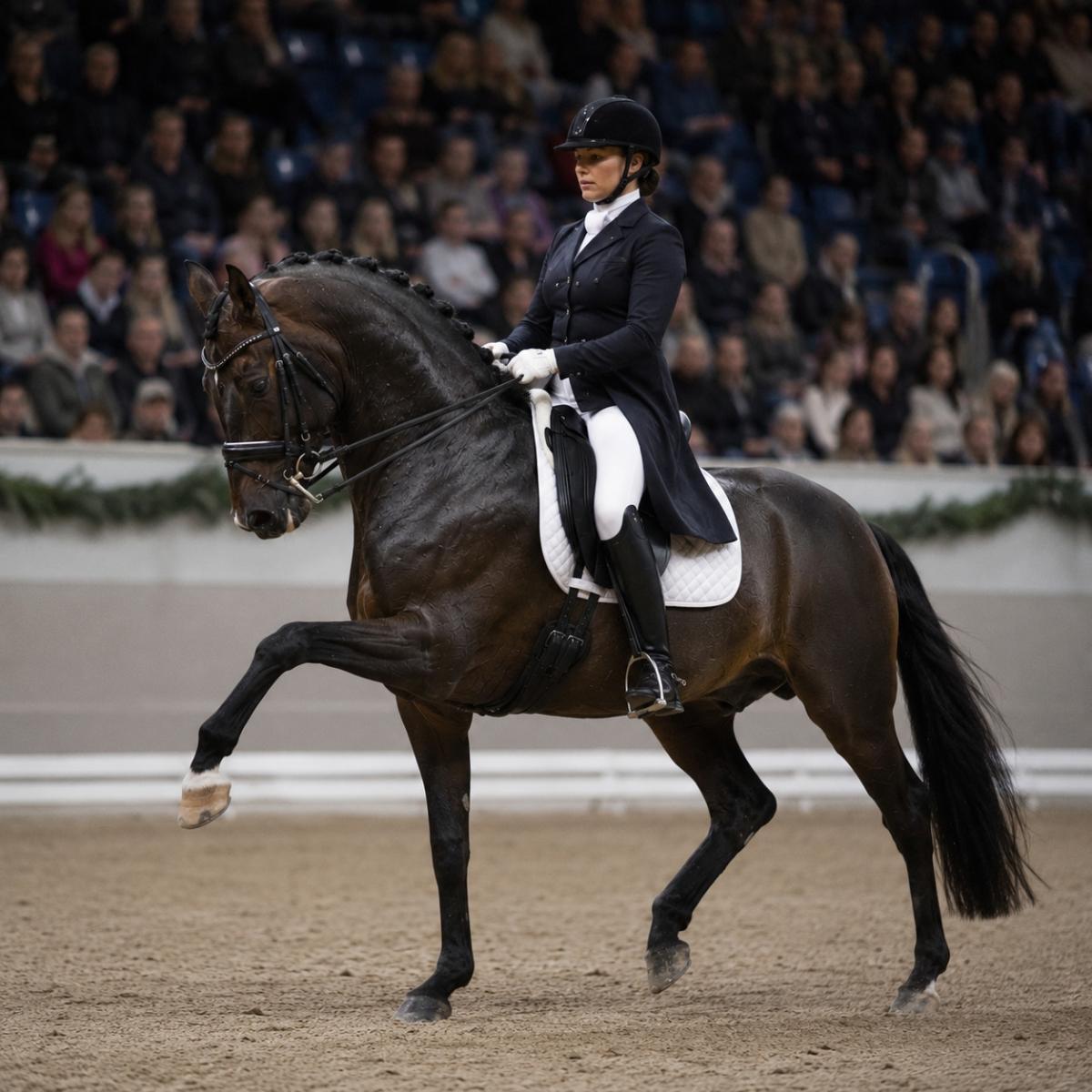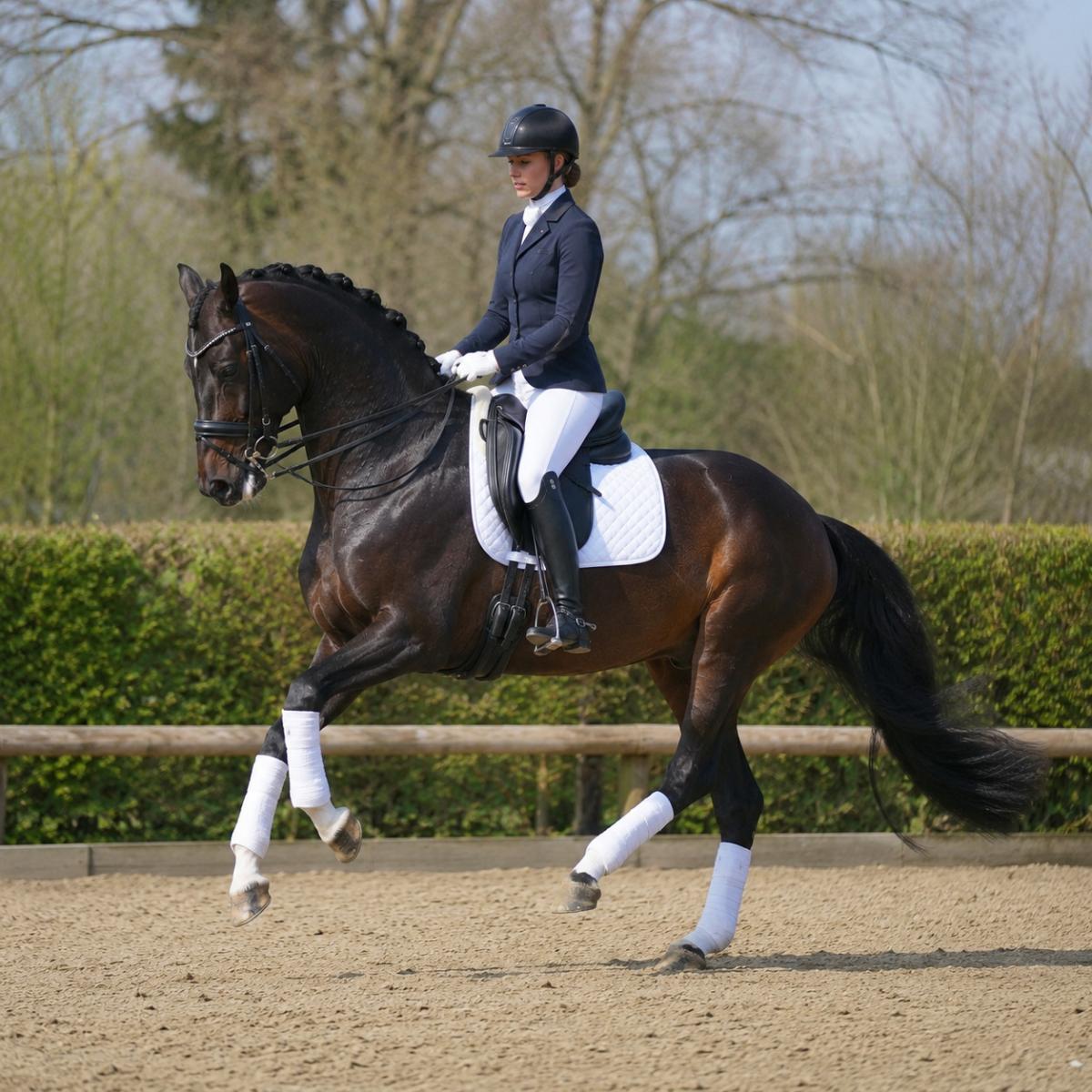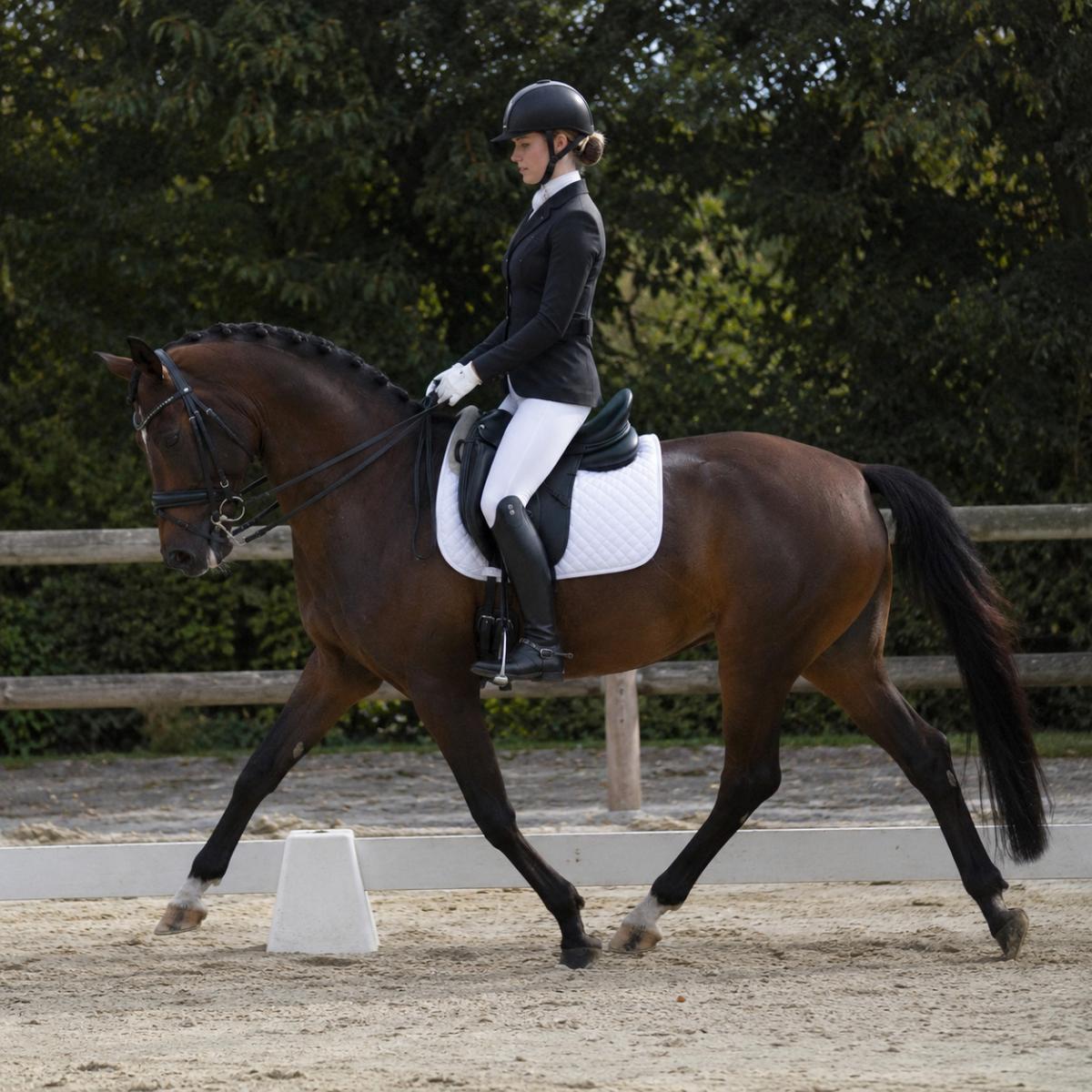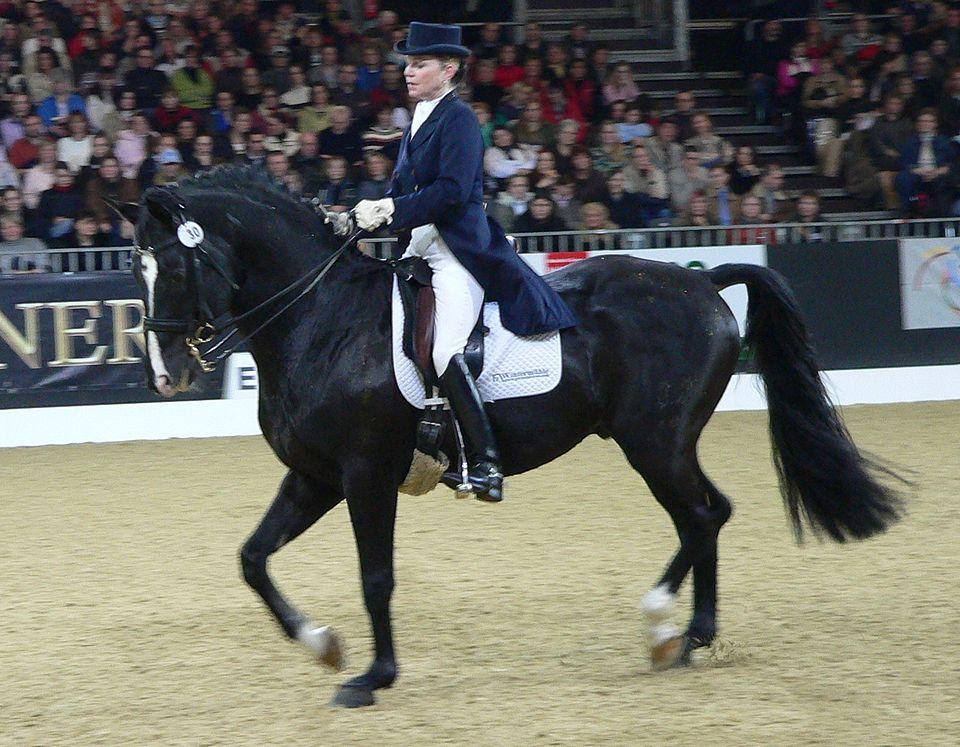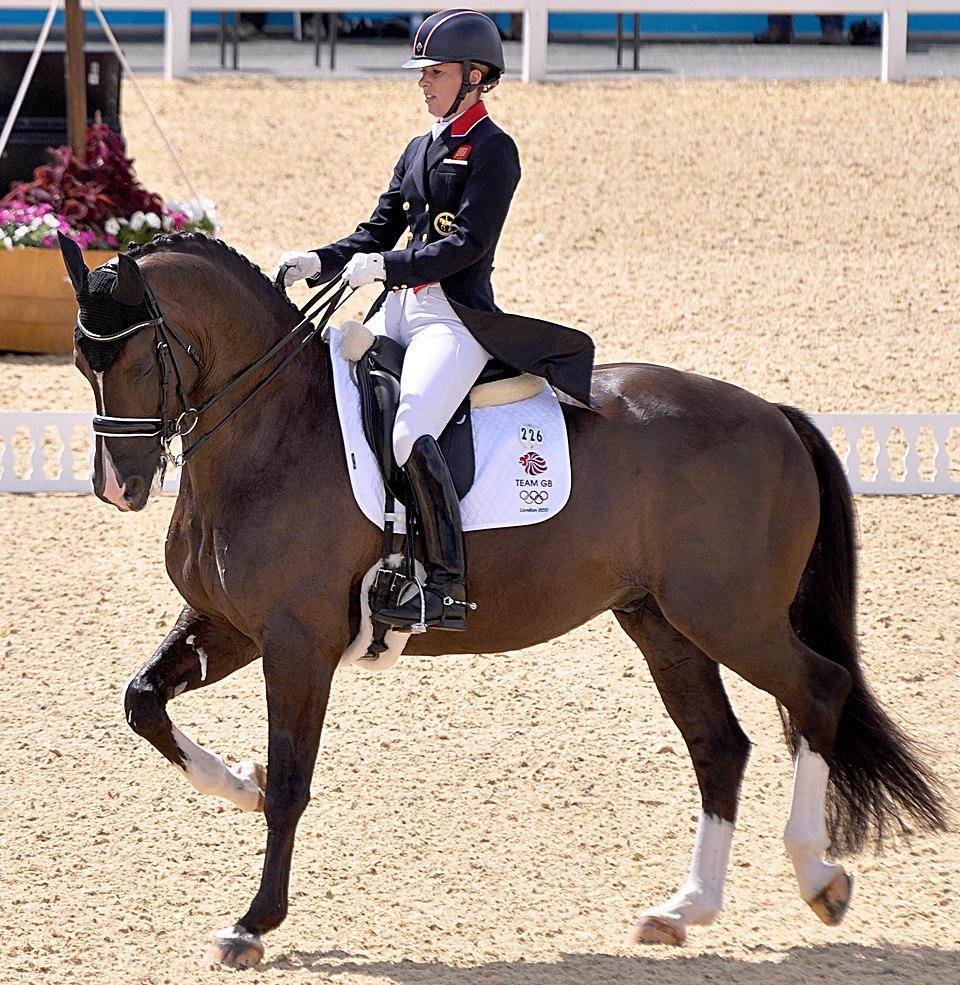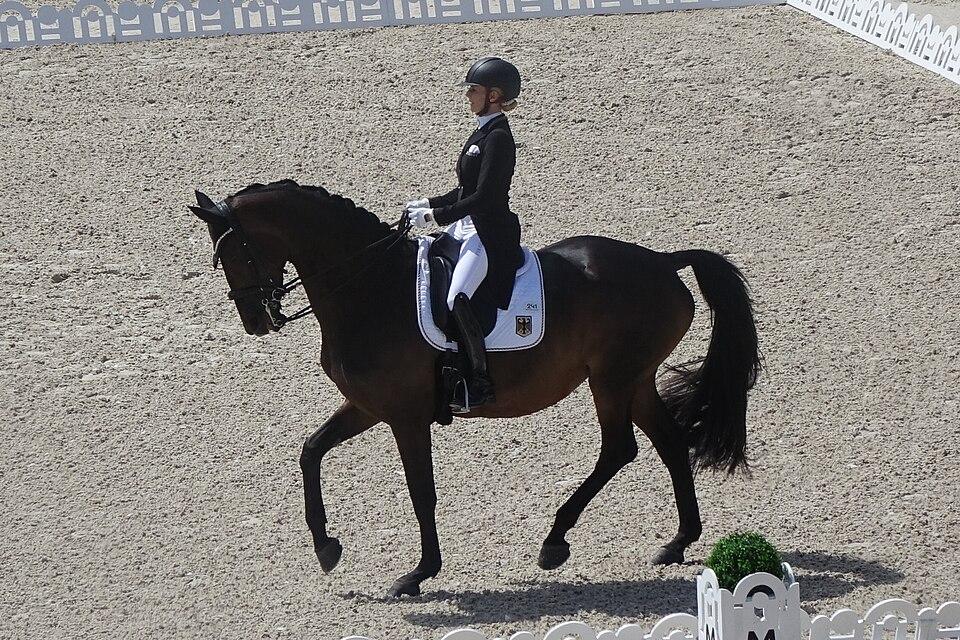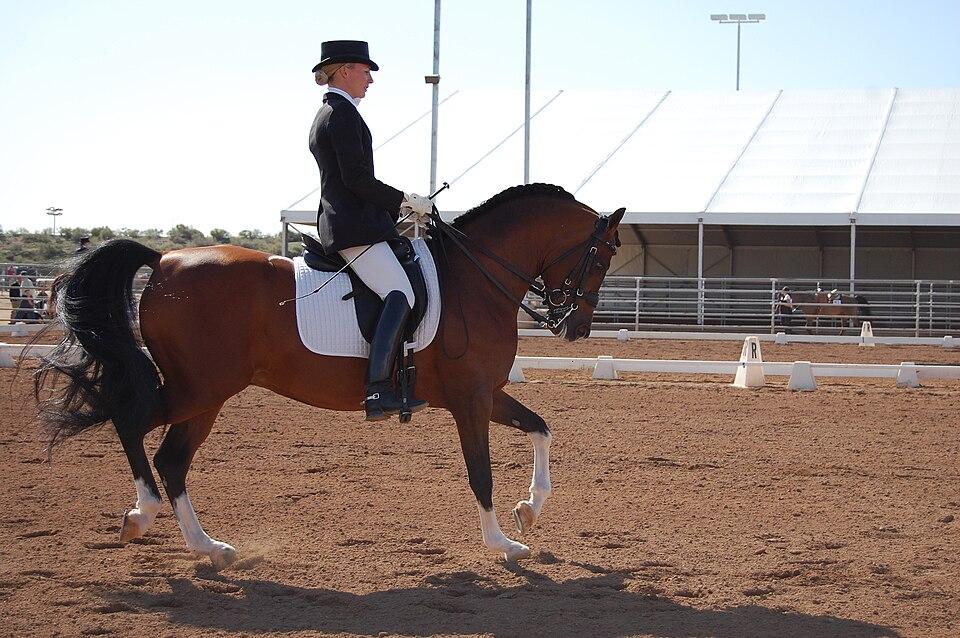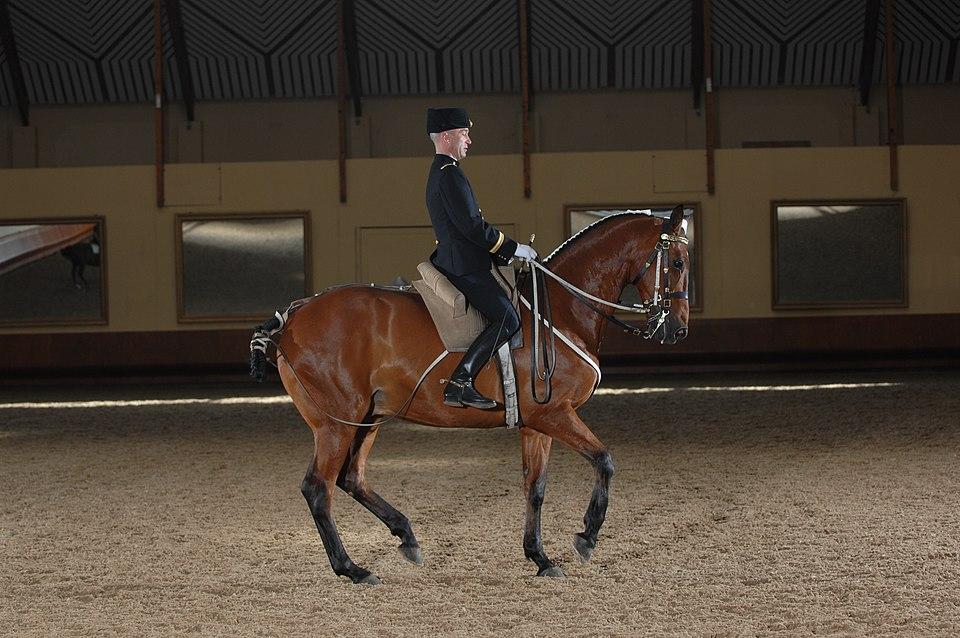
Piaffe is one of the most characteristic movements of high-level dressage. To a spectator, it often resembles an extremely collected trot performed almost on the spot: the limbs work in alternating diagonal pairs while the horse makes virtually no forward progress.
This visual description is accurate, but it does not fully explain the movement.
The Fédération Équestre Internationale defines piaffe as a highly collected, cadenced, elevated diagonal movement giving the impression of remaining in place. Its purpose is to demonstrate the highest degree of collection while maintaining activity, balance and regularity.
From a biomechanical perspective, piaffe is even more unusual. It is not simply a trot whose speed has gradually been reduced to zero. Research on dressage horses shows that its locomotor organisation differs sufficiently for it to be considered a specialised form of locomotion, combining certain characteristics of walking and running gaits.
Piaffe retains diagonal coordination
As in trot and passage, piaffe is based on diagonal coordination of the limbs.
The right forelimb works in association with the left hindlimb, followed by the left forelimb and right hindlimb.
The FEI requires each diagonal pair to be alternately raised and returned to the ground with regularity and spring.
The limbs do not, however, necessarily have to touch and leave the ground at exactly the same instant.
Temporal studies of piaffe show that coordination between the limbs is more complex than the perfectly simultaneous alternation of two rigid diagonal pairs.
It is the overall organisation of the movement that remains diagonal.
The horse should give the impression of remaining in place
One of the essential characteristics of piaffe is its extremely limited forward progression.
The FEI requires the horse to give the impression of remaining in place, while allowing a slight tendency to move forward.
This distinction is important.
A good piaffe does not necessarily require the hooves to return to exactly the same spot with every step.
Above all, the horse should maintain its activity and remain ready to move forward as soon as the rider asks.
Moving backwards, progressing excessively forward or drifting sideways are, by contrast, significant faults.
Piaffe therefore requires a delicate balance: almost completely reducing horizontal speed without suppressing locomotor activity.
Piaffe is not simply trot slowed down to zero
Piaffe is traditionally associated with trot because it retains diagonal coordination.
Biomechanical measurements, however, show that gradually slowing trot is not enough to produce piaffe.
A study involving six Grand Prix horses compared in-hand trot, working trot, collected trot, passage and piaffe.
As collection increased, speed and stride length decreased while stance duration increased.
During piaffe, the researchers no longer observed a true suspension phase. (pubmed.ncbi.nlm.nih.gov)
This characteristic clearly distinguishes piaffe from conventional trot and passage.
A biomechanically hybrid gait
The absence of a true aerial phase makes the classification of piaffe particularly interesting.
A biomechanical review of collected trot, passage and piaffe compared several criteria used to distinguish walking from running gaits.
Collected trot and passage displayed the characteristics of running gaits.
Piaffe was different.
Its kinematics showed some characteristics of a walking gait, while ground-reaction forces and movement of the centre of mass retained an organisation more commonly associated with running gaits. (pubmed.ncbi.nlm.nih.gov)
The authors therefore describe piaffe as a hybrid gait.
Piaffe is consequently not only spectacular: it represents a rather unusual form of locomotor organisation in the horse.
Why does piaffe still look like trot?
The impression of trot comes primarily from the alternating diagonal limbs.
Visually, this organisation is immediately recognisable.
But a gait is not defined solely by the order in which the limbs move.
Researchers can also examine:
- stance duration;
- the presence or absence of an aerial phase;
- forces applied to the ground;
- the trajectory of the centre of mass;
- limb compression;
- and exchanges of mechanical energy.
When these characteristics are considered, piaffe appears far more unusual than a simple trot on the spot.
Piaffe requires balance without forward speed
When a horse trots normally, forward progression contributes to the dynamics of locomotion.
During piaffe, horizontal speed becomes extremely low.
The horse must nevertheless continue alternating its supports while maintaining balance.
A study measuring ground-reaction forces in seven trained dressage horses found considerable step-to-step variability in horizontal forces. The authors suggested that this variability may partly reflect the difficulty of maintaining balance on a diagonal pair without the momentum provided by forward movement. (pubmed.ncbi.nlm.nih.gov)
This constraint helps explain why piaffe is such a demanding movement.
The hindlimbs play an important role, but they do not carry the entire horse
Piaffe is often explained by saying that the horse “transfers its weight onto the hindquarters”.
This description is too simplistic.
Measurements from seven horses performing piaffe showed that peak vertical forces remained higher in the forelimbs than in the hindlimbs.
However, compared with other diagonal gaits, the researchers observed a relative shift in force distribution towards the hindlimbs. (pubmed.ncbi.nlm.nih.gov)
These two observations are compatible.
Collection can modify the relative contribution of the hindlimbs without making them responsible for the majority of vertical support.
The common claim that the horse “carries all its weight behind” therefore does not correspond to what biomechanical measurements show.
The hindlimbs compress more
The changes observed in the hindlimbs do not concern forces alone.
During passage and piaffe, the hindlimb joints display characteristics that differ from those seen in ordinary trot.
Kinematic studies have found greater flexion of the stifle and hock at the beginning of stance during passage and piaffe. (pubmed.ncbi.nlm.nih.gov)
A biomechanical review also describes the hindlimbs as functioning more like springs, with greater compression during passage and piaffe than during trot. (pubmed.ncbi.nlm.nih.gov)
This compression contributes to the horse's characteristic vertical movement.
It tells us considerably more about piaffe than simply observing how high the horse lifts its feet.
Piaffe is not about making the horse lift its legs
This distinction is essential.
A horse can learn to raise its limbs alternately without producing the biomechanical organisation required for piaffe.
The FEI does not judge foot elevation alone.
It looks for characteristics including:
- clear diagonal coordination;
- regularity;
- activity;
- balance;
- a supple back and topline;
- engaged and active hindlimbs;
- and great mobility of the forehand.
A recent review of biomechanical literature concerning certain in-hand training methods similarly argues that mechanically eliciting limb elevation does not guarantee the characteristics of genuine collection. (pubmed.ncbi.nlm.nih.gov)
Lifting the legs and performing correct piaffe are therefore two different things.
The base of support also matters
The way the horse places its limbs affects balance.
The FEI considers crossing the limbs, swaying sideways and presenting an abnormally wide or extremely narrow base of support to be significant faults.
This shows that piaffe is not assessed solely by how it looks from the side.
Judges must also consider the horse's straightness and lateral stability.
A piaffe that looks spectacular from the side may therefore reveal important faults when viewed from the front.
Piaffe requires considerable energy despite the lack of speed
Remaining almost on the spot does not mean that the movement is mechanically economical.
Quite the opposite.
A study of the mechanics of diagonal gaits compared trot, passage and piaffe in three highly trained horses.
The researchers found that mechanical energy losses associated with collisions increased substantially as speed approached zero. In their analysis, these losses were approximately three times greater during piaffe than during trot. (pubmed.ncbi.nlm.nih.gov)
The authors compared some mechanical characteristics of piaffe with bouncing in place.
The horse's low speed should therefore not be confused with low mechanical effort.
Why is collection essential?
The regulatory purpose of piaffe is precisely to demonstrate the highest degree of collection.
Collection, however, is not simply a particular posture.
It involves changes in stride length, joint movement, limb compression and the overall organisation of locomotion.
As trot becomes increasingly collected, speed and stride length decrease.
Piaffe represents an extreme situation in which horizontal progression becomes almost zero while activity must be maintained.
The horse therefore has to organise its body very differently from the way it would when simply slowing down or stopping.
Correct piaffe must remain active
The apparent stillness of piaffe can lead to another misunderstanding.
The aim is not to keep the horse in place by preventing it from moving forward.
The FEI instead requires piaffe to be animated by lively activity, with the horse ready to move forward as soon as it is asked.
This readiness is fundamental.
A horse mechanically restrained between conflicting aids may appear to remain on the spot without producing the quality of movement required.
Piaffe therefore combines two apparently contradictory demands: almost no forward progression and considerable locomotor activity.
Regularity remains essential
The FEI considers several characteristics to be serious faults, including:
- irregular or jerky steps;
- the absence of clearly recognisable diagonal pairs;
- crossing the limbs;
- swinging the forehand or hindquarters;
- excessive forward progression;
- moving backwards;
- and disturbances of rhythm.
The height of the limbs cannot compensate for these problems.
As with passage, spectacle is therefore only one aspect of the movement.
Regularity, coordination and balance remain fundamental.
How is piaffe taught?
There is no universal method for teaching piaffe in exactly the same way to every horse.
Different equestrian traditions have developed different approaches.
Training may involve:
- transitions;
- progressive development of collected trot;
- variations in the degree of collection;
- ridden work;
- or certain forms of in-hand work.
But reproducing the visible limb movement is not enough.
The horse must develop the physical qualities and coordination required to reduce forward progression dramatically while maintaining balance and activity.
Piaffe therefore belongs within an advanced training progression, rather than being an isolated movement taught independently from the rest of dressage.
In-hand work can be used, but its effects depend on the method
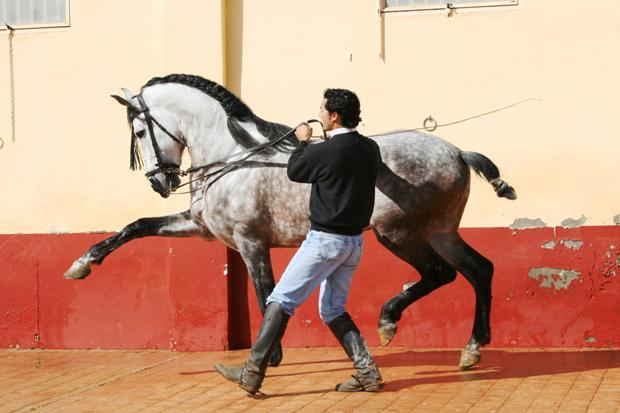
In-hand work has a historical place in several haute école traditions.
It may be used to prepare or refine certain aspects of piaffe.
That does not mean that every in-hand technique produces the same adaptations.
A review published in 2026 examined methods based on tactile stimulation of the limbs to provoke their elevation. Drawing on the available biomechanical literature, the author argues that primarily eliciting a limb-withdrawal response is not sufficient to develop genuine collection. (pubmed.ncbi.nlm.nih.gov)
This publication presents a particular biomechanical interpretation and does not, by itself, validate or invalidate every form of in-hand training.
It nevertheless highlights an important principle: the outward appearance of a movement does not guarantee that the horse is using its body in the desired way.
What is the difference between piaffe and passage?
Piaffe and passage share diagonal coordination and a very high degree of collection.
They are nevertheless different movements.
Passage retains clearly visible forward progression and a suspension phase.
Piaffe reduces progression almost to zero and, in biomechanical studies of high-level horses, generally does not display the same true aerial phase.
This difference profoundly changes the mechanics of locomotion.
Passage remains biomechanically classified as a running gait, whereas piaffe displays its unusual hybrid organisation between walking and running characteristics. (pubmed.ncbi.nlm.nih.gov)
Piaffe is therefore not simply passage brought to a halt.
Passage-piaffe transitions reveal the quality of training
In Grand Prix tests, horses must be able to transition from passage into piaffe and then return to passage.
These transitions are particularly demanding.
The horse moves from a highly collected diagonal movement with forward progression and suspension to one in which horizontal speed becomes almost zero, before immediately regaining forward progression.
All of this must happen without losing:
- rhythm;
- balance;
- activity;
- straightness;
- or quality of contact.
These transitions therefore demonstrate the horse's ability to make profound changes to its locomotion without disrupting its overall organisation.
Can every horse learn piaffe?
There is no universal answer.
The ability to develop high-quality piaffe depends on many factors, including conformation, locomotion, physical capacity, health, coordination, learning and quality of training.
Populations heavily selected for dressage, such as the Hanoverian, KWPN and Oldenburg, are strongly represented in international competition.
The Pura Raza Española (PRE) and Lusitano come from different breeding histories in which collected work has also played an important role.
Breed alone, however, cannot predict the quality of an individual horse's piaffe.
Claiming that all Iberian horses naturally perform better piaffe, for example, would be a generalisation that is difficult to demonstrate scientifically.
Does piaffe occur naturally?
Competitive piaffe is a trained and standardised movement.
A horse at liberty can nevertheless produce very short, elevated or nearly stationary diagonal movements in certain situations involving excitement or tension.
These behaviours may visually resemble some characteristics of piaffe.
They are not, however, equivalent to the movement required in dressage.
High-level piaffe must be produced on request, with regularity, balance, direction, contact and the ability to transition immediately into other movements.
Dressage therefore organises existing locomotor capacities of the horse into a precise and repeatable exercise.
Piaffe belongs to a long haute école tradition
Piaffe did not originate with modern competition.
It belongs to the broader history of European haute école, in which the development of collection and highly controlled movements has played an important role.
European equestrian traditions evolved over several centuries and influenced one another.
It would therefore be reductive to attribute the invention of modern piaffe to a single school or to one exclusively military purpose.
The movement practised today forms part of this historical heritage, while its competitive form is now defined by precise regulatory criteria.
Piaffe also features in debates surrounding modern dressage
Like other highly advanced exercises, piaffe regularly appears in discussions surrounding modern dressage.
Questions concern tension, head and neck position, training methods and the distinction between spectacular expression and correct function.
A study comparing videos of elite dressage horses from 1992 and 2008 found an increased frequency of head positions behind the vertical during passage and piaffe in the sample examined. (pubmed.ncbi.nlm.nih.gov)
Other research using an ethogram designed to identify behaviours associated with pain in ridden horses has also examined Grand Prix horses and identified behaviours deserving particular attention during advanced movements, including piaffe. (pubmed.ncbi.nlm.nih.gov)
These observations do not mean that piaffe is inherently harmful.
Instead, they show that the quality of the movement, the methods used and the horse's physical condition must be considered separately from the simple ability to perform the exercise.
A spectacular movement whose quality lies in the details
Piaffe naturally attracts attention because the horse appears to produce considerable activity without actually travelling anywhere.
But its difficulty lies in much more than this illusion of trotting on the spot.
The horse must coordinate its diagonal limbs, maintain balance with almost no horizontal speed, manage substantial forces, compress and extend its limbs in an organised way and remain ready to move forward immediately.
Biomechanics even shows that piaffe occupies an unusual position among equine gaits, combining kinematic characteristics of a walking gait with centre-of-mass mechanics and forces more commonly associated with running gaits.
It is this complex organisation, far more than the height of the legs, that makes piaffe one of the most technically demanding movements in dressage.
Sources and references
- Fédération Équestre Internationale – Dressage Judging Manual
- Fédération Équestre Internationale – Dressage Rules
- Holmström, Fredricson & Drevemo – Biokinematic effects of collection on the trotting gaits in the elite dressage horse
- Clayton & Hobbs – A Review of Biomechanical Gait Classification with Reference to Collected Trot, Passage and Piaffe in Dressage Horses
- Clayton & Hobbs – Ground Reaction Forces of Dressage Horses Performing the Piaffe
- Hobbs & Clayton – Collisional mechanics of the diagonal gaits of horses over a range of speeds
- Clayton – Classification of collected trot, passage and piaffe based on temporal variables
- Scheibenpflug – In-hand training of Piaffe and passage with leg stimulation: A literature-based biomechanical argument for why this method fails to produce true collection