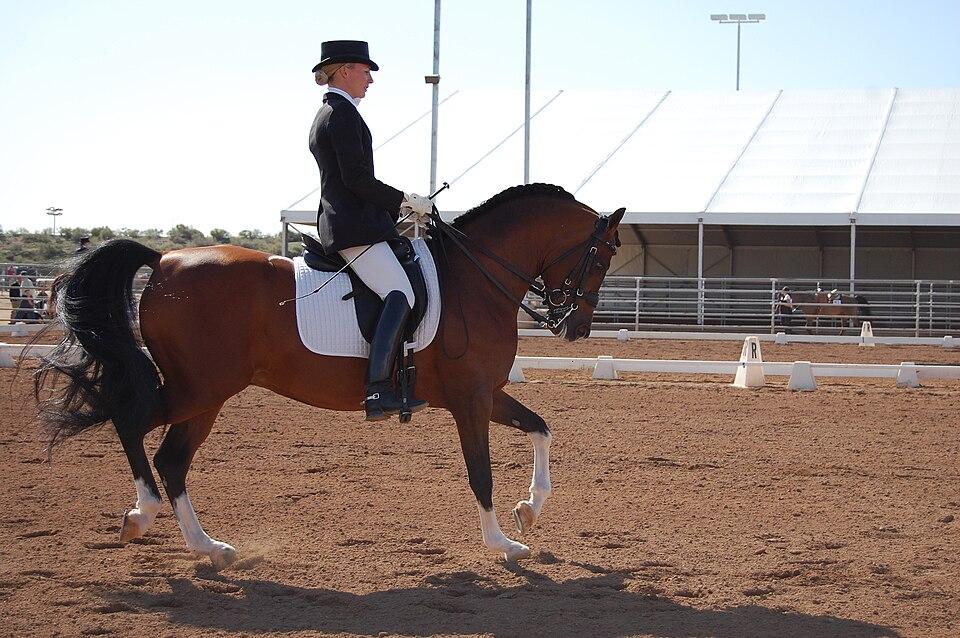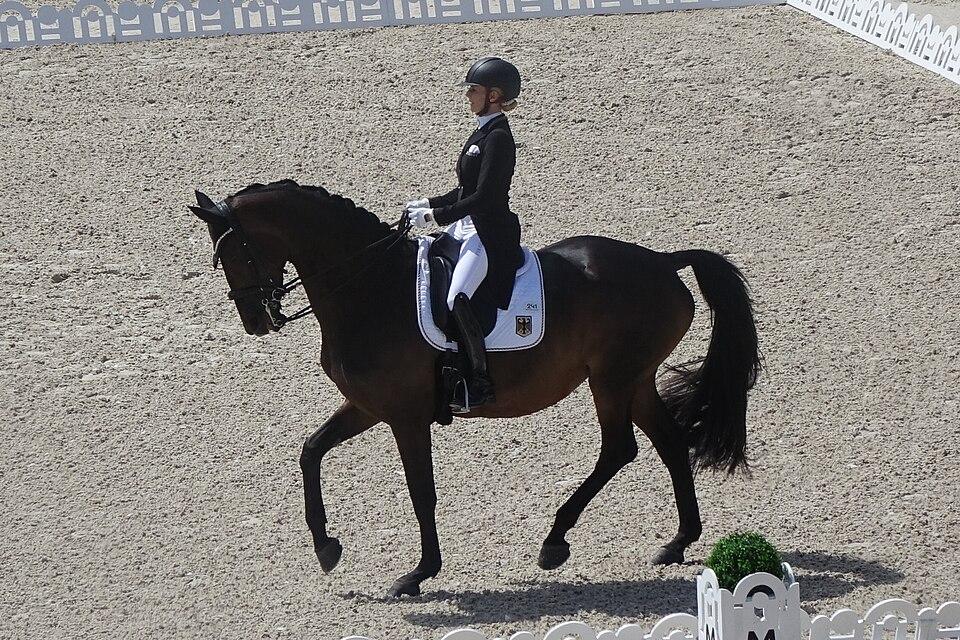
Dressage uses a scoring system that differs considerably from disciplines in which the result is determined primarily by time, distance or the number of faults.
Two horses can perform exactly the same test and receive noticeably different scores.
The reason is simple: judges do not merely check whether the required movement was performed. They also assess the quality with which it was executed.
Rhythm, suppleness, contact, impulsion, straightness, collection, accuracy and the quality of transitions can all influence the marks.
In international competition, each movement or group of movements listed on the judge's sheet receives a mark. The points are then added together, any coefficients and penalties are applied, and the result is expressed as a percentage of the maximum possible score.
Understanding a dressage score therefore requires looking well beyond the final percentage.
A dressage test is divided into scored movements
A dressage test is a predetermined sequence of movements, figures and transitions.
Depending on the level, it may include relatively simple elements such as:
- circles;
- transitions between gaits;
- changes of direction;
- halts;
and, as the level of difficulty increases, lateral work, flying changes, pirouettes and highly advanced movements such as passage and piaffe.
On the score sheet, the elements to be assessed are numbered.
An element may consist of a single movement, but it can also include a sequence of several movements or a transition associated with the exercise.
The judge awards a mark to each of these elements.
The final score is therefore not simply a general impression awarded at the end of the test. It results largely from the accumulation of marks awarded throughout the performance.
Marks range from 0 to 10
Under the Fédération Équestre Internationale system, movements are marked on a scale from 0 to 10.
Each mark has an official meaning:
- 10: Excellent;
- 9: Very good;
- 8: Good;
- 7: Fairly good;
- 6: Satisfactory;
- 5: Sufficient;
- 4: Insufficient;
- 3: Fairly bad;
- 2: Bad;
- 1: Very bad;
- 0: Not executed.
A zero therefore has a particular meaning. It does not simply indicate an extremely poor movement, but an element in which practically nothing of the required movement has been performed.
FEI rules also allow half marks, from 0.5 to 9.5, enabling judges to make finer distinctions between performances.
This scale makes a dressage score sheet easier to interpret. A 5 is not a disaster, but it indicates that the execution was only sufficient, while an 8 officially represents a good performance.
A mark does not simply measure whether the movement was completed
This is probably one of the most confusing aspects of dressage for newcomers.
A horse can perform the required figure and still receive only a 5 or 6.
Conversely, two horses can follow almost exactly the same line and receive different marks.
The judge must assess how the movement is performed.
In its judging guidance, the FEI refers to the dressage training scale, in which rhythm, suppleness, contact, impulsion, straightness and collection become relevant according to the horse's level and the movement being assessed.
Accuracy is also taken into account.
A movement that is recognisably performed but accompanied by loss of rhythm, imbalance, resistance or a significant contact problem cannot therefore receive the same mark as a precise, balanced and fluent execution.
Accuracy has several dimensions
Being accurate does not simply mean passing exactly beside a letter in the arena.
The FEI judging guidance distinguishes several aspects of accuracy.
Judges consider the preparation of the movement, its geometry, whether prescribed markers are respected and whether the appropriate tempo is maintained.
A circle should have the required dimensions.
A diagonal should reach the correct point.
A transition required at a particular letter should occur there.
A shoulder-in should begin and end correctly.
Corners and curved lines also form part of the required geometry.
A movement can therefore be technically correct in principle while losing marks because it begins too early, finishes too late or follows an inaccurate line.
Conversely, perfect geometry cannot automatically compensate for poor locomotion.
Accuracy and quality of execution are assessed together.
Rhythm is a fundamental basis of scoring
Dressage first requires the horse to preserve the fundamental characteristics of its gaits.
Walk, trot and canter each have their own temporal organisation.
Irregularity, a break of gait or an incorrect alteration of rhythm can therefore substantially affect a mark.
This requirement remains important even in spectacular advanced movements.
A highly expressive passage that becomes irregular does not become excellent simply because the horse lifts its limbs very high.
Similarly, a spectacular flying change accompanied by significant loss of balance or disorganisation will not be assessed in the same way as a clean, controlled change.
Judges therefore assess whether difficulty is achieved without compromising the fundamental qualities of locomotion.
Contact is also part of the assessment
The relationship between the horse and the rider's aids contributes to the quality of the performance.
The horse should accept appropriate contact without significant resistance.
A visually rounded outline is not enough.
A horse may have an arched neck while still displaying contact problems, such as an open mouth, resistance to the hand, a tense neck, a low poll or the nose carried excessively behind the vertical.
FEI judging guidance identifies such problems among faults that can significantly affect the assessment of the performance.
This is why the concept of a horse being on the bit cannot be reduced to the position of its head.
Judges assess a functional relationship between locomotion, contact and the rider's aids.
Balance and collection become increasingly important at higher levels
As the level increases, movements require the horse to modify its balance and develop greater collection.
This becomes particularly visible in pirouettes, piaffe, passage and some Grand Prix transitions.
Judges are not, however, simply looking for the visual impression of a horse “sitting behind”.
They assess whether the movement displays the characteristics expected at its level of difficulty, without major loss of rhythm, activity, straightness or contact.
Collection therefore becomes one of the elements that enables correct execution of advanced movements rather than an independent visual effect.
Transitions are an integral part of dressage
A transition is not simply the space between two interesting movements.
It can itself be assessed.
The horse should be able to change gait, stride length or degree of collection while maintaining balance and responsiveness to the aids.
This becomes particularly important in sequences such as transitions between passage and piaffe.
The horse must greatly reduce its forward progression and then regain it without losing rhythm or activity.
A test containing impressive individual movements but consistently disorganised transitions therefore cannot be assessed as a completely polished performance.
The rider is also assessed through the performance
Dressage seeks to create the impression of discreet communication between horse and rider.
This does not mean that the rider is passive.
On the contrary, the rider must continually organise the movement, prepare the figures and adjust the aids.
Ideally, however, those aids should remain effective and as unobtrusive as possible.
FEI judging guidance considers, among other things, the quality of the rider's seat and the effectiveness of the aids. At the highest levels of assessment, the aids should be sensitive and almost imperceptible, creating an impression of harmony between horse and rider.
Conversely, very visible aids, excessive dependence on the reins or a rider position that interferes with the horse's movement can negatively affect the assessment.
The apparent ease of an excellent test is therefore itself the result of a high level of skill.
Why do some movements have coefficients?
Not every element in a dressage test necessarily carries the same weight.
Some may have a coefficient specified on the test sheet.
If a movement receives a mark of 7 and has a coefficient of 2, for example, it contributes 14 points to the total rather than 7.
The coefficient does not change the quality of the mark awarded by the judge. It changes its importance in the final calculation.
Coefficients allow greater weight to be given to particular elements considered especially important in the relevant test.
It would be inaccurate, however, to say that all piaffes, passages or flying changes automatically carry a high coefficient: coefficients depend on the specific test being ridden.
The official test sheet is therefore the reference.
A mistake in a movement and an error of course are not the same thing
This distinction is important.
A horse that misses a flying change or performs a poor transition makes a mistake in the execution of the movement. This affects the mark awarded for the relevant element.
An error of course is different. It occurs when the rider performs the test incorrectly, for example by turning in the wrong direction or omitting a required movement.
Under the FEI system, the judge at C may then ring the bell and indicate where the rider should resume the test.
An error of course also results in the penalty specified by the regulations.
Points can therefore be lost in two different ways: through insufficient quality of execution or through a regulatory penalty.
Some errors can lead to elimination
Not every error simply results in the loss of a few points.
The rules specify various situations that can lead to elimination.
Repeated errors of course can eventually result in elimination under the applicable regulations.
Other grounds for elimination may have nothing to do with the technical quality of the test itself.
A competition result therefore depends not only on the marks written beside individual movements, but also on the regulations and any penalties that apply.
The exact provisions should always be checked in the rules governing the particular competition, especially because national regulations are not necessarily identical to FEI rules.
How are the marks converted into a percentage?
The general calculation is relatively straightforward.
Each mark is multiplied by any coefficient attached to it.
The resulting points are then added together.
Applicable penalties are taken into account, and the total is compared with the maximum number of points available.
For example, if a test has a maximum possible score of 400 points and a judge ultimately awards 280 points, the corresponding result is:
280 ÷ 400 × 100 = 70%
The percentage therefore compares the points actually awarded with the theoretical maximum available in the test.
A result of 70% means that the combination received the equivalent of 70% of the maximum available points, not that 70% of the movements were performed correctly.
What happens when there are several judges?
At major competitions, several judges assess the same test from different positions around the arena.
Each completes an individual score sheet and awards their own marks.
The judges' results are then combined according to the rules of the competition to produce the final score for the horse-and-rider combination.
There is an obvious advantage to this system: a single judge does not determine the entire result.
It also allows the test to be viewed from several angles.
A straightness problem, for example, may be considerably easier to see from the end of the arena than from a position along the side.
Differences between judges do not disappear completely, however.
They are an important subject in research into the reliability of dressage judging.
What do scores of 60%, 70% or 80% actually mean?
It is tempting to create a universal scale in which 60% means “average”, 70% means “very good” and 80% means “exceptional”.
This can provide a rough intuition, but it is too simplistic.
The sporting significance of a percentage depends on factors including:
- the level of the test;
- the competition category;
- the strength of the field;
- and the context in which the score was achieved.
A score of 70% in an elementary test and 70% in an international Grand Prix clearly do not represent the same technical difficulty.
The scoring system does, however, allow these percentages to be understood mathematically.
An average mark of 6 out of 10 produces approximately 60%, an average of 7 approximately 70%, and an average of 8 approximately 80%, before accounting for the specific characteristics of the test sheet and any penalties.
On the FEI scale, 6 means “Satisfactory”, 7 “Fairly good” and 8 “Good”.
This correspondence is more precise than assigning an arbitrary overall description to each percentage range.
Why is scoring above 80% so difficult?
A score above 80% requires an extremely high average across the entire test.
It is not enough to receive a 9 for a spectacular passage or a 10 for an outstanding pirouette.
A single exceptional mark has relatively little influence if many other movements receive 6s and 7s.
To maintain an average close to 8 throughout an entire test, the combination must accumulate movements judged good or better while keeping mistakes to a minimum.
This consistency is what makes very high percentages difficult to achieve.
The final score therefore rewards consistency as well as individual moments of exceptional quality.
One mistake can affect more than one mark
Some faults have consequences that extend beyond the movement in which they first occur.
A loss of balance may, for example, disrupt the following transition.
Significant resistance can affect several consecutive movements before the rider re-establishes a stable performance.
Conversely, a small isolated inaccuracy may have only a limited effect.
This is why there is not always a formula such as “this mistake automatically costs one point”.
The judge assesses what actually happened and how it affected the required movement.
Why can judges give different marks?
Dressage remains a judged sport.
Even with established criteria, regulations, training and a common scoring scale, assessment requires human observation.
Two judges may not perceive exactly the same thing.
First, they do not watch the test from the same position.
They may also differ slightly in how they assess the significance of a fault or the quality of a particular movement.
This variability is not merely theoretical.
Scientific research into dressage judging has examined differences between judges and potential biases that may influence scores.
The use of several judges, judge education and standardised assessment methods are intended to reduce the influence of individual judgement, although they cannot entirely remove the human element.
Dressage scoring is not purely “artistic”
Describing dressage as a mixture of technical assessment and artistic taste can be misleading.
In a standard prescribed test, judges have specific criteria for each movement and must apply a defined scoring scale.
There is inevitably an element of judgement because a complex observation must ultimately be converted into a numerical mark.
But judges do not simply decide whether they “like” the performance.
They are expected to assess observable elements such as rhythm, accuracy, quality of the gaits, contact, balance, straightness, collection and execution of the movements.
Freestyle tests performed to music have a specific artistic component and their own assessment system.
It is therefore important to distinguish the subjectivity inherent in human judging from a scoring system based primarily on aesthetic preference.
A score tells the story of the entire test
The final percentage is ultimately a summary of a large amount of information.
Behind a simple 72.4% might be an excellent passage, an average transition, a very good pirouette, a missed flying change, several consistent movements and a small penalty.
Two tests receiving exactly the same percentage can therefore have completely different profiles.
This is why the detailed judge's sheet is much more informative than the final score alone.
It reveals where points were gained, where they were lost and which strengths or difficulties appeared repeatedly throughout the test.
A system designed to assess quality as well as execution
Dressage scoring is therefore not simply a matter of checking off a sequence of figures.
Each element is assessed for its quality, marks may be weighted by coefficients, penalties are applied where necessary, and the result is converted into a percentage.
This system allows judges to consider both technical accuracy and the quality of the horse's way of going.
It also explains why two tests that appear very similar to an inexperienced spectator can finish several percentage points apart.
The more a spectator learns to recognise rhythm, balance, contact, straightness, quality of transitions and collection, the easier it becomes to understand the numbers displayed at the end of a dressage test.
Sources and references
- Fédération Équestre Internationale – Dressage Rules
- Fédération Équestre Internationale – Dressage Judging Manual
- Fédération Équestre Internationale – Dressage Tests