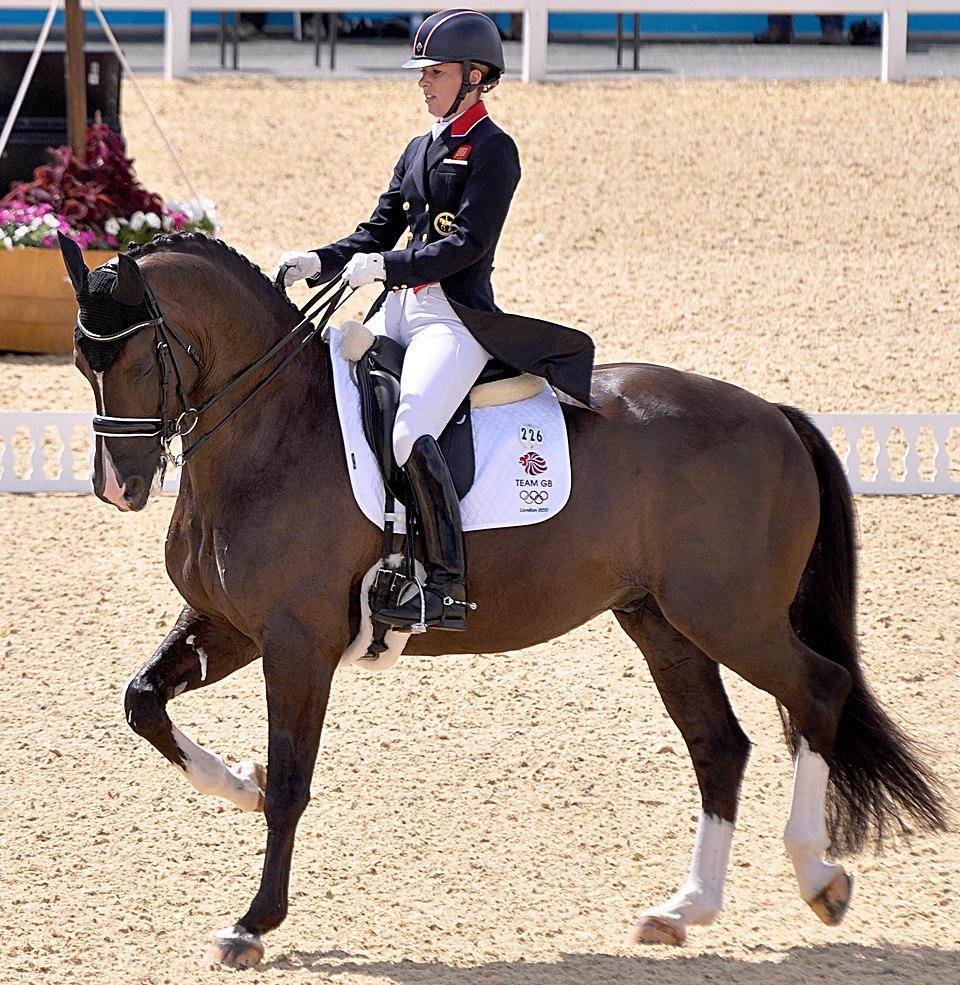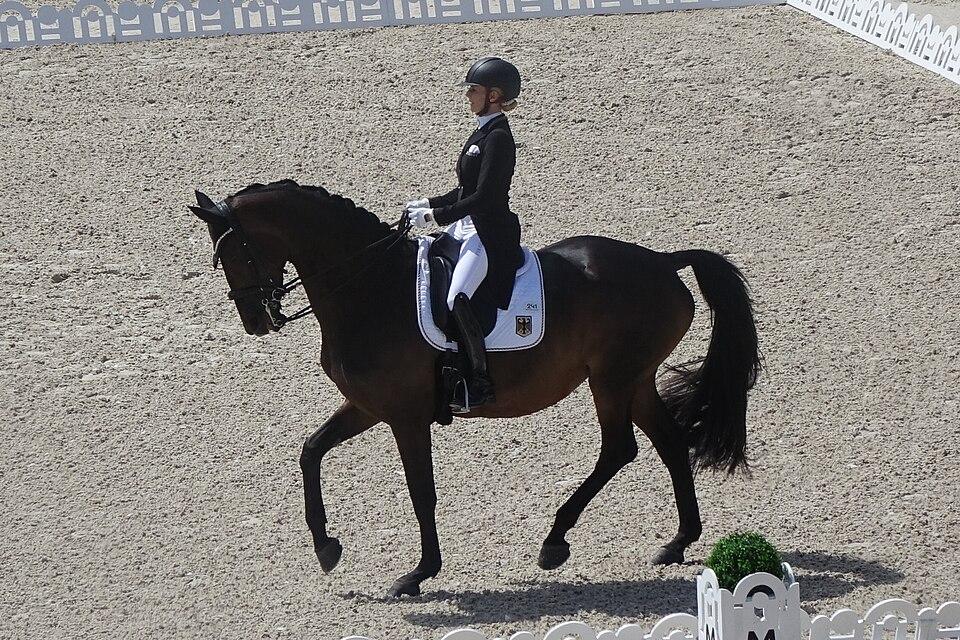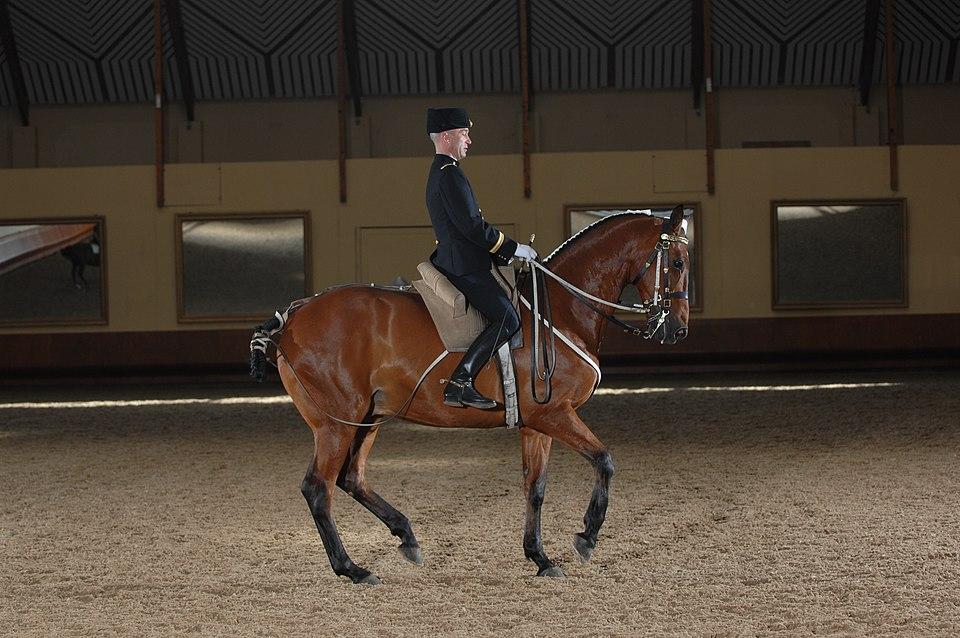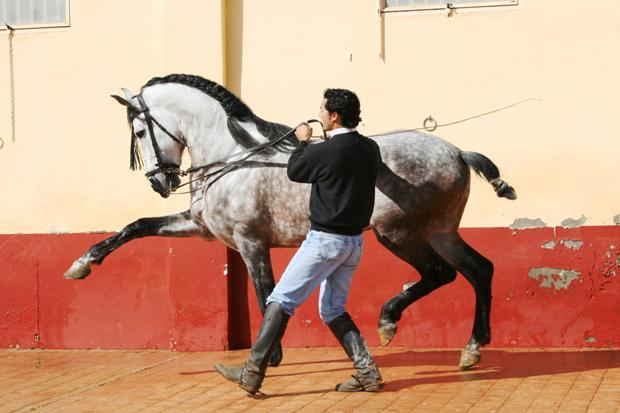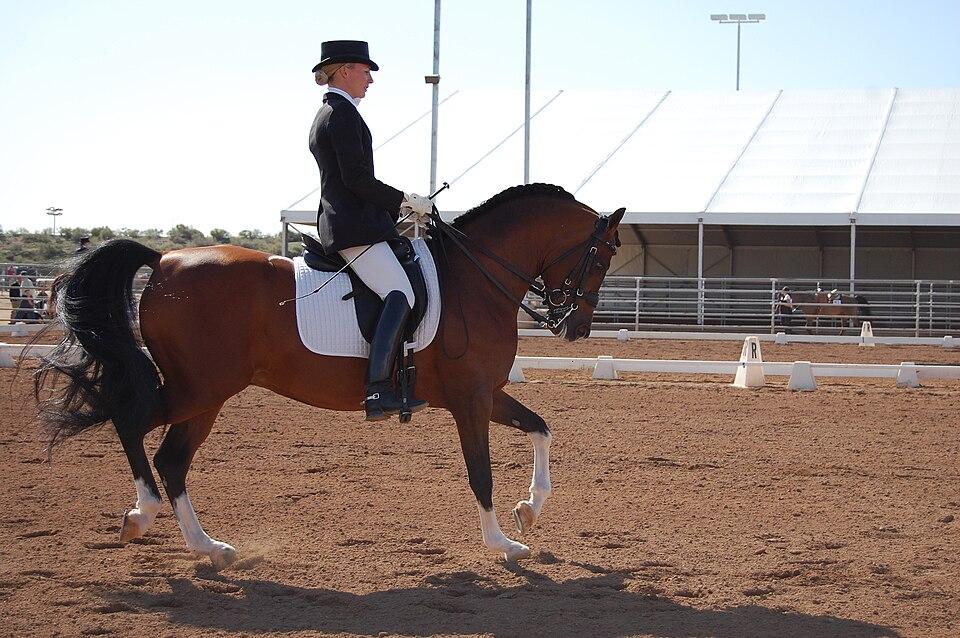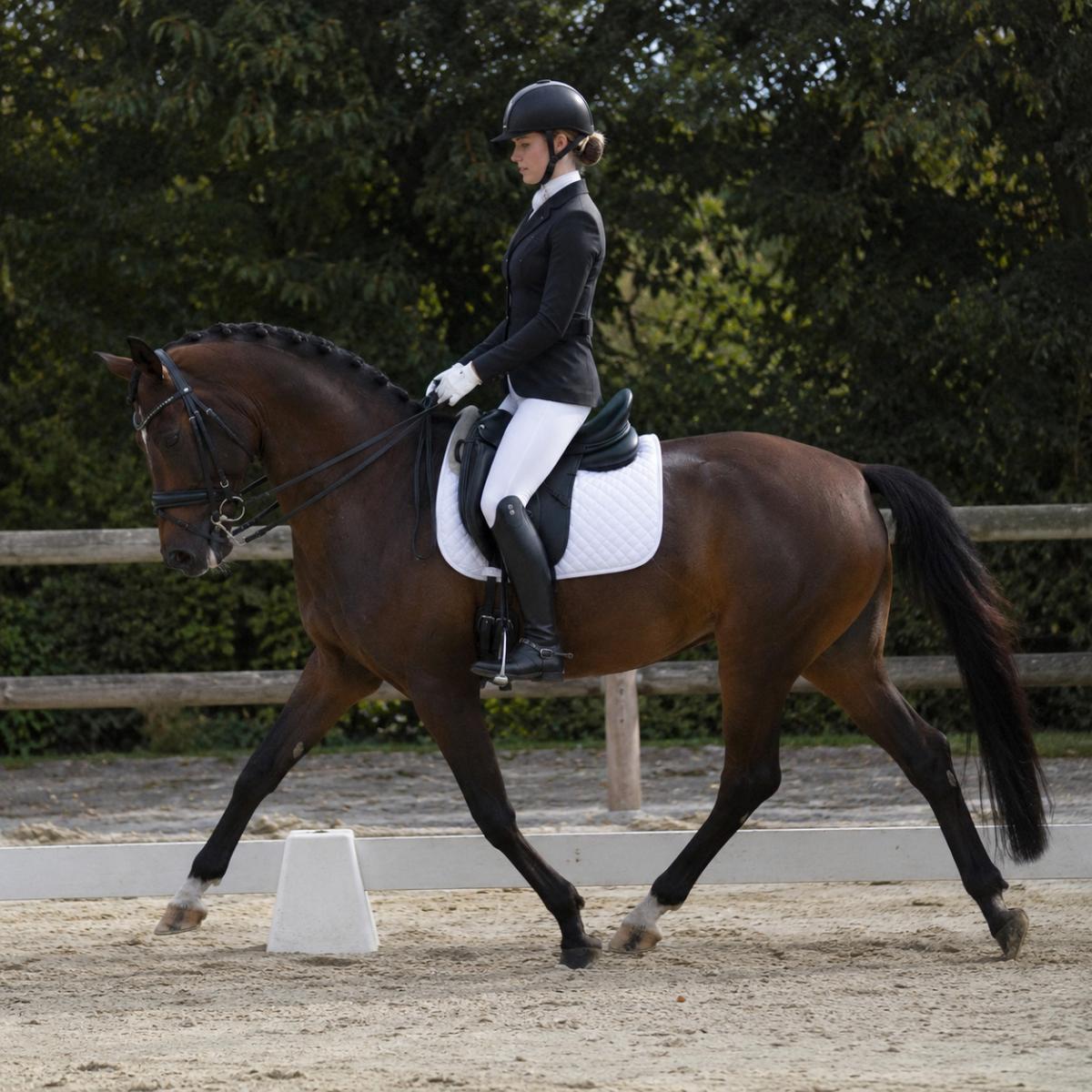
The expression “on the bit” is one of the fundamental concepts of dressage, but it is also frequently misunderstood. It is sometimes reduced to its most visible feature: a rounded neck and a head held in a particular position.
That interpretation is incomplete.
In dressage terminology, being on the bit involves several interconnected elements: quality of locomotion, suppleness, consistent and elastic contact, balance and responsiveness to the rider's aids.
The concept therefore describes less a particular shape of the neck than a quality of connection between the horse's movement and the rider's contact.
Being on the bit is not simply a head position
A horse can display a rounded neck and carry its nose close to the vertical without genuinely being on the bit.
A particular head position can be produced in different ways.
The rider may use the reins to create flexion of the neck, the horse may evade the contact by bringing its nose excessively towards its chest, or it may temporarily adopt a posture that visually resembles the desired outline.
None of these situations is sufficient to demonstrate that the rest of the horse's body is functioning correctly.
Conversely, the appropriate outline varies with the horse's level of training, the gait and the degree of collection. A young horse in the early stages of training should not necessarily display the same outline as a Grand Prix horse.
The Fédération Équestre Internationale itself specifies that the neck should be raised and arched according to the horse's stage of training and according to the extension or collection of the gait. (inside.fei.org)
There is therefore no single silhouette that automatically identifies a horse as correctly on the bit.
Contact is central to the concept
Contact describes the connection between the rider's hands and the horse's mouth through the reins.
The French Institute for Horse and Riding describes the traditional concept of contact as a confident, soft and permanent relationship between the rider's hand and the horse's mouth, through reins adjusted by the rider and taken up by the horse as it moves forward. (equipedia.ifce.fr)
Contact is therefore neither a complete absence of tension in the reins nor a continuous pulling action from the rider.
In the desired form of work, the horse accepts this connection without excessive resistance while the rider's hands accompany the movements produced by locomotion.
FEI dressage rules similarly describe a horse on the bit as accepting the bridle with a light, consistent and soft contact, without resistance to the rider. (inside.fei.org)
This quality of contact is one of the defining elements of a horse working correctly on the bit.
The horse participates in creating the contact
The expression “putting a horse on the bit” can suggest that the rider creates the position with the hands.
The intended principle is different.
The horse should itself seek the contact through its forward movement. The rider adjusts the length of the reins and maintains a sufficiently stable connection for the horse to take that contact without encountering a rigid hand or, conversely, a connection that continually disappears.
The IFCE describes a horse on the bit as taking contact with the bit through the action of the hindquarters, with impulsion transmitted through the back and poll. (equipedia.ifce.fr)
In equestrian terminology, this is often described as a connection running “from back to front” or “from the hindquarters into the contact.”
This should not be interpreted as physical energy literally travelling from the hindlimbs to the bit. It summarises a training principle: the position of the forehand should result from the horse's overall movement and willingness to seek the contact, rather than being produced solely by rein action.
Impulsion does not simply mean going faster
Impulsion plays an important role in this process.
It does not simply mean speed.
A horse can move quickly while remaining unbalanced, hurried or unresponsive to the aids.
In dressage terminology, impulsion refers more closely to the activity and energy with which the horse moves forward, particularly through the action of the hindlimbs.
That activity must then be organised by the rider.
A horse lacking activity may become inconsistent in the contact or fail to genuinely seek the bit. Conversely, simply increasing speed does not automatically improve the contact.
The aim is therefore activity compatible with rhythm, balance and responsiveness.
The back contributes to the horse's overall movement
The back is frequently mentioned when discussing a horse being on the bit.
This association is meaningful, but traditional expressions such as “the horse lifts its back” or “the energy travels through the back” should not be interpreted as complete descriptions of a simple biomechanical mechanism.
The equine spine undergoes complex movements of flexion-extension, axial rotation and lateral bending during locomotion.
Head and neck position can itself influence some of these movements.
A study involving eight horses found that different head and neck positions altered back kinematics, particularly at the walk. A high, constrained position reduced some back movements compared with a free or lower position. (pubmed.ncbi.nlm.nih.gov)
Another study of elite dressage horses found changes in back and hindlimb kinematics according to different head and neck positions at trot. It also showed that the exact degree of neck flexion was not consistently correlated with limb and trunk movements. (pubmed.ncbi.nlm.nih.gov)
These findings reinforce an important point: the shape of the neck alone cannot reveal how the horse's entire body is functioning.
The neck position changes with the level of training
As the horse's movement and contact develop, its outline can change as well.
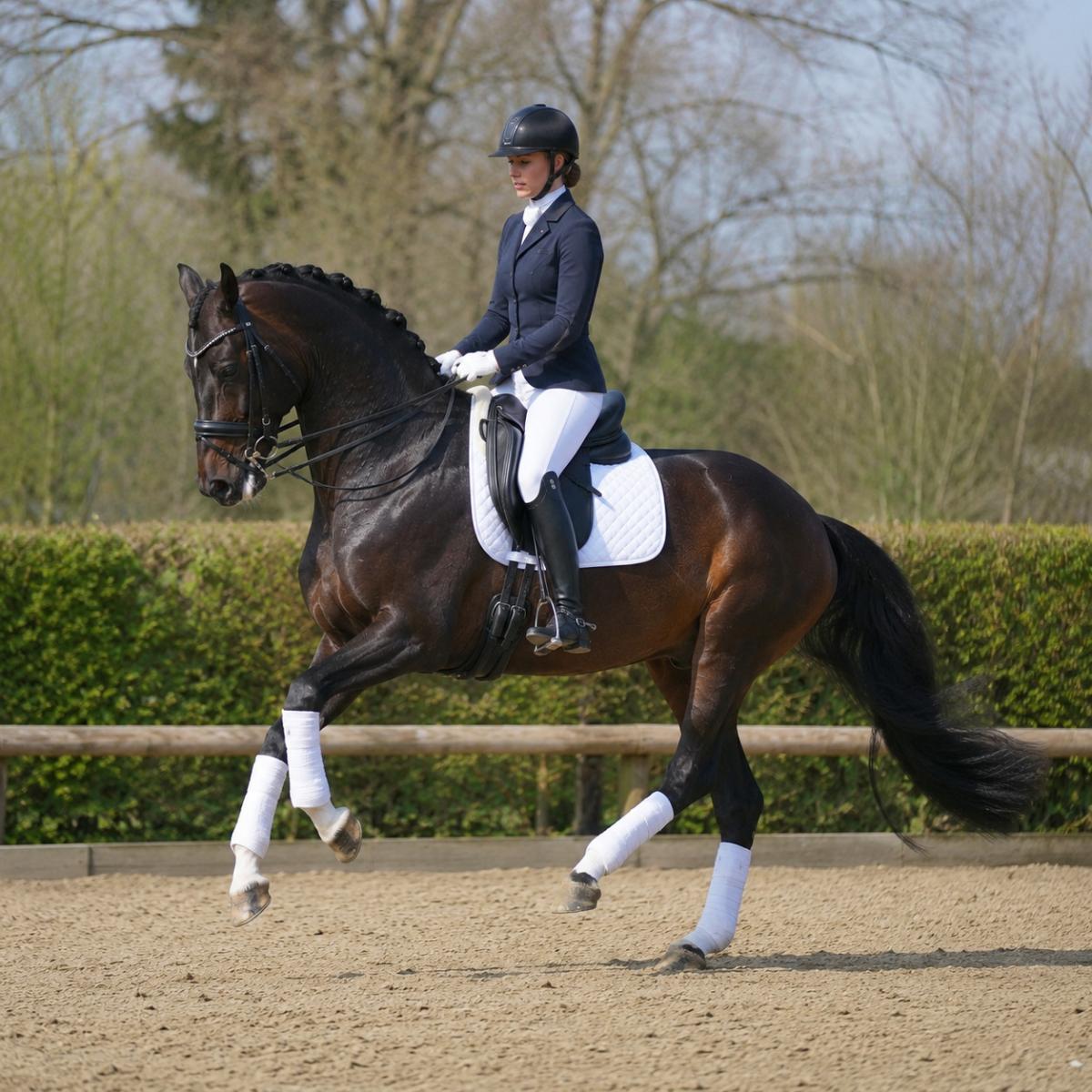
FEI dressage rules describe the correctly on-the-bit horse as carrying the neck more or less raised and arched according to its stage of training and the movement being performed, with a supple poll as the highest point and the nose generally slightly in front of the vertical. (inside.fei.org)
This description is important because it directly relates the outline to the context.
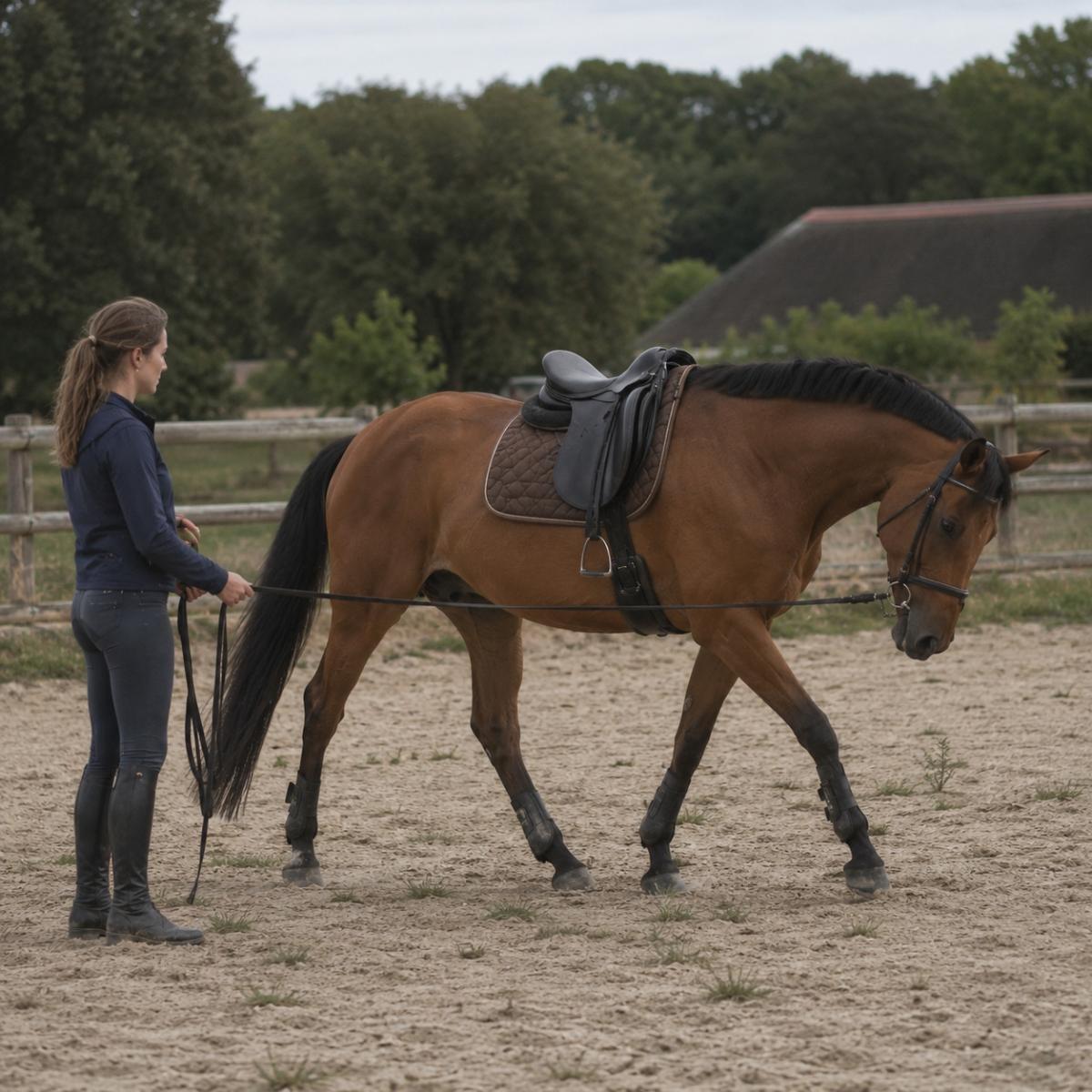
During stretching work, the horse may extend its neck forward and downward while maintaining a correct relationship with the contact.
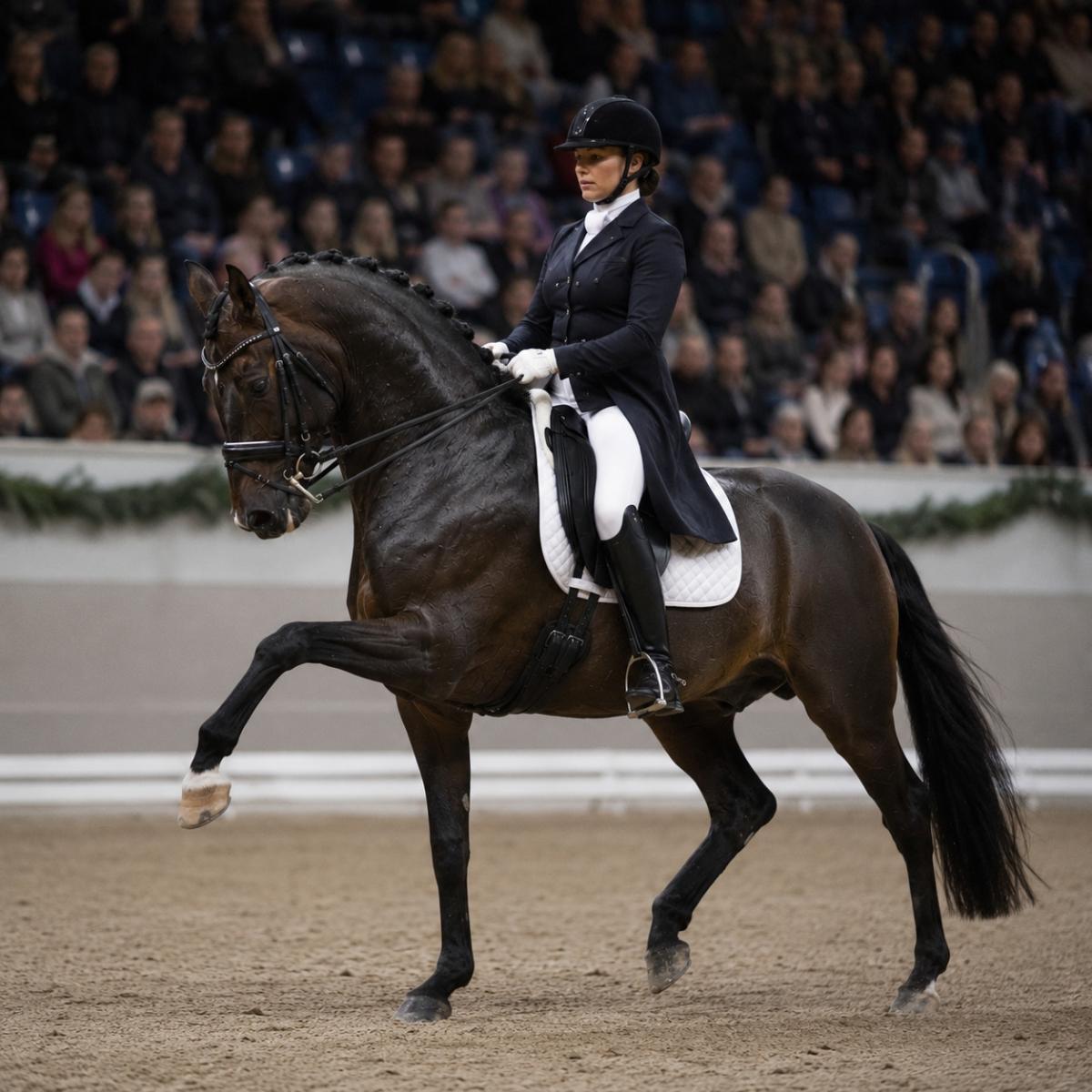
During highly collected movements, the neck will instead be carried higher.
Being on the bit therefore does not mean maintaining exactly the same head angle throughout an entire training session.
“On the bit” and the French concept of “mise en main”
French equestrian terminology contains two closely related expressions: mise sur la main and mise en main.
They are frequently used as though they were perfect synonyms, but traditional French definitions distinguish between them.
Être sur la main refers broadly to the horse's locomotion, suppleness, contact and responsiveness to the rider.
La mise en main refers more specifically to relaxation of the mouth and poll within the desired head-and-neck carriage, with the degree of elevation and arching of the neck varying according to the horse's training and the amplitude of the gait. (equipedia.ifce.fr)
English equestrian vocabulary does not reproduce this distinction perfectly.
The expression “on the bit” generally covers much of what French riders describe as sur la main, while concepts such as acceptance of the contact, flexion at the poll and carriage help describe the more specific elements contained in mise en main.
This difference in terminology is useful when comparing French and English dressage literature.
A horse on the bit is not a horse leaning heavily on the reins
Contact involves some tension in the reins, but this should not be confused with excessive pressure.
A horse may become heavy in the hand, leaving the rider with the impression of constantly having to support or restrain substantial weight through the reins.
The IFCE specifically distinguishes correct contact from excessive leaning on the bit. (equipedia.ifce.fr)
At the opposite extreme, the horse may avoid the connection with the rider's hands, causing the reins to become unstable or slack.
The desired contact lies between these situations: present and consistent enough for communication without becoming a permanent pulling contest.
The quality of the contact can be tested
The shape of the neck does not always reveal whether the horse genuinely maintains a correct relationship with the rider's hands.
Certain exercises can make this easier to observe.
The IFCE describes, among others, two useful situations.
When the rider progressively allows the reins to lengthen, a correctly connected horse should be able to stretch its neck forward and downward while following the contact, without immediately losing the organisation of its movement.
Conversely, when the rider temporarily advances the hands and reduces or releases the contact, the horse should be capable of maintaining its carriage and gait without collapsing onto the forehand or depending entirely on the reins for balance. (equipedia.ifce.fr)
These exercises illustrate why being on the bit is a functional organisation, rather than simply a shape maintained by the rider's hands.
The mouth can also provide information about contact
The horse's interaction with the bit can be reflected in movements of the mouth.
Dressage rules recognise that a horse accepting the contact may quietly chew the bit.
Care is nevertheless needed before interpreting every mouth movement as a direct indication of relaxation or tension.
A study of seven horse-and-rider combinations analysed mouth movements, rider hand movements and rein tension. Mouth movements were associated with several variables, including rein tension and the distance between the rider's hand and the horse's mouth. The researchers emphasised the complexity and considerable variability of horse-rider interaction. (pubmed.ncbi.nlm.nih.gov)
An open mouth, repeated resistance or considerable instability can therefore provide useful information, but no single sign can by itself summarise the overall quality of contact.
The appearance of being on the bit can be misleading
It is possible to create an outline that resembles a correctly connected horse without achieving the other elements associated with being on the bit.
The horse may excessively shorten its neck, withdraw from the contact or carry its nose behind the vertical.
The outline may appear “round”, while the functional relationship with the rider's hands differs from the desired one.
FEI rules state that the nose should generally remain slightly in front of the vertical, with the poll supple and the highest point of the neck. (inside.fei.org)
This helps distinguish two concepts that are frequently confused: producing an external shape and developing a functional connection.
The first can sometimes be produced directly through rein action. The second depends on the horse's overall movement and interaction with the rider.
Head position genuinely influences locomotion
Saying that head position “does not matter” would, however, be just as simplistic as claiming that it explains everything.
Biomechanical studies show that head and neck positions can alter back movement, coordination and the distribution of forces between the limbs.
In seven elite dressage horses, different head and neck positions produced changes in vertical ground-reaction forces and interlimb coordination. (pubmed.ncbi.nlm.nih.gov)
The visible position of the horse therefore has genuine biomechanical consequences.
What it cannot do on its own is determine the overall quality of the work, contact or balance.
The outline must always be considered within the horse's complete locomotor pattern.
Not every horse has the same outline
Conformation strongly influences external appearance.
Neck length and insertion, wither conformation, body proportions and many other characteristics vary between individuals.
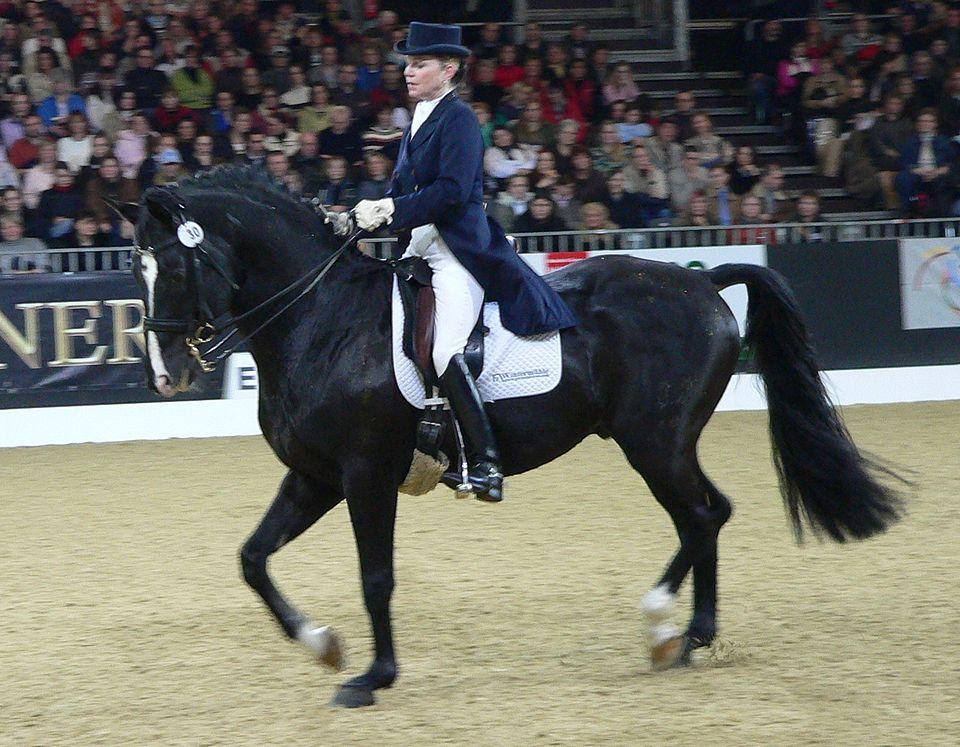
Two horses working correctly can therefore present different silhouettes.
Training level also matters.
The outline of a young horse with limited ability to collect itself will not be identical to that of an advanced horse performing passage, piaffe or flying changes.
Attempting to reproduce the silhouette of a Grand Prix horse in every horse would therefore ignore individual conformation, training level and the exercise being performed.
A foundation for progression in dressage
Being on the bit is not a particular movement that the horse learns and then performs occasionally.
It is a quality sought throughout the work.
As the level of training increases, the horse should be able to maintain a stable relationship with the rider through transitions, changes of gait, lateral work and progressively more collected movements.
FEI rules state that the horse should remain on the bit throughout the work, including at the halt. (inside.fei.org)
The challenge is therefore not simply to obtain an attractive outline for a few moments, but to preserve the quality of locomotion and contact as the exercises become more demanding.
The debate surrounding very closed head-and-neck positions
Head and neck position plays an important role in contemporary discussions about dressage.
Debates include horses worked for prolonged periods with the nose behind the vertical or in highly flexed head-and-neck positions.
Available scientific evidence shows that modifying or constraining head and neck position can indeed produce biomechanical changes.
A study of elite dressage horses found, for example, that an extremely elevated neck position increased some hindlimb movements but also increased lumbar extension during stance, with the authors suggesting that maintaining this position for prolonged periods could represent a risk. (pubmed.ncbi.nlm.nih.gov)
These findings cannot reduce every training method to a single head position.
They do, however, demonstrate why head and neck carriage should not be considered merely an aesthetic question.
A connection rather than a shape
A horse on the bit cannot therefore be identified solely by a rounded neck or a nose close to the vertical.
The concept combines several elements: quality of locomotion, activity, suppleness, balance, acceptance of contact and responsiveness to the rider's aids.
The visible head-and-neck position is one manifestation of this process, but it varies according to the individual horse, its level of training, the gait and the degree of collection.
This distinction explains why simply trying to “put the horse's head in position” can produce an outline that resembles dressage without producing the functional quality that dressage seeks.
In its fuller equestrian meaning, being on the bit describes a dynamic relationship between the moving horse and the rider's aids.
Sources and references
- Fédération française d'équitation – Échelle de progression
- IFCE – L'extension d'encolure : mythe, réalité et dérives
- IFCE – Les mains du cavalier : contact et actions de la main
- Fédération Équestre Internationale – Dressage Rules
- Rhodin et al. – The influence of head and neck position on kinematics of the back in riding horses at the walk and trot
- Rhodin et al. – The effect of different head and neck positions on the caudal back and hindlimb kinematics in the elite dressage horse at trot
- Weishaupt et al. – Effect of head and neck position on vertical ground reaction forces and interlimb coordination in the dressage horse
- Movements of the horse's mouth in relation to horse-rider kinematic variables