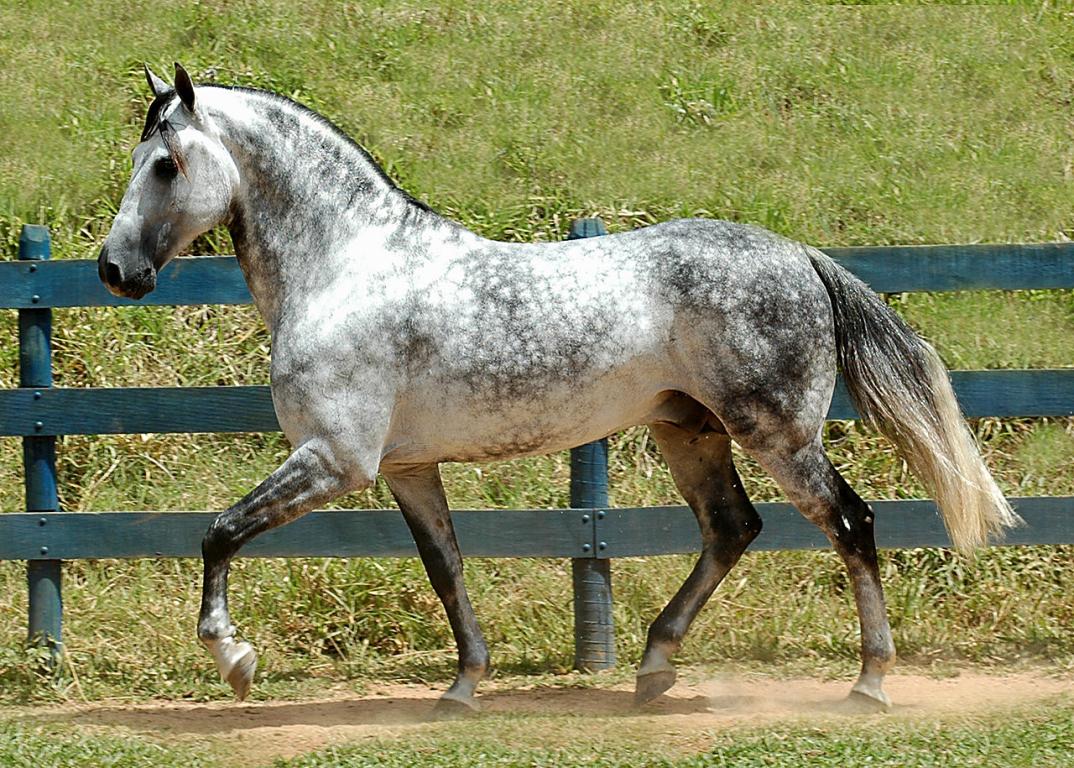
The Oldenburg is a German sport horse renowned for its talent in show jumping, dressage, and driving.
By the Chevaux du Monde editorial team · Published on · Updated on
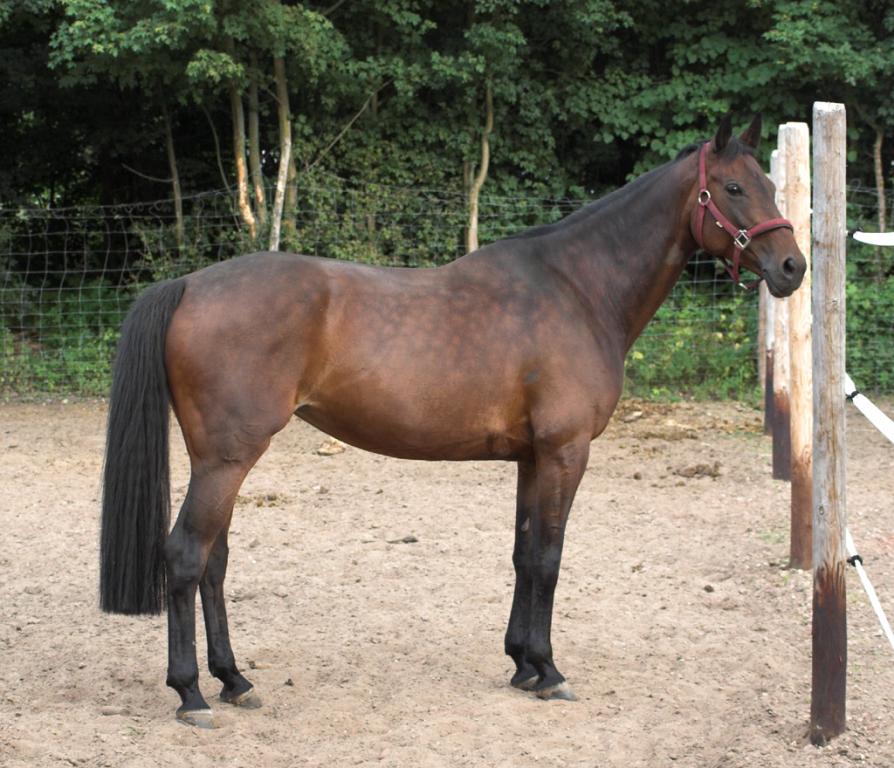
Type: Riding Horse
Continent: Europe
Country: Germany
Weight: 600 – 700 kg
Height: 165 – 180 cm
The Oldenburg originated in the historical region of the same name, which is now part of Lower Saxony in northwestern Germany. Breeding developed around the city of Oldenburg and in neighboring areas characterized by agricultural plains and a long tradition of horse breeding.
The original population consisted of strong, versatile horses used both on farms and for transportation. It shared part of its historical background with horses bred in East Frisia, although the Oldenburg gradually followed its own selection program.
During the seventeenth century, Count Anton Günther of Oldenburg, who lived from 1583 to 1667, played a major role in the development of regional horse breeding. According to the history published by the Oldenburg Breeding Society, Neapolitan, Andalusian and English stallions, as well as horses of Arabian ancestry, were used to improve the local population.
The objective at the time was to produce elegant and powerful horses for riding, classical riding schools and carriage driving. These historical influences should not be interpreted as a fixed genetic composition of the modern Oldenburg, whose population has been profoundly transformed by later selection programs.
Today’s Oldenburg is primarily a German sport horse. Membership of the population depends on registration in the studbook and compliance with its breeding rules rather than on the preservation of a completely closed regional lineage.
The administrative and historical center of the breeding program is located in Vechta, Lower Saxony. This region remains closely associated with breeding-stock inspections, mare shows, auctions and the stallion licensing events organized around the studbook.
Oldenburg breeding now extends far beyond its place of origin. Horses registered with or recognized by the studbook are bred in numerous European countries, North America and other regions where equestrian sport is well established.
This international distribution is supported by a comparatively open breeding policy. Breeding animals do not necessarily have to be born in the Oldenburg region, but they must satisfy the genealogical, conformational, health or performance requirements applicable to their section of the studbook.
The breeding organization currently brings together two closely associated programs. The Oldenburg, or OL, studbook is primarily focused on dressage, although it can register horses with other abilities. The Springpferdezuchtverband Oldenburg-International, or OS, operates a separate program focused on show jumping, eventing and dual-purpose horses with a predominantly jumping-oriented profile.
An Oldenburg breed profile should therefore distinguish the OL studbook from Oldenburg International. The OS abbreviation does not simply refer to every Oldenburg competing in show jumping, but to a specific breeding program.


The official program uses a purebreeding method but permits the introduction of breeding animals from other populations when their inclusion contributes to the breeding objective. The modern Oldenburg is therefore not a closed breed intended exclusively to preserve an unchanged regional genetic heritage.
Thoroughbreds, Anglo-Arabs and horses from several European studbooks have contributed to its transformation. Bloodlines from the Hanoverian, Holsteiner, Trakehner, Westphalian, Dutch and French sport-horse populations have helped breeders adapt its conformation and abilities to the requirements of modern equestrian sport.
The Oldenburg breeding program combines pedigree analysis, conformational assessment, performance testing and competition results. The data used to estimate breeding values relate particularly to dressage and show jumping. Performances recorded by young horses, mares, stallions and their offspring contribute to evaluations of breeding merit.
Selection does not focus solely on final competition results. The quality of the gaits, jumping ability, rideability, constitution, health and behavioral qualities may also be assessed through the applicable testing procedures.
The openness of the studbook provides access to a wide variety of bloodlines, but it does not automatically guarantee balanced genetic diversity. Internationally popular stallions may be used intensively across several studbooks, increasing the presence of the same ancestors throughout the sport-horse population.
Pedigree, performance and genomic information can support more informed mating decisions. Preserving a variety of maternal families also remains important, because selection centered on a small number of fashionable breeding animals could reduce the diversity available to future generations.
The earliest stages of organized breeding date from the sixteenth and seventeenth centuries. Count Johann XVI had already encouraged the use of foreign breeding animals, but his successor Anton Günther became particularly associated with the growing reputation of Oldenburg horses.
Crossbreeding with stallions from different European and Oriental populations contributed to the production of horses sought after for riding, classical riding schools and carriage work. Breeding remained largely in private hands, a characteristic that allowed owners to adapt their choice of stallions to changing market requirements.
In 1820, the use of approved breeding stallions was regulated by the state. A register of origins was introduced in 1861, followed by the establishment of two breeding societies near the end of the nineteenth century. These organizations helped standardize the population and strengthened the inspection of stallions.
At this time, the Oldenburg was particularly renowned as a carriage horse. It was expected to combine power, presence, regular movement and the ability to pull a vehicle. It was also used on farms and for other forms of work requiring a versatile horse.
In 1923, the regional organizations merged to establish the association from which the present-day Verband der Züchter des Oldenburger Pferdes developed. Selection continued to favor a strong and substantial horse capable of meeting the agricultural and draft requirements of the period.
The mechanization of farming and transportation removed much of the demand for traditional working horses. After the Second World War, breeders progressively redirected their program toward producing horses for riding and equestrian sport.
Thoroughbred stallions were used to refine the population, lengthen its lines and improve athletic ability and movement. Breeding animals from other European populations were subsequently incorporated. From the 1970s onward, this openness increased and contributed to the development of a more athletic, long-lined and specialized sport horse.
The development of elite equestrian sport led to a clearer distinction between dressage and show-jumping breeding objectives. The OL program is now principally associated with dressage, whereas the Oldenburg-International register has its own selection program for jumping horses.
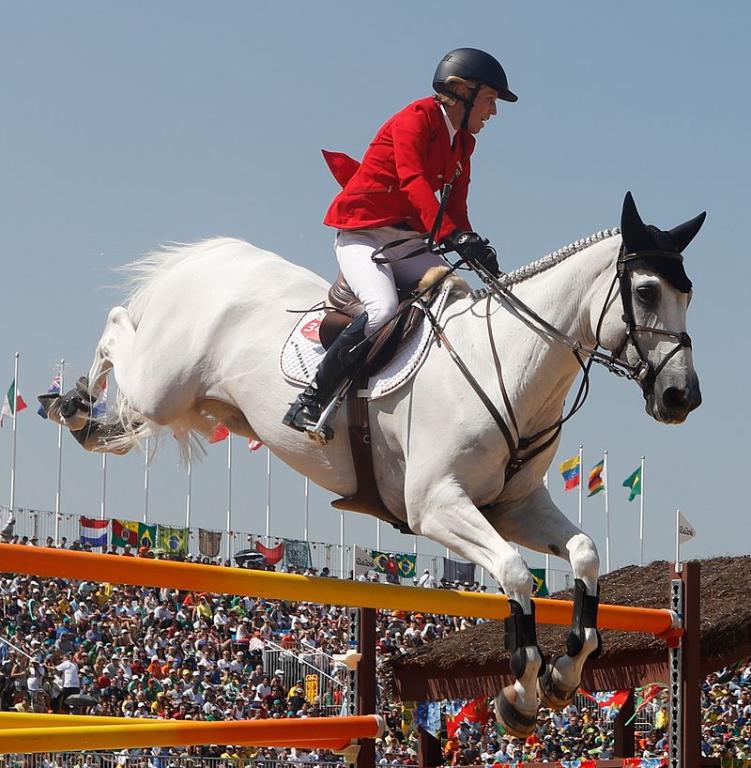
Oldenburg horses now compete internationally in dressage, show jumping and, to a lesser extent, eventing. This transformation illustrates the breed’s transition from a regional carriage and working horse to a modern sport-horse population defined by performance selection.
The official breeding objective calls for a horse that is willing to work, capable of cooperating with its rider and able to use its physical abilities effectively in sport. Rideability, temperament, character and constitution may be observed during performance testing of breeding animals.
A dressage-oriented Oldenburg is generally expected to be attentive, responsive and capable of remaining focused. A jumping-oriented horse must combine responsiveness, courage, body control and the ability to adjust its movement rapidly. These different functional objectives can result in noticeable temperamental differences between bloodlines.
It would be inaccurate to describe every Oldenburg as calm, easy or suitable for beginners. A horse bred for elite sport may be powerful, energetic and highly sensitive to the rider’s aids. These qualities can become difficult to manage when the horse’s training, environment or rider’s experience is unsuitable.
Actual behavior depends on the individual horse, its bloodlines, education, living conditions, health and the rider’s experience. Choosing an Oldenburg should therefore involve assessing the specific horse, its training and its suitability for the intended use.
The future of the Oldenburg depends on a breeding strategy capable of combining sport performance, health, functional longevity and genetic diversity. The pursuit of increasingly spectacular movement or greater jumping power should not come at the expense of soundness, balance, rideability or the duration of a horse’s sporting career.
Competition data, performance tests and genomic profiles can help refine the selection of breeding animals. These indicators must nevertheless be interpreted carefully: a breeding value or competition result cannot by itself describe the overall quality of a horse or determine its compatibility with a particular mare.
Testing for hereditary disorders, particularly Warmblood Fragile Foal Syndrome, should remain part of responsible pedigree management. The aim is to prevent at-risk matings without abruptly excluding large numbers of healthy carriers, which could unnecessarily reduce genetic diversity.
Growing demand for horses suitable for non-professional riders also encourages the selection of cooperative, consistent and sufficiently versatile individuals. However, this should not lead to presenting every Oldenburg as easy to ride: some bloodlines are specifically selected for elite sport and may produce especially powerful, energetic or sensitive horses.
Warmblood Fragile Foal Syndrome, generally abbreviated as WFFS, is a hereditary disorder documented in several European sport-horse populations, including the Oldenburg. It is associated with a variant of the PLOD1 gene and follows an autosomal recessive inheritance pattern.
An affected foal inherits one copy of the variant from each parent. The disorder causes extreme skin fragility, lesions of the mucous membranes, joint laxity and hyperextension. It is considered fatal. Some pregnancies may end in abortion or stillbirth, while foals born alive generally cannot survive for long.
When two healthy carriers are bred together, each pregnancy has a theoretical 25% risk of producing an affected foal. Genetic testing can identify carrier breeding animals and prevent carrier-to-carrier matings. A healthy carrier can be bred to a genetically clear horse without producing an affected foal, although part of the resulting offspring may inherit carrier status.
Since 2019, the Oldenburg breeding program has required WFFS testing for stallions registered or intended for registration in Stallion Books I and II. The result is recorded and published, but carrier status does not automatically prevent registration.
Beyond this documented disorder, the health of an Oldenburg depends substantially on its bloodlines, conformation, training and living conditions. As with other large sport horses, progressive conditioning, appropriate hoof care, correct saddle fit, sufficient recovery and monitoring of the locomotor system are particularly important.
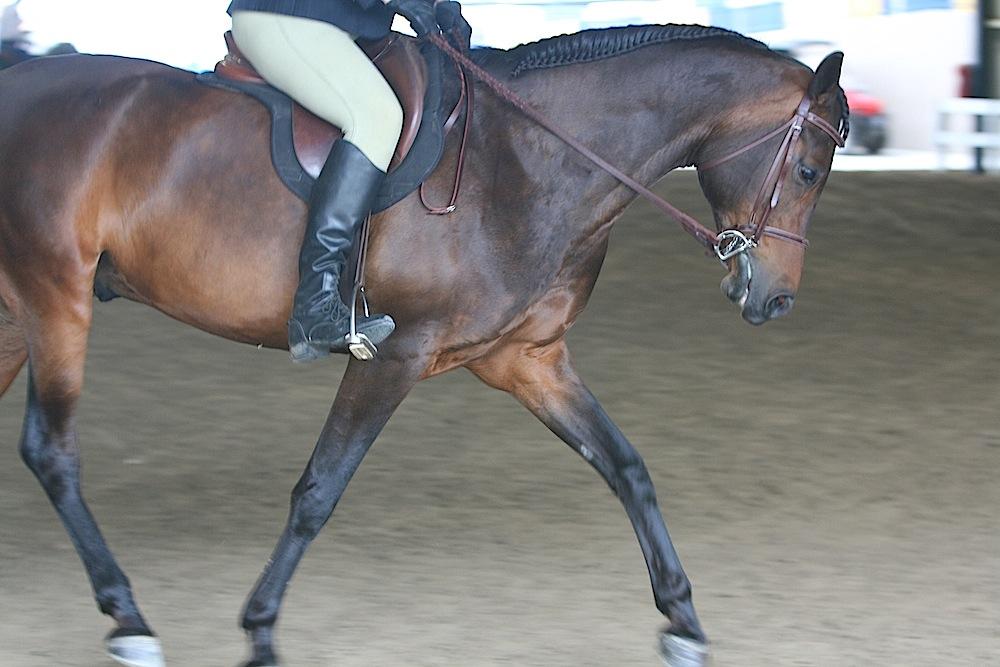
A regular, ground-covering and relaxed walk with active hind legs and clear overtracking.
An energetic, elastic and rhythmical trot showing active impulsion, suspension and good freedom through the shoulder.
A balanced, ground-covering and uphill canter capable of collection, extension and easy adjustment of balance.
Born in 1993
1999 World Champion Young Horse, sire of an exceptional dressage lineage (Stedinger, Sir Donnerhall, Sandro Song...). His offspring dominate high-level sales across Europe.
Born in 1986
International Grand Prix dressage competitor, considered one of the best sires of the 20th century. He passed on a supple gait and excellent temperament.
Born in 1993
Team bronze medalist at the 2008 Beijing Olympics for Denmark. Also one of the top stallions for producing dressage horses.
Famous for many years as the Queen of Great Britain's royal carriage horse, the Oldenburg, one of the oldest warm-blood breeds in Europe, originated in a relatively small breeding area in the far northwest of Germany, which corresponds to the former Kingdom of Oldenburg, hence its name.
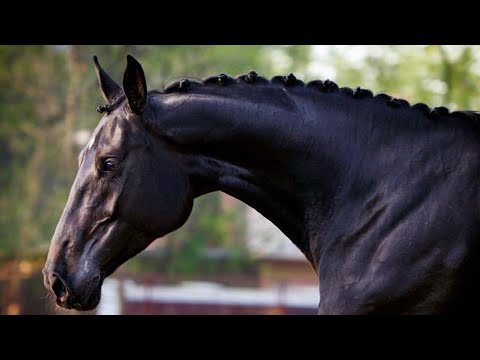
Gentle and gentle, the Oldenburg is a precocious horse with excellent longevity. It has many qualities: it is an energetic, reliable, willing, and balanced horse that demonstrates endurance and courage.