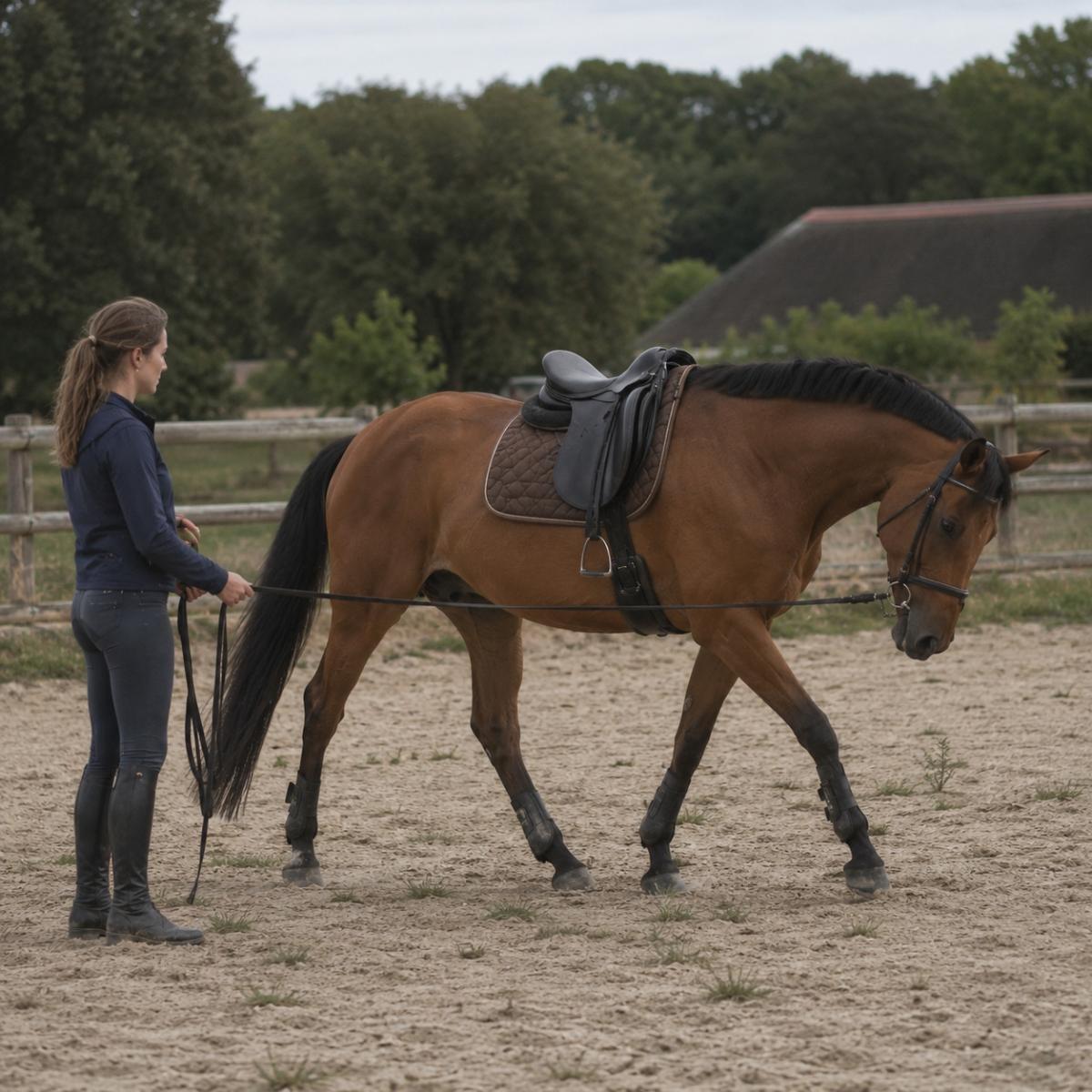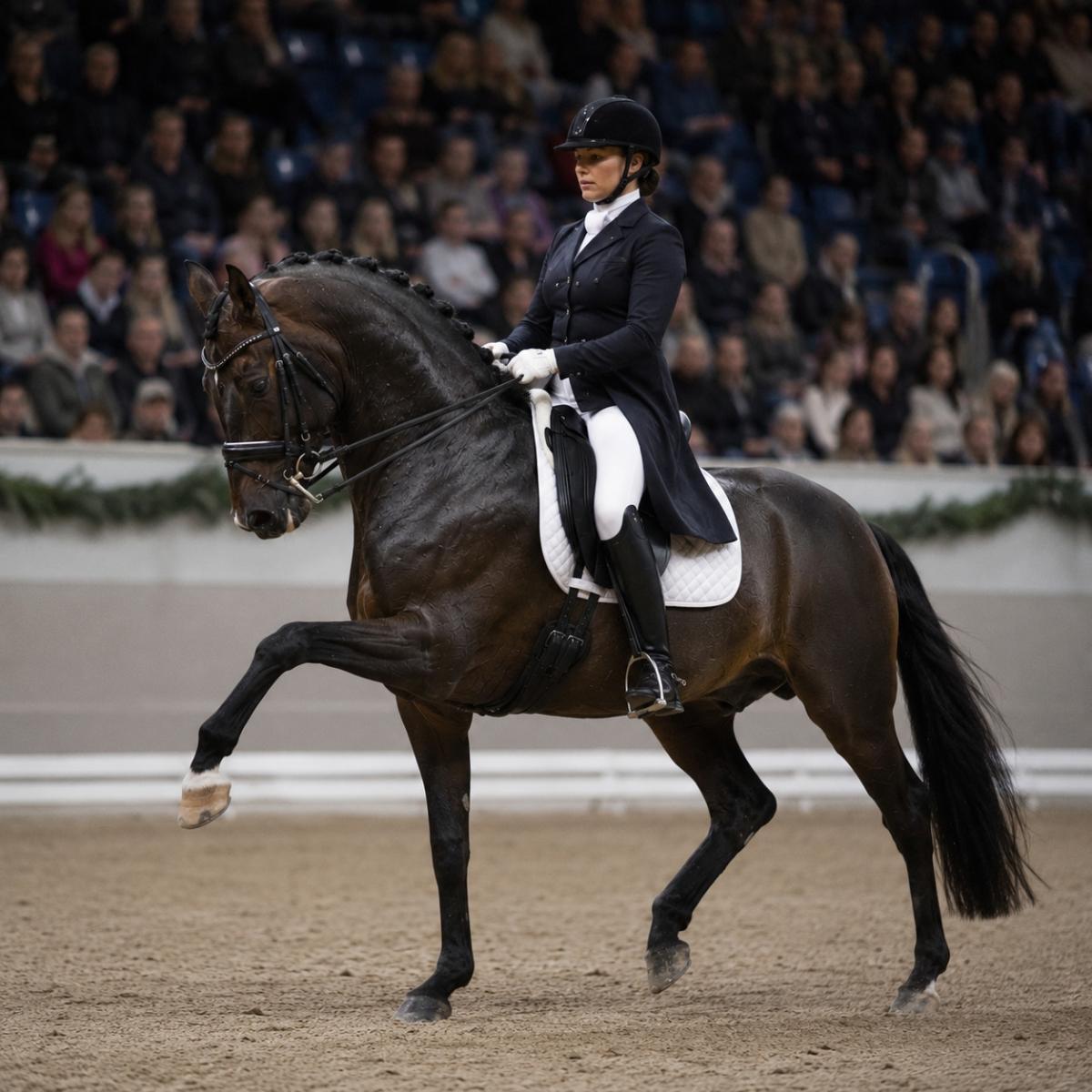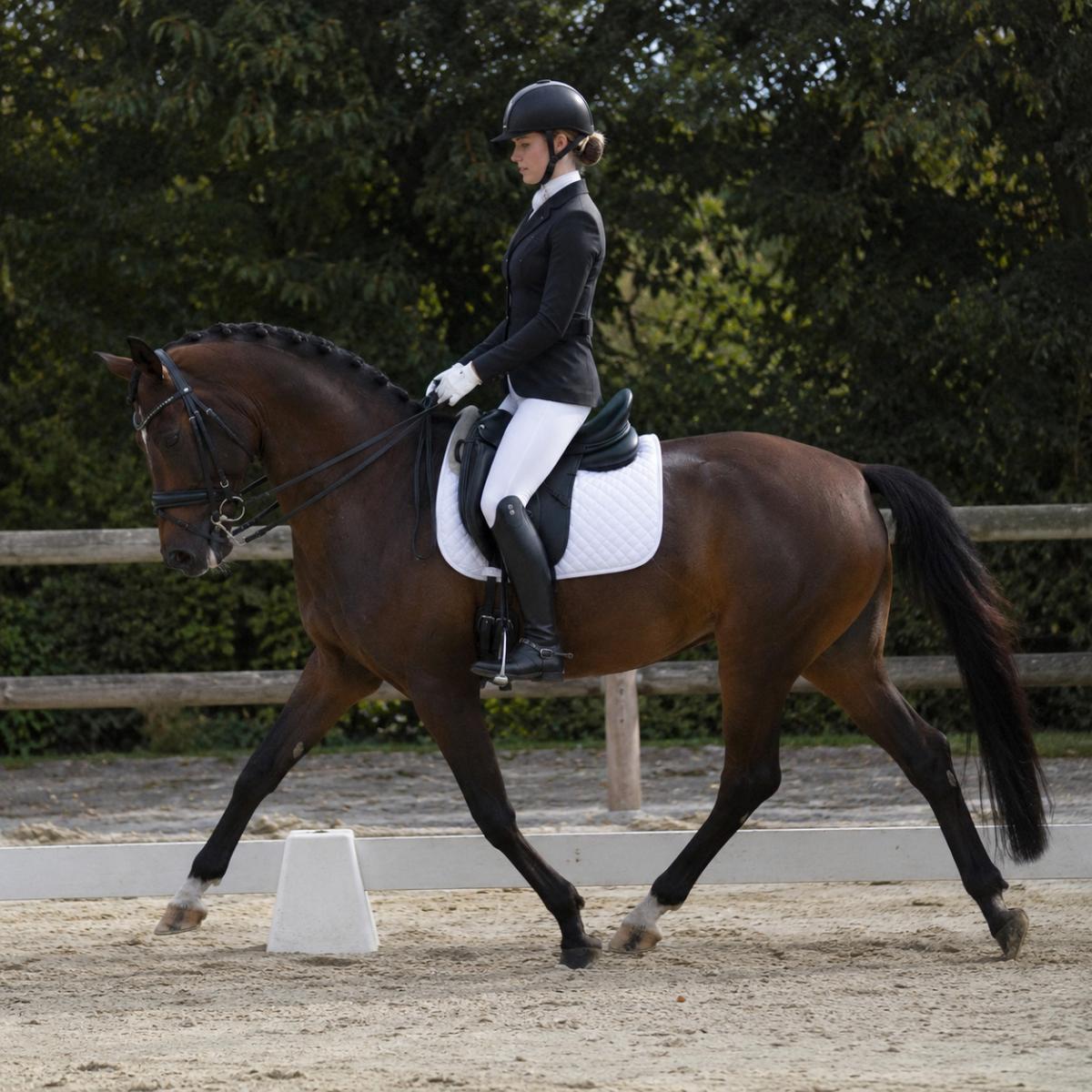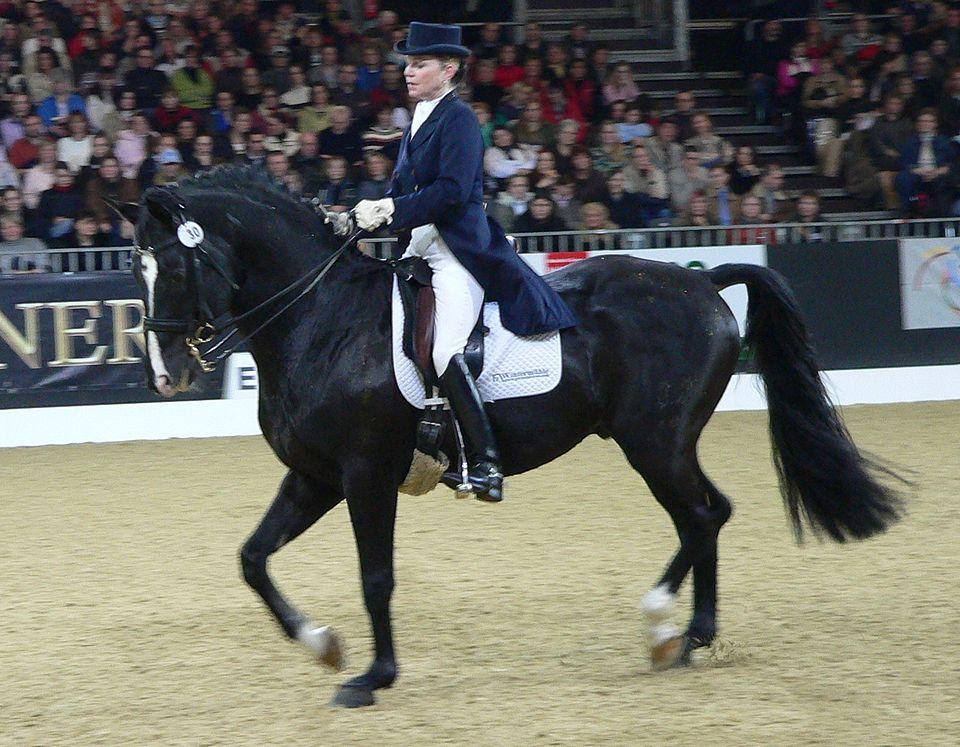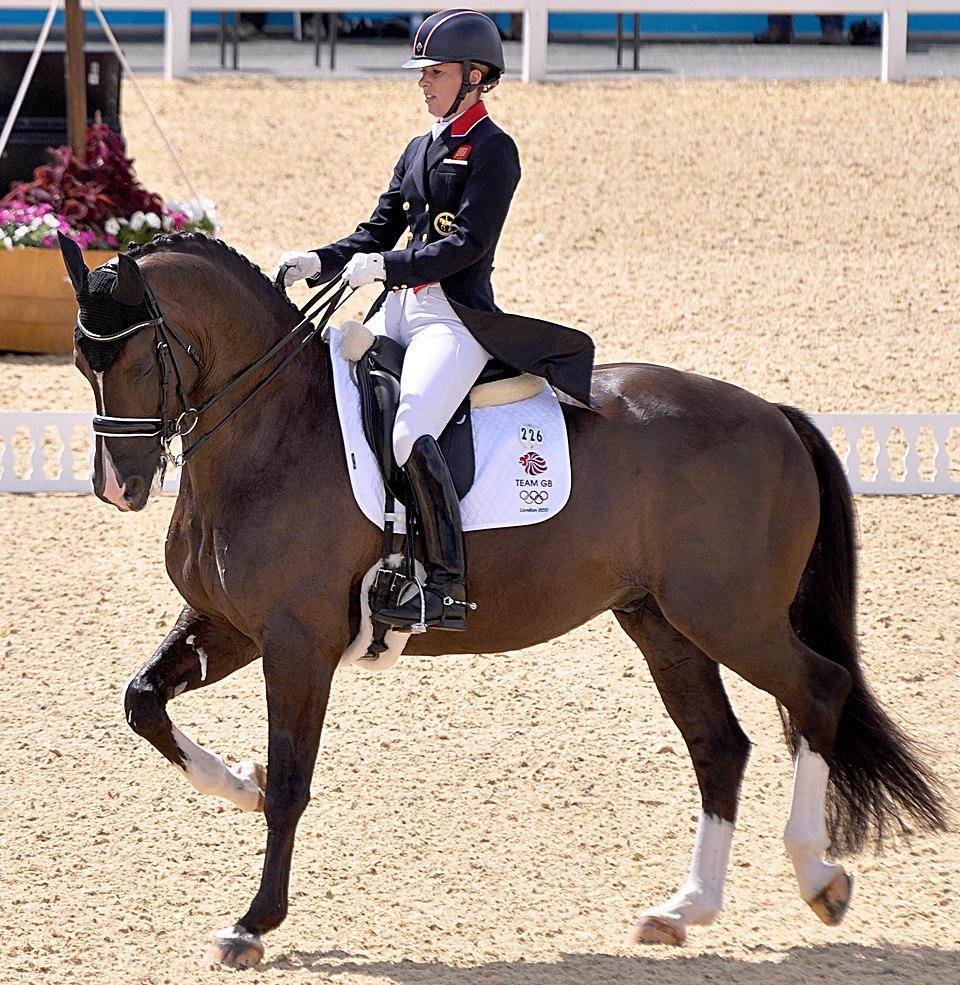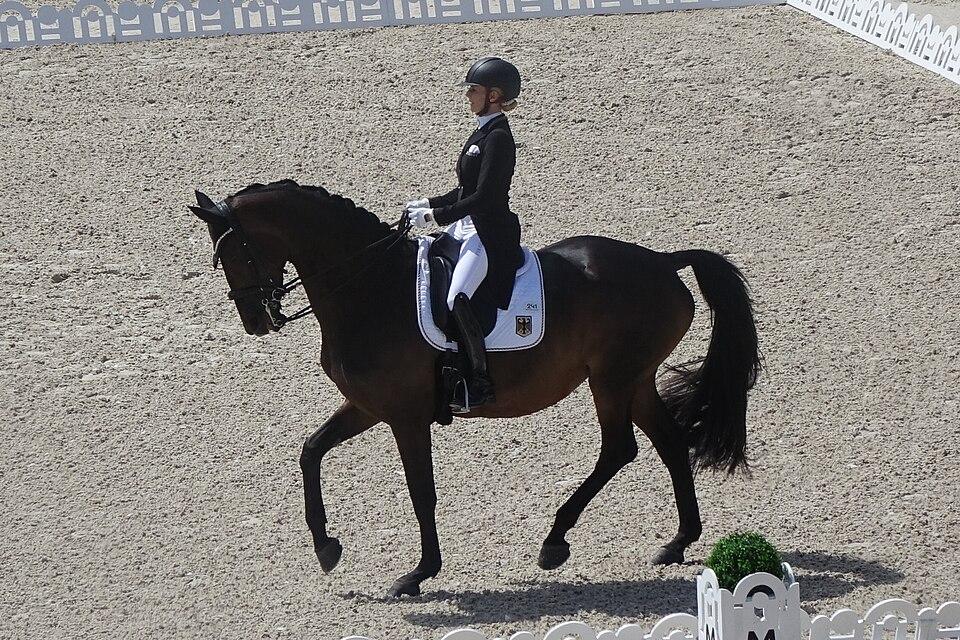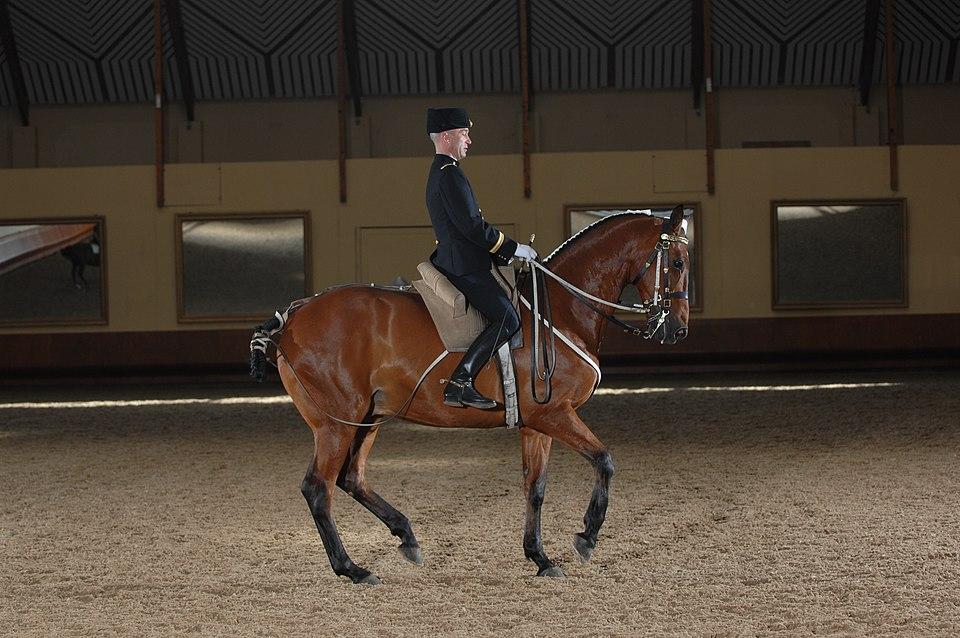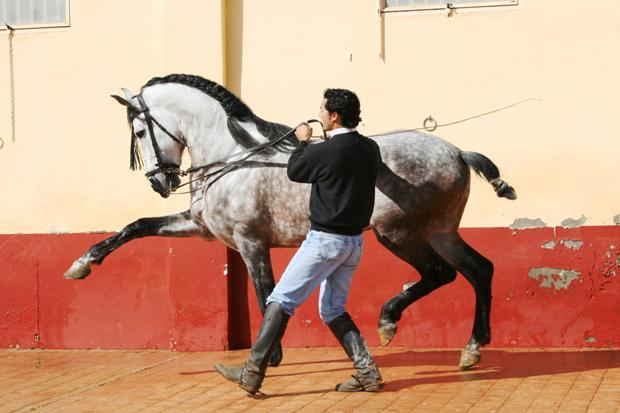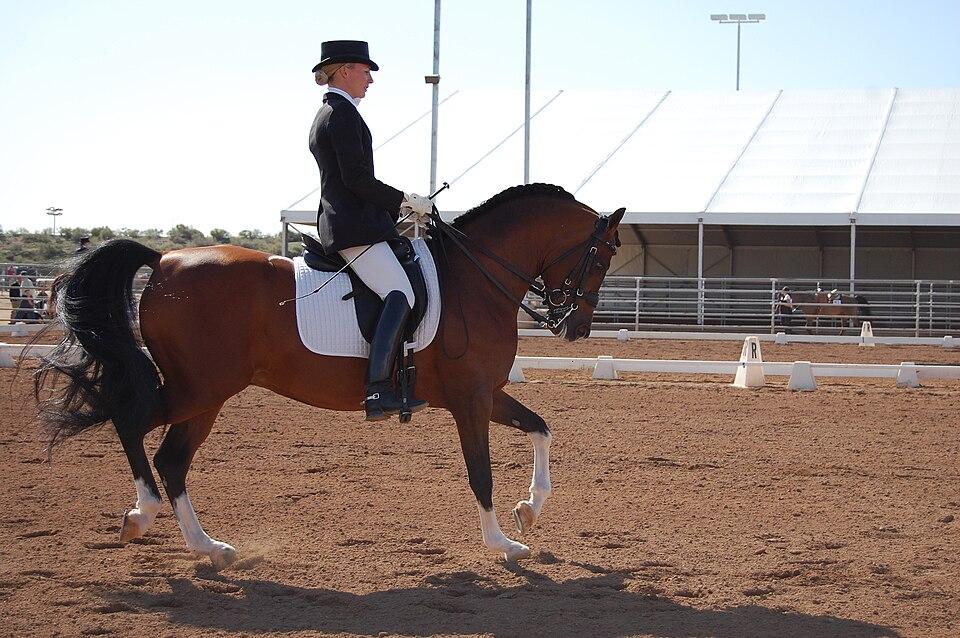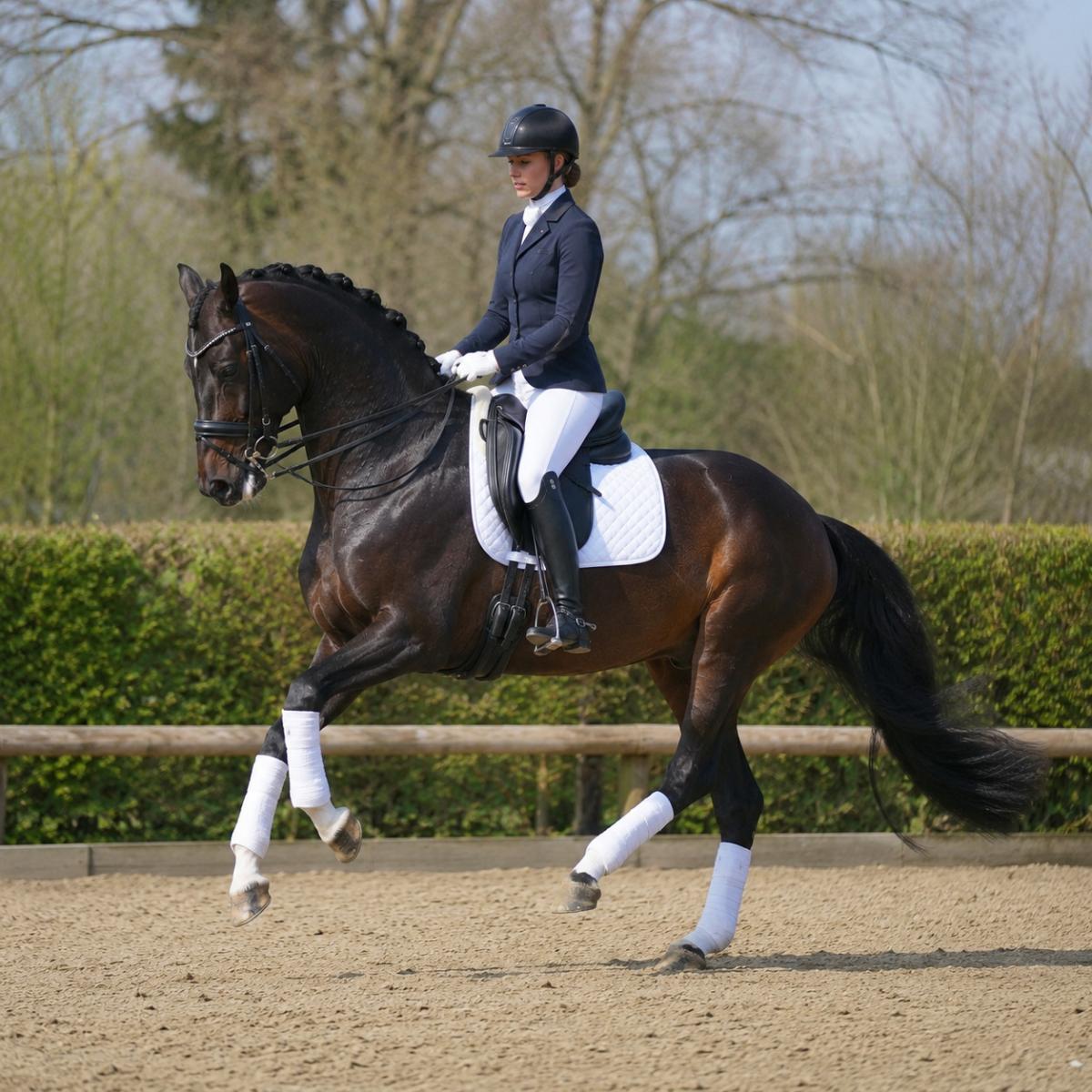
Flying changes are among the most recognisable movements in dressage. When perfectly performed, the horse changes from right-lead canter to left-lead canter, or vice versa, without transitioning through trot and without any apparent interruption of the rhythm.
At advanced levels, horses can even perform sequences of changes at regular intervals, culminating in one-tempi changes, where the lead changes with every stride.
Behind this apparent fluidity lies a complex movement. Changing lead requires the horse to alter the organisation of all four limbs within an asymmetrical gait in a very short period of time, while maintaining rhythm, direction, balance and responsiveness to the rider's aids.
Horses naturally possess the ability to change leads. Dressage therefore does not teach them an entirely new movement: it primarily teaches them to perform it on request, at a precise moment and under increasingly demanding conditions.
Understanding canter before the flying change
Canter is an asymmetrical three-beat gait followed by a suspension phase.
In right-lead canter, the sequence of footfalls differs from that of left-lead canter. One forelimb completes the sequence of ground contacts and gives its name to the lead on which the horse is cantering.
It is therefore more accurate to speak of a leading limb, or right- and left-lead canter, rather than a "dominant leg".
This distinction matters: the horse does not simply have one forelimb reaching farther forward than the other. The leading and trailing limbs perform different mechanical functions during the stride.
Kinematic and electromyographic analyses have indeed identified differences between the leading and trailing limbs during canter, both in their movement and in the activity of certain muscles. (pubmed.ncbi.nlm.nih.gov)
Changing lead therefore involves reorganising this asymmetry from one side to the other.
Horses naturally know how to change leads
The flying change is not an invention of dressage.
A horse at liberty can change its canter lead when changing direction, adjusting its trajectory or adapting its balance to a particular situation.
Lead changes are also observed in other equestrian disciplines. When jumping obstacles, for example, some horses naturally change the leading limb between take-off and landing.
A kinematic analysis of eventing horses jumping a cross-country obstacle observed changes in the leading forelimb and hindlimb around the jump, illustrating the horse's natural ability to reorganise its canter. (sciencedirect.com)
In dressage, the challenge is different.
The change must occur in response to the rider's request, at a predetermined point, without a sudden change of direction and while preserving the quality of the canter.
A natural movement is therefore progressively transformed into a controlled one.
Canter requires complex coordination of all four limbs
A flying change does not simply involve reversing the forelimbs.
Canter depends on precise coordination of all four limbs, each contributing at a particular moment in the stride.
Research into trot-to-canter transitions illustrates how strongly a change in gait involves reorganisation of interlimb coordination. During the transition from trot to canter, limb synchronisation changes progressively to produce the characteristic asymmetrical rhythm of canter. (sciencedirect.com)
During a flying change, the horse remains in canter but must switch from one asymmetrical organisation to its mirror image.
This explains why an error may involve only part of the body.
The horse may change the lead in front without correctly making the same change behind, or vice versa. It then becomes temporarily disunited, with the forelimbs and hindlimbs organised on different leads.
The foundations are established before flying changes
Flying changes appear relatively late in the training progression of a dressage horse.
Before introducing them, the rider generally seeks a canter stable enough for its balance and direction to be modified without losing rhythm.
Preparatory work can include:
- canter departs on both leads;
- transitions between gaits;
- variations within the canter;
- work on straight and curved lines;
- counter-canter;
- changes of direction;
- and progressively greater control of balance.
These exercises do not form a universal recipe that must always be followed in an absolutely fixed order.
Their purpose is primarily to establish that the horse understands the aids associated with canter and can maintain its organisation as the work becomes more demanding.
The flying change can then be introduced from a canter that is already sufficiently controllable, rather than being used as an exercise intended to correct an unstable canter.
Counter-canter develops control of the lead
Counter-canter has a particular role in this preparation.
The horse deliberately maintains the same lead even though the curve or direction might naturally encourage it to change.
The exercise therefore teaches the horse not to determine its lead automatically from the direction of travel alone.
It also allows the rider to establish that a particular lead can be requested and maintained.
This distinction becomes essential for flying changes: the horse must progressively understand that the change is associated with a signal from the rider, rather than simply with a change in direction.
Without this understanding, some horses begin to anticipate, changing as soon as they recognise a diagonal, corner or other situation they have associated with the exercise.
The aids provide the signal for the change
The rider uses a combination of aids to request a flying change.
Their exact application varies according to the horse, its level of training and the training method, but generally involves coordinated changes in the legs, seat and organisation of the canter.
The principle is not to mechanically move the horse's body with the aids.
Instead, the horse progressively learns to associate a particular configuration of signals with the expected response.
With repetition and training, the response can become sufficiently precise that the aids are extremely difficult to perceive from the outside.
This subtlety partly explains why changes performed by experienced horse-and-rider combinations can appear almost spontaneous.
Learning depends on associations
Like other responses learned under saddle, the flying change is acquired through learning.
The horse needs to understand which signal corresponds to the request and which response leads back to a stable situation.
The rider's precision is therefore particularly important.
If the aids constantly change, if several contradictory signals are given simultaneously or if corrections systematically arrive too late, the association becomes more difficult for the horse to understand.
Conversely, an identifiable request followed by release or reward when the correct response occurs helps clarify the association.
The objective is not simply for the horse to produce one correct change, but to identify the request and reproduce the response reliably.
Timing the request is essential
The flying change must fit into the canter stride cycle.
The rider therefore cannot request the movement effectively at just any point in the stride.
The horse needs sufficient time to modify the coordination of its limbs before the following stride.
Timing becomes particularly important as the changes are performed closer together.
In sequences, the rider must coordinate the aids with the rhythm of the canter so that each change occurs after exactly the required number of strides.
At advanced levels, this temporal precision becomes one of the major challenges of the exercise.
A correct flying change involves both forelimbs and hindlimbs
One of the most visible errors occurs when the horse does not change simultaneously in front and behind.
The horse may change with the forelimbs before the hindlimbs, or become temporarily disunited.
The Fédération Équestre Internationale defines the flying change as a change in which the forelegs and hind legs change at the same moment, while the movement should remain fluent, balanced and controlled. (inside.fei.org)
Quality therefore involves more than simply ending up on the correct lead.
The change itself must preserve the organisation of the canter.
A flying change is more than a change during suspension
The flying change is often described as taking place "in the air", during the suspension phase of canter.
This description helps explain the name and distinguishes it from a change performed through an intermediate transition, but it can create an oversimplified picture of the biomechanics.
The horse does not suddenly rearrange all four limbs once completely suspended above the ground.
The change is integrated into the complete sequence of limb movements and ground contacts between canter strides.
What primarily characterises the flying change is the absence of an intermediate transition through trot or walk: the horse changes directly from one canter lead to the other while maintaining the gait.
Why do disunited changes occur?
Several errors can appear during the learning process.
The horse may:
- change late behind;
- change in front but not behind;
- accelerate before or after the change;
- lose straightness;
- alter the rhythm significantly;
- break into trot;
- or anticipate the request.
These difficulties do not have a single cause.
They may be related to understanding of the aids, timing of the request, balance, coordination, tension or physical difficulty.
An isolated mistake during training does not therefore necessarily indicate a specific problem.
Persistent difficulty, however, particularly when it repeatedly occurs on the same side or is accompanied by other changes in locomotion, deserves closer attention rather than simply increasing the number of repetitions.
The two leads are not mechanically identical
Right- and left-lead canter are mirror-image organisations, but the mechanical demands placed on each limb are not identical within an individual stride.
Research on the forelimbs has identified significant kinematic differences between the leading and trailing limbs during canter. The leading limb, for example, showed greater flexion of certain joints during the swing phase. (pubmed.ncbi.nlm.nih.gov)
Muscular activity also differs according to the function of the limb.
A study of ten ridden horses found greater activity of the gluteus medius muscle in the trailing hindlimb during certain phases of canter, associated with differences in limb retraction, hip extension and stifle flexion. (pubmed.ncbi.nlm.nih.gov)
These differences help explain why working on both leads contributes to developing locomotion that is as balanced and adaptable as possible.
Physical preparation involves the whole horse
Flying changes are sometimes described as requiring simply "a lot of hindquarter strength" or highly developed abdominal muscles.
The reality is more global.
The horse must control its trunk, modify the coordination of all four limbs and maintain balance while continuing to canter.
The muscles of the leading and trailing limbs do not perform exactly the same activity during the stride. Electromyographic studies show that canter itself already relies on a complex asymmetrical organisation of muscular activity. (pubmed.ncbi.nlm.nih.gov)
Physical preparation is therefore less about developing one particular muscle than about enabling the horse to maintain strength, coordination and stability while the organisation of the canter changes.
Straightness becomes increasingly important
A horse can technically complete a flying change while also shifting sideways or altering its line of travel.
As training progresses, it must learn to change lead while remaining as straight as possible.
This requirement becomes particularly visible in sequences.
FEI dressage rules require the horse to remain light, calm and straight, while maintaining the same rhythm and balance throughout successive changes. (inside.fei.org)
An advanced flying change is therefore more than an inversion of the canter lead.
It must be integrated into locomotion in which direction, rhythm and balance remain controlled.
From isolated changes to flying changes in sequence
Once the individual flying change is sufficiently understood and stable, training can progress towards changes performed at shorter intervals.
The horse must then not only change correctly, but also wait for the next request.
In advanced dressage tests, flying changes can be performed in sequences at regular intervals.
FEI dressage includes sequences performed:
- every four strides;
- every three strides;
- every two strides;
- and every stride.
In a sequence of two-tempi changes, for example, the horse changes lead every two canter strides. During one-tempi changes, the lead changes with every stride. (inside.fei.org)
The difficulty increases considerably because the horse must continuously alternate the right-left organisation of the canter without losing rhythm.
One-tempi changes require extremely precise coordination
One-tempi changes are among the most advanced forms of the exercise.
With every new stride, the horse changes canter lead.
The rider must therefore alternate the aids with considerable temporal precision, while the horse must respond without accelerating, becoming tense or anticipating beyond what is being requested.
The visual result can appear remarkably fluid.
Behind this fluidity, however, lies a rapid succession of reorganisations of the canter, repeated with every stride.
In assessing sequences, FEI criteria include the preservation of rhythm, balance, straightness, fluency and impulsion. (inside.fei.org)
Anticipation can develop through learning
As the horse becomes more familiar with the exercise, a new difficulty can emerge: anticipation.
A horse may learn that a flying change is regularly requested on a particular diagonal or after a certain movement.
It may then begin offering the change before the rider actually asks for it.
This illustrates why training is not simply about teaching the horse how to change, but also when to change.
The rider needs to be able to maintain the existing lead when desired and then obtain the change from a precise aid.
Counter-canter, varied lines and changes in exercise patterns can help distinguish between contextual clues and the actual signal.
Behaviour influences the quality of the change
Tension can substantially alter flying changes.
A horse that strongly anticipates may accelerate, rush or perform changes without waiting for the rider's requests.
Conversely, a horse that does not respond sufficiently may change late or lose activity.
The desired response lies between these two situations: the horse should remain sufficiently responsive to react quickly without becoming automatic or rushed.
FEI rules specifically emphasise maintaining a horse that is calm, light and straight, with consistent rhythm and balance during sequences. (inside.fei.org)
The quality of a flying change therefore depends on both physical coordination and the stability of the learned response.
Breed does not determine the ability to perform flying changes
Flying changes are sometimes associated with breeds that are strongly represented in international dressage.
Sport-horse populations have indeed been selected for various characteristics related to locomotion, dressage aptitude and performance.
This does not mean that a particular breed automatically possesses an "easy flying change".
The movement occurs naturally in horses, while learning to perform it under saddle depends on a much broader combination of factors: individual locomotion, balance, conformation, health, learning, experience and quality of training.
Two horses of the same breed can therefore differ considerably in how easily they learn the exercise.
At the individual level, breed alone cannot predict how easily a horse will learn flying changes.
From a natural movement to a Grand Prix exercise
The flying change illustrates particularly well how dressage training works.
The horse already possesses the natural ability to change canter leads.
Training does not create this coordination from nothing. Instead, it progressively transforms a spontaneous response into a movement controlled through precise aids.
The horse first learns to strike off on the requested lead and maintain a stable canter. It then develops greater control of balance, lines and transitions. The flying change can eventually become a response to an identifiable aid.
With experience, this response becomes increasingly precise.
A single flying change can progress into a sequence, then two-tempi changes and finally changes at every stride.
What appears almost instantaneous in a Grand Prix horse is therefore the result of a long learning process: reorganising the complete canter pattern at the moment requested by the rider without losing rhythm, straightness or balance.
Sources and references
- Fédération Équestre Internationale – Dressage Rules
- FEI – Dressage Rules, flying changes and changes in series
- Electromyographic and Kinematic Comparison of the Leading and Trailing Fore- and Hindlimbs of Horses during Canter
- Effect of speed and leading or trailing limbs on surface muscle activities during canter in Thoroughbred horses
- Comparative kinematic analysis of the leading and trailing forelimbs of horses cantering on a turf and a synthetic surface
- Spatio-temporal gait characteristics during transitions from trot to canter in horses
- A study of transitions between the trot and canter in dressage horses