Discover the Lipizzan, a historic European breed renowned for classical dressage, its baroque build, ancient bloodlines and breeding tradition.
By the Chevaux du Monde editorial team · Published on · Updated on
Type: Riding Horse
Continent: Europe
Country: Slovenia
Weight: 450 – 550 kg
Height: 153 – 158 cm
The Lipizzan takes its name from the Lipica Stud Farm, now located in Slovenia. The stud was founded in 1580 under the Habsburg monarchy to produce horses suitable for the imperial court and classical equitation.
The breed was developed from Iberian horses combined with bloodlines of Italian, German, Danish and Oriental origin. Its history subsequently became closely associated with several Central European countries, particularly Austria, Slovenia, Croatia, Hungary and Slovakia.
Lipizzans are traditionally bred at several state stud farms in Central and Southeastern Europe. The best known include Lipica in Slovenia and Piber in Austria, which supplies horses to the Spanish Riding School in Vienna.
Other historic populations are maintained in Croatia, Hungary, Slovakia, Romania, Serbia and Italy. The breed is also raised by private breeders in Europe, North America and other regions, although its population remains relatively limited.


Lipizzan breeding is structured around a limited number of carefully recorded paternal and maternal lines. The six classical stallion lines are Pluto, Conversano, Neapolitano, Favory, Maestoso and Siglavy. Other lines are recognised within certain national populations and stud-book traditions.
The preservation of mare families is equally important. At the Piber Federal Stud, 17 classical mare families are maintained. Pedigree management and cooperation between stud books are essential for limiting inbreeding and preserving the breed's genetic diversity.
In 1580, Archduke Charles II of Inner Austria founded a court stud at Lipica. Its purpose was to breed elegant, powerful and agile horses for the Habsburg court and the practice of classical equitation.
The Lipizzan was developed over several centuries through carefully managed breeding. Six stallions born between the eighteenth and nineteenth centuries founded the classical paternal lines still preserved today.
The breed was repeatedly threatened by European conflicts. Horses were evacuated several times, and the breakup of the Austro-Hungarian Empire dispersed breeding populations among different countries. These events explain why several national stud books and historic studs now participate in the breed's preservation.
The Lipizzan became internationally renowned through the Spanish Riding School in Vienna, where selected stallions perform the exercises of classical dressage. In 2022, the traditions of Lipizzan horse breeding were inscribed on UNESCO's Representative List of the Intangible Cultural Heritage of Humanity.
The Lipizzan is traditionally selected for its trainability, balance, endurance and ability to collect. These qualities are particularly valued in classical dressage and driving.
The breed generally matures later than many modern sport horses. Its training should therefore be progressive and adapted to the physical and mental development of each individual.
Temperament varies between horses and is also influenced by bloodline, breeding conditions, handling and education. Breed descriptions should not replace an individual assessment of the horse.
The future of the Lipizzan depends on cooperation between national stud books, the preservation of historic bloodlines and the maintenance of sufficient genetic diversity. Exchanges of breeding animals between populations can help prevent excessive inbreeding.
The international recognition of Lipizzan breeding traditions and the breed's continued use in dressage and driving support its conservation. Breeding decisions must nevertheless balance historical selection criteria, genetic diversity, health and functional ability.
No single disease should be considered universal or exclusive to the Lipizzan. As with any population managed through a relatively limited number of bloodlines, genetic diversity and the selection of breeding animals require careful monitoring.
The breed is known for its relatively late maturity. Workload, nutrition and training should therefore be adapted to the horse's stage of development. Routine veterinary care, dental monitoring, hoof care and appropriate weight management remain essential.
A slow, majestic walk with cadenced steps, marked by a pronounced knee lift and proud neck carriage. It demonstrates the horse’s mental discipline and ability to maintain balance and tension without haste.
A two-beat trot with strong engagement of the hindquarters, marked knee flexion, and a harmonious body posture, typical of high-school dressage. This gait gives an impression of suspension and natural elegance.
A very cadenced and contained canter, with deep engagement of the hindquarters. It is often used in transitions and showcases control and precision.
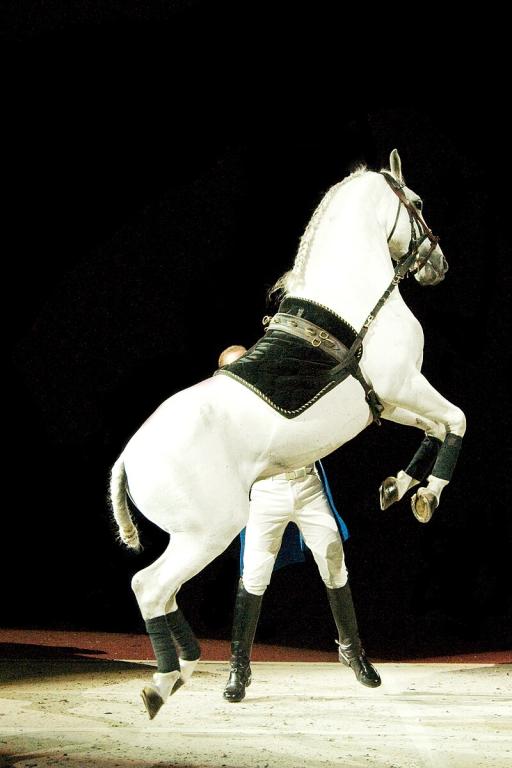
The horse rears at an angle of about 30° from the ground, hind legs bent, maintaining perfect balance.
A levade followed by a series of small jumps forward. The hind legs propel the horse while the forelegs remain tucked.
A jump into the air where the horse kicks out with its hind legs before landing. A very rare figure requiring strength and precision.
An extended walk where the horse lifts its forelegs very high in alternation. This is not a natural gait, but a classical dressage movement.
A trot in place, very rhythmic and cadenced, with vertical impulsion.
A very slow, suspended, and elegant trot with pronounced elevation of the limbs and maximum body tension.
Born in 1979
The oldest registered Lipizzan stallion under the Lipizzan International Federation (LIF). Often called the “Levader of the century”, he was known for his intelligence, strong character, and remarkable aptitude.
Born in 1997
A Grand Prix performer, he became a film and show star, notably in "Shadow & Me". Retired in 2017 at the age of 20.
Born in 1989
A state stud stallion, appreciated for his conformation and sporting qualities.
Born in 1981
An important broodmare, she became a notable figure in the Conversano lineage.

Lipica is the birthplace of the Lipizzaner family and home to the largest Lipizzaner stud farm in the world. Experience this in the company of over 300 white Lipizzaners on over 300 hectares of greenery.