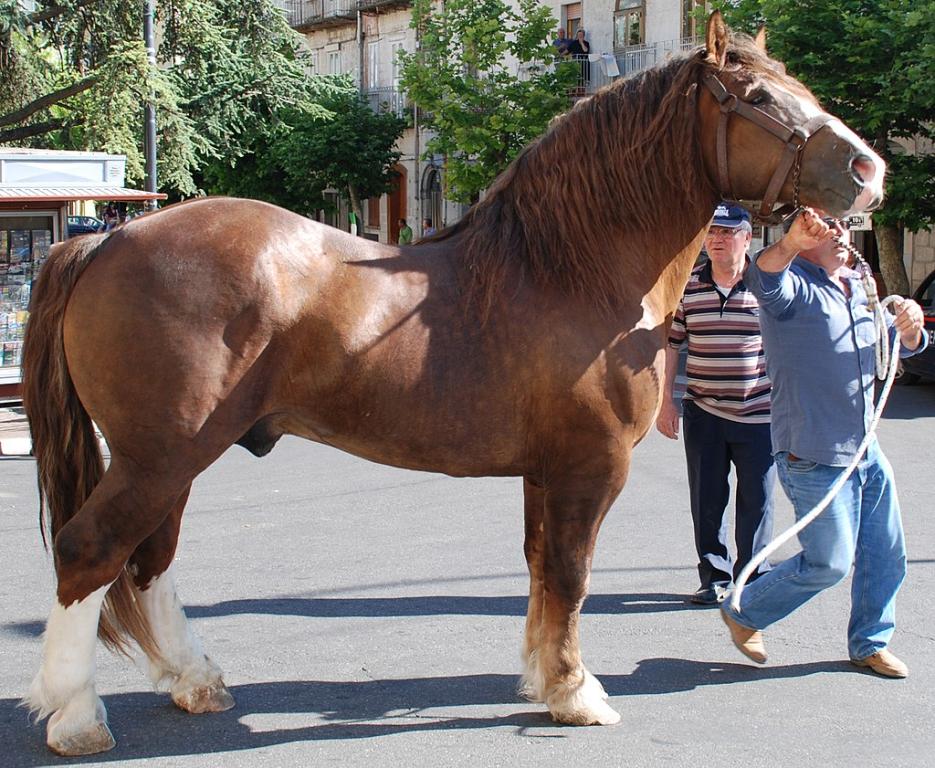
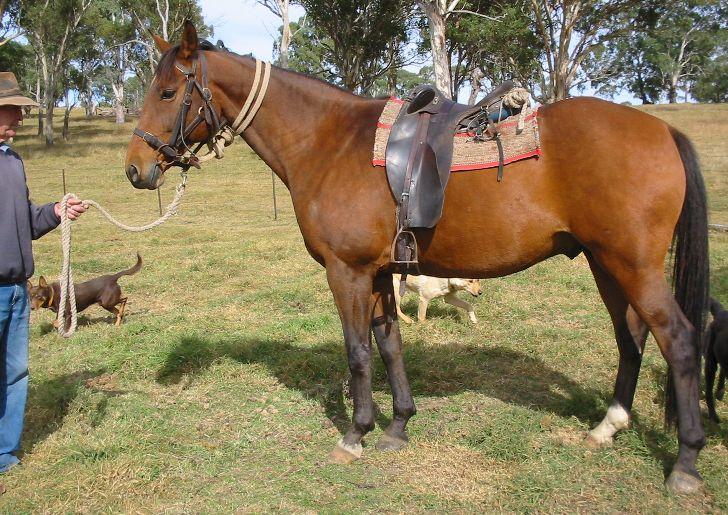
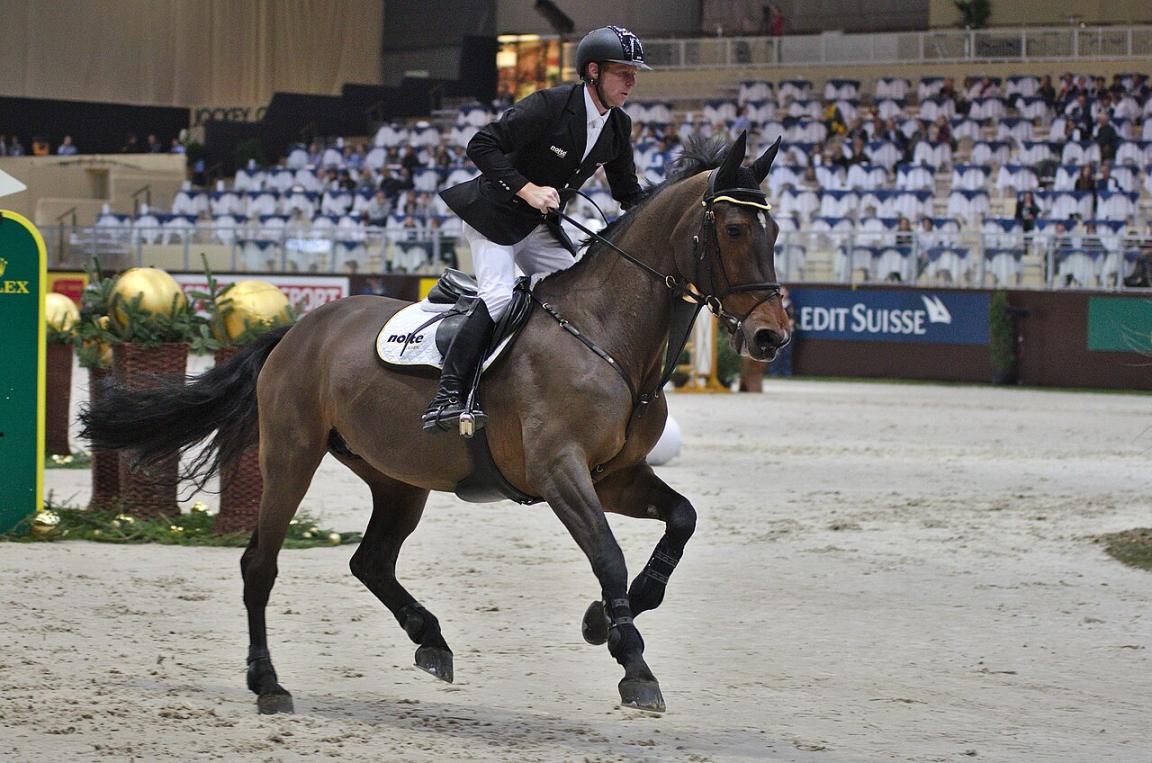
The Bavarian Warmblood, descended from the near-extinct Rottaler, excels in show jumping, dressage and eventing. A top Olympic sport horse bred in Bavaria since 1963.
By the Chevaux du Monde editorial team · Published on · Updated on
Type: Riding Horse
Continent: Europe
Country: Germany
Weight: 700 – 900 kg
Height: 160 – 175 cm
Name: German Sport Horse Studbook (DSP) — Bavarian section
Founded: 2014
The Bavarian Warmblood, known in German as the Bayerisches Warmblut, is a German sport-horse population developed in Bavaria. Its breeding was particularly associated with the agricultural regions of southeastern Germany and the Landesverband Bayerischer Pferdezüchter, the Bavarian regional horse breeders’ association.
The modern Bavarian Warmblood was developed for equestrian sport from regional mares and breeding animals belonging to several European riding-horse populations. It is therefore not a closed breed preserving exclusively Bavarian ancestry.
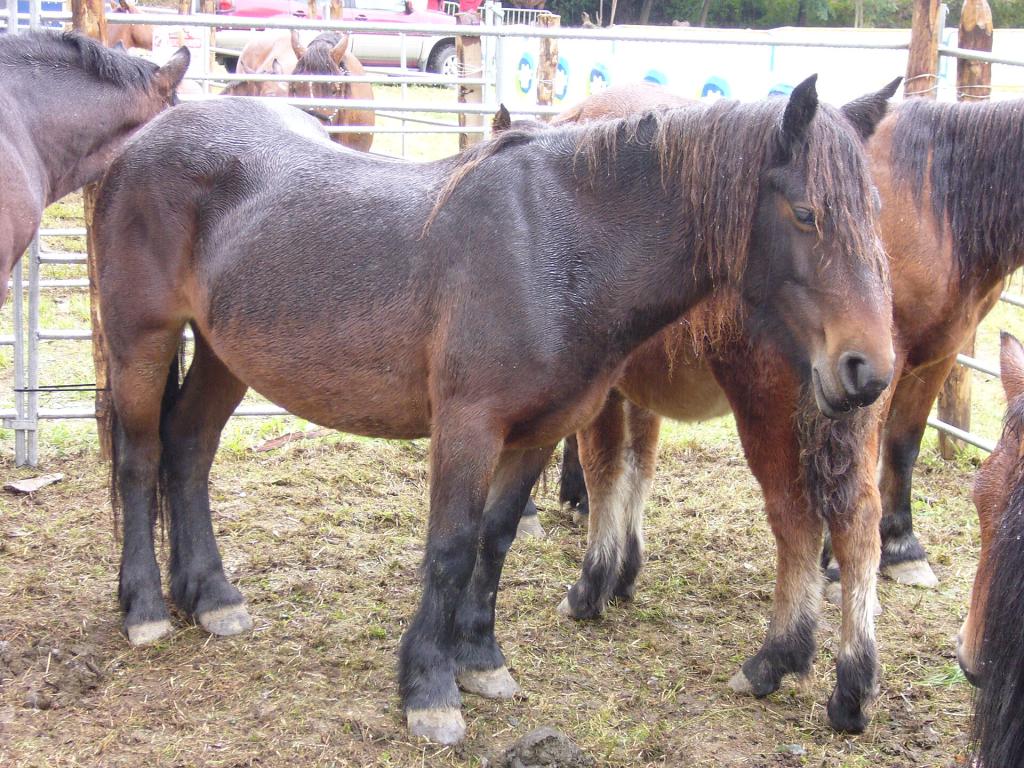
The Bavarian Warmblood’s history is closely connected to the Rottaler, an older multipurpose horse bred in the Rott valley of Lower Bavaria. This substantial horse was used for farm work, driving and riding. Mechanization shifted demand toward leisure riding and equestrian sport, resulting in a profound transformation of the breeding program.
Breeding animals from other German and European populations were introduced to refine the type, improve the gaits, strengthen jumping ability and produce a horse suited to the Olympic disciplines.
Since 2014, the Bavarian Warmblood has no longer been maintained as an independent studbook for new generations. It was incorporated into the German Sport Horse, or DSP, together with several other regional populations from southern and eastern Germany.
The Bavarian Warmblood nevertheless remains identifiable as a historical population and regional breeding origin. Horses registered before the integration retain their genealogical identity, while new foals produced through the Bavarian program are registered as German Sport Horses.
The Bavarian Warmblood’s original breeding area lies in Bavaria, particularly around Munich-Riem and throughout the Land’s agricultural regions. Breeding traditionally relies on a network of private owners and breeders supported by the regional association.
The Landesverband Bayerischer Pferdezüchter now oversees German Sport Horses bred in Bavaria. Its responsibilities include foal registration, maintenance of the regional studbook sections, mare inspections, performance testing and breeding events.
Since the 2014 reorganization, the German Sport Horse studbook has been jointly managed by several regional breeding associations. Bavaria retains its local organization and breeder services, but its horses are produced under a common DSP breeding objective.
The DSP incorporates the former Bavarian Warmblood, Württemberger, Brandenburg, Saxony-Anhalt, Thuringian, Saxon and Zweibrücker populations. This structure provides a considerably broader geographical and genealogical base than the former Bavarian studbook.
Horses descending from Bavarian bloodlines are found in numerous European countries and on the principal international sport-horse markets. Their distribution is supported by auctions, exchanges of breeding animals, artificial insemination and participation in dressage, show jumping and eventing competitions.


The Bavarian Warmblood illustrates the transformation experienced by many regional European horse populations during the twentieth century. A horse formerly selected for farming, driving and general utility was progressively redirected toward the production of a modern sport horse.
This transformation relied on breeding animals from several populations, including the Hanoverian, Holsteiner, Trakehner, Westphalian and other European sport horses. Thoroughbred and Anglo-Arab blood could also be introduced to contribute refinement, endurance and athletic distinction.
The present DSP breeding program is open to several recognized populations. The genetic and zootechnical identity of the modern Bavarian Warmblood therefore rests less on exclusively regional ancestry than on Bavarian mare families, verified pedigrees and shared performance criteria.
Breeding animals are assessed through their conformation, gaits, rideability, jumping ability, individual performance and the results of their offspring. This approach allows the introduction of outside bloodlines while maintaining a coherent functional objective.
In 2014, five German regional associations decided to manage the German Sport Horse studbook jointly. The official DSP association presents this decision as a major step in unifying the sport-horse populations of southern Germany.
Germany’s official animal genetic resources database explicitly records that the Bayerisches Warmblut was incorporated into the German Sport Horse in 2014. Previously registered Bavarian breeding animals were transferred into the new studbook with the same status as DSP breeding stock.
A broader studbook increases the number of potentially available breeding animals, but it does not automatically guarantee balanced genetic diversity. The same internationally popular stallions may be used simultaneously across several European populations, increasing the representation of certain ancestors in pedigrees.
Monitoring coefficients of relationship, mare families and the actual use of stallions therefore remains important. Sustainable selection should not reduce genetic progress to the repeated use of a small number of heavily promoted breeding animals.
Before the development of specialized sport-horse breeding, Bavaria maintained several horse populations used on farms, for transportation and under saddle. The Rottaler was particularly associated with Lower Bavaria and the Rott valley.
The Rottaler was valued as a multipurpose horse, substantial enough for agricultural work and driving but also suitable for riding. Its conformation belonged to the historical type of European carriage horse and heavy warmblood.
The mechanization of agriculture and transportation, which accelerated after the Second World War, removed many of the traditional roles performed by these horses. To maintain an economically viable breeding industry, Bavarian breeding authorities progressively redirected selection toward the riding horse.
From the 1960s onward, the Bayerisches Warmblut name accompanied this new direction. The population was transformed through the introduction of lighter and more athletic breeding animals from several German and European studbooks.
The new breeding program sought a horse capable of participating in dressage, show jumping and eventing. Gait quality, rideability, power, jumping technique and functional conformation progressively replaced agricultural aptitude as the principal selection criteria.
As in other German studbooks, mare inspections, stallion licensing, performance tests and competition results structured the breeding program. The Bavarian Warmblood consequently developed into a sport-horse population comparable with other German warmbloods while retaining its regional organization.
In 1990, several southern German breeding associations formed a working group to organize joint events. This cooperation was strengthened through shared stallion licensing events and the development of a common marketing identity.
In 2014, the breeding associations of Bavaria, Baden-Württemberg, Brandenburg-Anhalt, Rhineland-Palatinate-Saar and Saxony-Thuringia decided to manage the German Sport Horse studbook jointly. The former Bavarian Warmblood was then formally incorporated into this population.
The Bavarian Warmblood name remains relevant for horses registered under that designation before the merger, for their bloodlines and for the history of Bavarian breeding. A foal produced today through the Bavarian program is normally registered as a German Sport Horse, rather than in a new independent Bayerisches Warmblut studbook.
The modern Bavarian Warmblood was selected for willingness, learning ability and sufficient cooperation with its rider. The German Sport Horse breeding objective seeks a horse whose temperament, character and rideability make it suitable for a range of equestrian activities.
These objectives do not mean that every horse displays the same behavior. Dressage-oriented horses may be highly sensitive to the aids, while some jumping bloodlines are selected for quick reactions, initiative and considerable energy.
The openness of the breeding program permits the use of numerous populations and families. This creates diversity in conformation as well as in temperament. A horse produced for international competition may require an experienced rider even when it belongs to a population generally selected for cooperation.
Behavior depends on the individual horse, its bloodlines, education, living conditions, health and the rider’s experience. Training level, daily management and compatibility between horse and rider are therefore more important than a general description of the population.
It would be misleading to present every Bavarian Warmblood as suitable for beginners. Selection should be based on the specific horse, its education and its reactions in the environment in which it will be used.
The future of Bavarian bloodlines now forms part of the German Sport Horse breeding program. The principal challenge is to retain the qualities developed by regional breeders while benefiting from the wider genetic base and shared selection tools of the DSP.
Selection should balance sport performance, rideability, health and functional longevity. Spectacular movement or exceptional jumping power are insufficient breeding objectives when accompanied by locomotor weakness, poor balance or a temperament unsuited to the horse’s intended use.
Competition records, young-horse tests, breeding-stock assessments and genomic information can improve the accuracy of selection. These indicators must nevertheless be interpreted in context, since a horse’s performance also depends on its development, training, rider and environment.
Monitoring Fragile Foal Syndrome and other hereditary abnormalities is another important consideration. Genetic testing should prevent at-risk matings without systematically excluding every healthy carrier, which could cause an unnecessary reduction in genetic diversity.
Demand for horses suitable for amateur riders should also be considered. Maintaining bloodlines with genuine cooperation, functional movement and versatility can complement selection aimed at elite competition.
Fragile Foal Syndrome type I, formerly known as Warmblood Fragile Foal Syndrome or WFFS, concerns the European sport-horse populations from which the Bavarian Warmblood developed. This hereditary disorder is associated with a variant of the PLOD1 gene and follows an autosomal recessive inheritance pattern.
Affected foals may present abnormally thin and fragile skin, lesions of the mucous membranes, joint laxity and hyperextension. The condition is lethal. Some foals die before birth or are born prematurely, while foals born alive generally cannot survive for long.
A horse carrying one copy of the variant is normally clinically unaffected but can transmit it to its offspring. Mating two carriers creates a theoretical 25% risk of producing an affected foal in each pregnancy. Genetic testing identifies clear and carrier breeding animals and makes it possible to prevent such matings.
A study examining almost 400,000 coverings recorded by ten German studbooks found a lower average foaling rate associated with carrier stallions. These results concern the German riding-horse population as a whole and do not provide a prevalence specific to the former Bavarian Warmblood.
Since 2019, active stallions in German riding-horse breeding programs have been required to undergo testing for the variant. Screening should be used to plan matings rather than to remove every healthy carrier abruptly, which could unnecessarily reduce genetic diversity.
Beyond this documented condition, available sources do not identify a disease specific to the Bavarian Warmblood with a precisely established prevalence. As with every sport horse, veterinary monitoring, progressive conditioning, recovery, hoof care, correct saddle fit and surveillance of the locomotor system remain essential.
A regular, relaxed and sufficiently ground-covering walk with clear activity from the hind legs.
An energetic, ground-covering and elastic trot with active impulsion and good freedom through the shoulder.
A balanced, uphill and ground-covering canter capable of collection and easy adjustment of stride length.
Born in 1993
Top-performing show jumping stallion, winner of numerous 1.40 m and 1.50 m classes over more than 11 years. Named "Jumper Sire of the Year" in the USA in 2013.
Born in 2006
Competed at Grand Prix level in February 2016, then represented Spain at the Rio 2016 Olympic Games, where he placed 5th individually in the freestyle Kur.