Discover the Percheron, a French draft horse breed renowned for its strength, elegance, and versatility. Info on origins, uses, and more.
By the Chevaux du Monde editorial team · Published on · Updated on
Type: Draft Horse
Continent: Europe
Country: France
Weight: 600 – 1200 kg
Height: 160 – 185 cm
The Percheron is a French breed originating in the former province of Perche, a historical territory now divided mainly between the departments of Orne, Eure-et-Loir, Sarthe and Loir-et-Cher. Its original breeding area is particularly associated with the Huisne valley and the surroundings of Mortagne-au-Perche and Nogent-le-Rotrou.
This area of hedged farmland, situated between Normandy and the Paris Basin, lay across important trade routes. Local breeders developed horses capable of combining draft power, endurance and active movement to meet the needs of transportation, agriculture and commerce.
Numerous traditional accounts attribute substantial Arabian or Oriental ancestry to the Percheron. Horses of Oriental origin probably influenced certain French horse populations at different periods. However, the precise extent of their contribution to the Percheron cannot be established because sufficiently old and continuous genealogical records do not exist.
The modern breed primarily resulted from structured regional selection during the nineteenth century, shaped by economic demand and the qualities required by horse users. Claims presenting the Percheron as the direct descendant of a particular Oriental horse should therefore be treated as historical traditions rather than demonstrated genealogical facts.
Despite its distribution across many countries and the development of populations adapted to different markets, the Percheron remains closely associated with its French birthplace. The Société Hippique Percheronne de France, founded in 1883, is responsible for managing the French breeding program and guiding the breed’s selection.
The historical center of Percheron breeding lies in the Perche region, particularly around the Huisne valley. The breed is now raised in many other parts of France. Breeding animals are monitored through the French stud book and the selection program administered by the Société Hippique Percheronne de France.
From the second half of the nineteenth century onward, Percherons were exported in very large numbers. The breed became particularly prominent in the United States and Canada, where it played a major role in farming, freight transportation and urban draft work. Populations were also established in the United Kingdom, South America, Australia, Japan and several other regions.
This international expansion produced differences among national populations. Some breeding programs favor a very substantial horse for heavy draft work, while others seek a more mobile type suited to driving, public presentations or work requiring greater agility. Breed standards and registration requirements should consequently be considered in relation to the country and stud book concerned.


French selection traditionally recognizes two orientations within the breed. The Percheron Trait is the larger and more powerful type, developed to produce considerable pulling force at a moderate pace. The Percheron Diligencier is lighter and more mobile, with greater emphasis placed on active, ground-covering movement, particularly at the trot.
These orientations are not separate breeds. They represent complementary functional types within the same population. Preserving both helps maintain morphological diversity and allows the Percheron to remain suitable for several forms of work and driving.
Historical exports made the Percheron one of the most internationally distributed French draft breeds. Percheron breeding stock contributed to the formation or improvement of several foreign draft-horse populations. This expansion created an important genetic heritage, although populations established in different countries subsequently followed their own selection objectives.
Breed management must account for the representation of different families, the degree of relatedness between breeding animals and the potentially intensive use of a limited number of stallions. Pedigree monitoring, reliable identification and cooperation among breeding organizations can help control the increase of inbreeding.
Genetic diversity should not be assessed solely through the total number of registered horses. Preserving less-represented families and maintaining the functional qualities associated with both recognized types are equally important considerations.
Before the stud book was established, horses bred in the Perche formed a regional population selected for the requirements of farms, travelers and merchants. Their reputation rested on their ability to sustain considerable effort while retaining sufficiently active and efficient movement.
During the nineteenth century, postal services, stagecoaches and commercial carriers required horses capable of pulling vehicles over long distances at a relatively fast pace. The Percheron consequently became renowned as a fast draft and coaching horse. This function helped establish a type that was powerful but generally more mobile and refined than breeds developed exclusively for slow, heavy traction.
The expansion of railways gradually reduced the importance of stagecoach transportation. At the same time, agriculture, industry and urban freight services required horses capable of moving increasingly heavy loads. Percheron selection therefore moved toward greater size, substance and power while attempting to retain active movement.
The Société Hippique Percheronne de France was founded in 1883. The creation of the stud book structured the registration of breeding animals and organized selection within the breed. This period also coincided with the spectacular expansion of the international Percheron trade.
Thousands of horses were exported, especially to North America. In the United States, the Percheron became one of the principal draft breeds employed on farms and in cities. This establishment led to the development of a substantial American population whose type and breeding objectives have not always been identical to those of the French stud book.
The mechanization of agriculture and transportation, which accelerated after the Second World War, caused demand for draft horses to fall sharply. Population numbers declined as many of the breed’s traditional occupations disappeared.
Since the late twentieth century, the Percheron has benefited from renewed interest in driving, forestry work, tourism, heritage demonstrations and the selective return of animal traction to farms and local authorities. These activities favor well-trained and manageable horses capable of working regularly in varied environments.
The Percheron is generally selected for a cooperative, steady and willing disposition. A working draft horse must respond accurately to its handler, maintain a controlled effort and remain manageable when working near a vehicle, agricultural implement, other horses or members of the public.
Steadiness should not be confused with a lack of sensitivity or energy. Some individuals are responsive and particularly active in their movement, especially among horses representing the Diligencier type. Progressive and consistent training is essential to channel their strength while preserving light, precise responses.
The Percheron’s size and power can make gaps in training potentially dangerous. Respectful handling, standing quietly, lifting the feet, loading and leading should be established from a young age. Driving horses require methodical habituation to harness, noises, vehicles, pressure from the traces and road traffic.
Temperament also depends on the individual horse, its bloodlines, education, living conditions, health and previous experiences. The breed’s reputation for a calm disposition should therefore never replace an assessment of the actual horse, its training and its suitability for the intended handler or driver.
The future of the Percheron depends on preserving its identity as a genuine working horse while adapting its abilities to contemporary needs. Leisure and competition driving, forestry work, specialized agricultural traction, management of natural areas, tourist transportation and some municipal services provide opportunities to use its strength while retaining its mobility.
Selection should preserve efficient movement, sound bone, functional hooves and a temperament compatible with modern working conditions. Excessive emphasis on size or body mass could compromise endurance, balance and long-term soundness. Maintaining the more active Diligencier type is particularly relevant for activities requiring speed, sustained trotting ability and greater agility.
Genetic testing can also support more informed breeding decisions, particularly regarding PSSM1. These tools should be incorporated into broader pedigree management so that the frequency of an unfavorable variant can be reduced without causing an abrupt loss of genetic diversity.
The transmission of practical knowledge relating to harnessing, driving, agricultural work and the training of young horses remains essential. Preserving a draft breed requires more than maintaining its population size: it also requires skilled users capable of developing and demonstrating its working abilities.
Polysaccharide Storage Myopathy type 1, commonly abbreviated as PSSM1, is a documented health consideration in the Percheron. The disorder is associated with a variant of the GYS1 gene and follows an autosomal dominant inheritance pattern. A horse carrying one copy of the variant may therefore develop clinical signs and can transmit it to its offspring.
Possible signs include muscle stiffness, reluctance to move, pain, excessive sweating, muscle tremors, reduced performance and episodes of exertional rhabdomyolysis, commonly described as tying-up. The nature and severity of clinical signs vary between individuals and may be influenced by diet, exercise and management.
A study involving several horse breeds found a particularly high frequency of the PSSM1 variant in the sampled Percheron population. This result should not be interpreted as an estimate applying to every Percheron population worldwide, because variant frequency can differ substantially between countries, breeding groups and bloodlines.
A DNA test can distinguish horses without the tested variant from heterozygous and homozygous carriers. Results should be incorporated into a breeding strategy that also considers genetic diversity, conformation, health and functional ability. A genetic result does not replace veterinary examination when a horse presents muscular symptoms.
Management of affected horses generally involves regular appropriate exercise, limiting excessive dietary sugar and starch, and providing a properly balanced ration developed with qualified professionals. Dietary and exercise changes should be progressive and adapted to the individual horse.
As with other large horses, body-condition management, appropriate hoof care, monitoring of joints and tendons, and suitable working surfaces are important. Excess body weight increases the mechanical load placed on the feet and locomotor system. The growth of young horses should also be supported through balanced nutrition without encouraging excessively rapid development.
A regular, active and ground-covering walk suited to prolonged draft work.
An energetic, balanced and sufficiently extended trot, particularly important in the Diligencier type and in horses selected for driving.
Born in 2005
Award-winning Percheron in driving and work competitions, known for his strength and exemplary temperament.
Born in 2010
Famous show mare at French equestrian fairs, remarkable for her presence and elegance.
Born in 2012
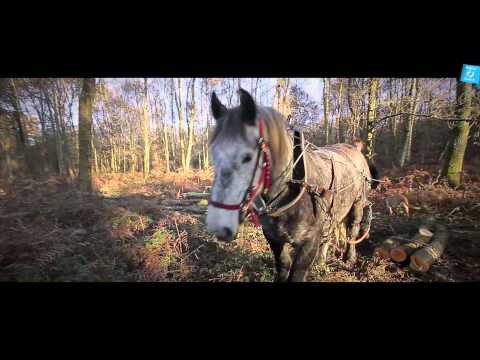
Used in ecological logging demonstrations, showcasing the power and versatility of the Percheron.

For centuries, Percherons were perceived as animals only good for agricultural work. The mechanization of agriculture marked their decline, then that of horse butchering, their extinction. The return of the draft horse, more ecological and more economical, allows us to place the future in a sustainable development approach.
![[DISCOVERY] The Percheron](https://img.youtube.com/vi/pCtzkSbUioU/hqdefault.jpg)
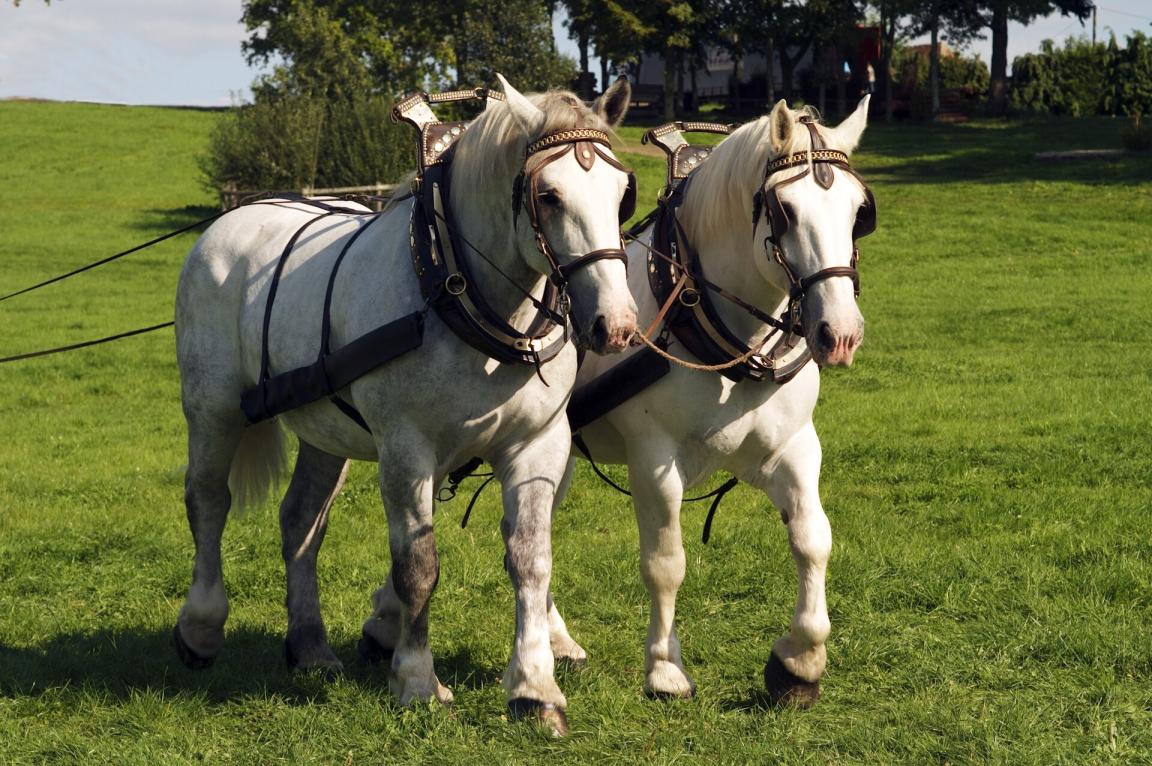
This is perhaps the most well-known draft horse to the general public. With its shades of gray and expressive face, the Percheron was one of the horse breeds highlighted at the last Paris Agricultural Show. Focus on this gentle, sturdy horse whose versatility is one of its main assets.