Discover the Minorquin, an elegant black horse from Menorca, known for dressage, equestrian shows and its major role in the island’s festivals.
By the Chevaux du Monde editorial team · Published on · Updated on
Type: Riding Horse
Weight: 450 – 600 kg
Height: 151 – 170 cm
The Minorquin originates from the island of Menorca, in the Balearic Islands, Spain. Its breed cradle is therefore highly localized: it is not a general Spanish horse, but a breed deeply connected to a specific Mediterranean island, its territory, its traditions and its local equestrian culture.
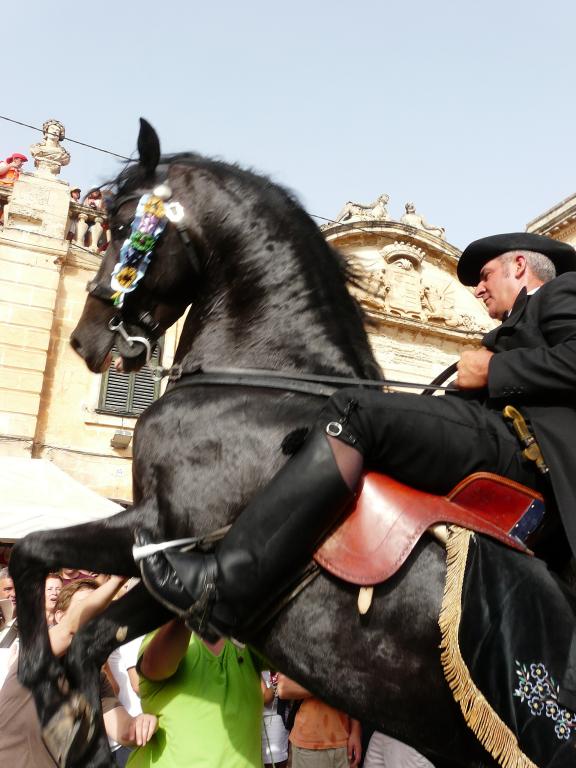
The development of the Minorquin is closely associated with doma menorquina, a traditional form of riding specific to Menorca. This practice values a horse that is supple, elegant, responsive and close to humans, capable of performing in popular festivals and equestrian demonstrations. The breed therefore holds an important place in Menorcan cultural identity, especially during festivals where black horses are strongly present.
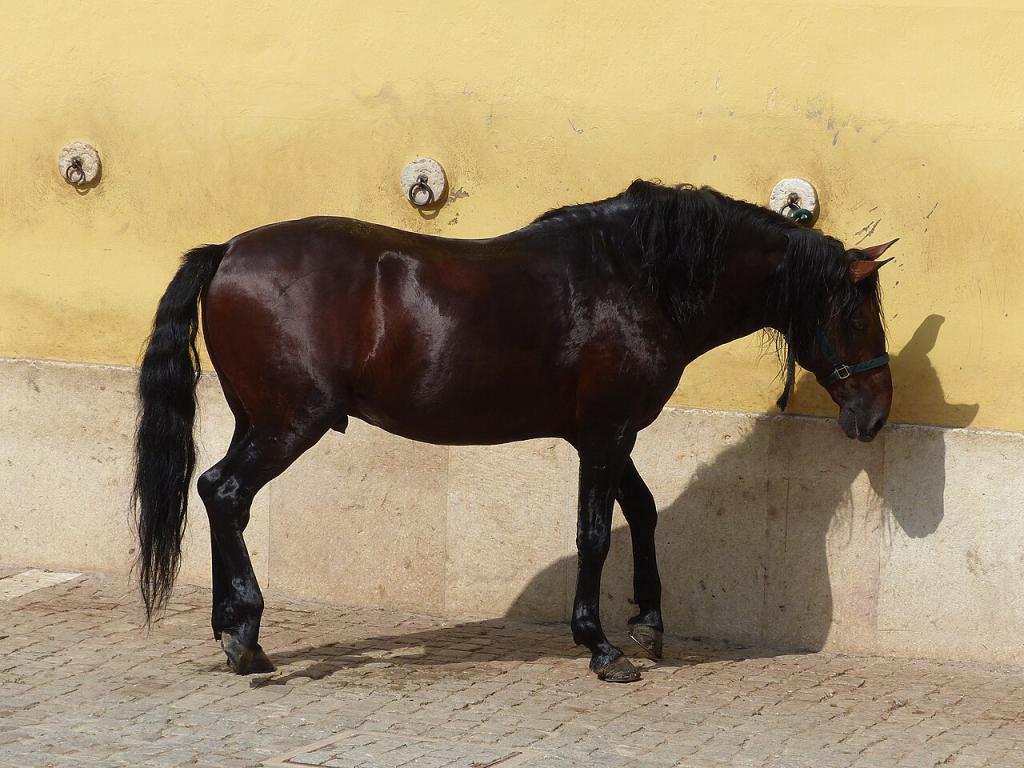
Today, the Minorquin is recognized as the Caballo de Pura Raza Menorquina, or Purebred Menorcan Horse. Its modern selection is based on an official stud book and a breed standard that defines precise criteria, including the uniform black coat, minimum height and desired morphological type. This recognition has helped protect an equine population long associated with a limited island territory.
The Minorquin is mainly bred on the island of Menorca, in the Balearic Islands, Spain. This island is its historical, geographical and cultural cradle. The breed remains strongly associated with local traditions, especially doma menorquina, popular festivals and equestrian demonstrations.
The breeding of the Caballo de Pura Raza Menorquina remains mostly concentrated in the Balearic Islands, with a particularly important presence in Menorca. This island-based distribution explains the importance of the official stud book, which makes it possible to track bloodlines, supervise breeding animals and preserve the breed type.
The Minorquin can be found elsewhere in Spain and more rarely abroad, but its spread remains limited compared with better-known Iberian breeds. It therefore retains a very local and heritage-based dimension, directly linked to Menorca’s equestrian identity.
This restricted breeding area makes the conservation of the breed particularly important. Maintaining the population, the uniform black coat, the morphological type and genetic variability depends largely on the work of Menorcan breeders and the organizations responsible for monitoring the breed.


The Minorquin has genetic importance mainly because it helps preserve an autochthonous island breed. Originating from Menorca, it represents a highly localized equine heritage, with a strong breed identity and a smaller population than major international breeds. Its preservation therefore contributes to maintaining Spanish equine genetic diversity.
The breeding programme for the Caballo de Pura Raza Menorquina aims to preserve the breed’s genetic variability while maintaining its breed type. Genealogical information, molecular analyses and performance data make it possible to monitor the population more effectively, evaluate breeding animals and reduce the risks linked to overly closed selection.
The management of breeding animals is important for preserving the qualities specific to the Minorquin: a uniform black coat, an elegant conformation, and a temperament suited to doma menorquina, dressage, equestrian shows and light driving. The breeding stallion catalogue helps breeders guide matings and preserve the desired characteristics.
The Minorquin is not primarily used to improve other breeds. Its genetic value lies mainly in safeguarding a rare heritage, linked to an island and a very specific equestrian culture. Conservation measures, including in vivo conservation and the preservation of genetic material, help protect this breed over the long term.
The Minorquin is a horse breed originating from the island of Menorca, in the Balearic Islands. Its history is linked to the ancient presence of horses on the island and to the influence of horses from the south of the Iberian Peninsula. It is generally associated with other island Iberian horses, particularly the Mallorquin, with which it shares a regional and Mediterranean origin.
For a long time, the Minorquin was used in the daily life of the island, both for rural work and for riding. Its value was not based only on work: it became deeply associated with the popular festivals of Menorca, where mounted black horses hold a central place. This cultural role helped maintain interest in the breed even when horses became less important in agricultural work.
The history of the Minorquin is inseparable from doma menorquina, a traditional form of riding from the island. This practice highlights an elegant, responsive, supple horse with a close bond to its rider. It has strongly shaped the modern image of the breed, which is now recognized for equestrian shows, demonstrations, dressage and local festivals.
The modern recognition of the breed was organized at the end of the 20th century. The stud book of the Purebred Menorcan Horse was created in 1987, with a founding population drawn notably from several important bloodlines. The breed was then officially recognized by the Spanish authorities in the late 1980s, which made it possible to regulate its selection, identification and conservation.
Current selection aims to preserve the type of the Caballo de Pura Raza Menorquina: a uniform black coat, elegant morphology, gaits suited to riding, and aptitudes for doma menorquina, dressage, shows and light driving. The Minorquin therefore remains a strongly heritage-based breed, while modern breeding also seeks to promote its sporting and functional qualities.
Today, the Minorquin is considered one of the equestrian symbols of Menorca. Its history combines an island origin, a strong presence in local traditions and recent official recognition. Its preservation is therefore not only about breeding: it also contributes to safeguarding Menorcan cultural heritage.
The Minorquin is generally described as a docile, noble horse close to its rider. Its selection is linked to a form of riding where the relationship with humans is very important, especially in doma menorquina and the traditional festivals of Menorca. It must therefore be present, attentive and sufficiently manageable in lively environments.
It is a horse known for being lively, energetic and responsive, without being sought as an uncontrollable animal. Its temperament must allow expressive exercises, dressage, equestrian shows and movements requiring impulsion. This responsiveness is an important quality, but it requires consistent training and a rider able to channel its energy.
The Minorquin is associated with the popular festivals of Menorca, where horses move among crowds, noise and excitement. This implies a desired temperament that is courageous, stable and confident, capable of remaining available despite a stimulating environment. This quality strongly contributes to its image as a horse of celebration and representation.
Beyond its physical appearance, the Minorquin is appreciated for its expressive and elegant behaviour. It often shows a proud attitude, with good presence under saddle. This nobility of behaviour matches the traditional uses of the breed, where overall appearance, responsiveness and presence are highly valued.
The Minorquin can be summarized as an energetic, docile, courageous and expressive horse, strongly oriented toward its relationship with humans. It is particularly suited to uses where an elegant, responsive and versatile saddle horse is sought, especially for doma menorquina, dressage, shows, light driving and supervised leisure riding.
The future prospects of the Minorquin depend first and foremost on the preservation of a local island breed with a limited population. Its future relies on maintaining active breeding in Menorca, managing the official stud book and monitoring breeding animals to avoid a loss of genetic variability.
The breed has an important asset: its very strong connection with the traditional festivals of Menorca, doma menorquina and equestrian shows. This cultural dimension can support its development, because the Minorquin is not only a saddle horse: it is also a living symbol of Menorcan identity.
The Minorquin may continue to develop in uses such as dressage, equestrian shows, light driving, trail riding and leisure riding. However, it should not be presented as a breed likely to become massively international or dominant in competition. Its future seems more closely linked to selective, heritage-based and quality-focused development.
A wider spread outside Menorca may help make the breed better known, but it must remain compatible with preserving the official breed type, especially the uniform black coat, elegant conformation and traditional aptitudes. The main challenge will therefore be to develop the breed without diluting its identity.
The Minorquin is generally considered a hardy and resistant horse, adapted to its Mediterranean island environment. To date, there is no widely recognized hereditary health problem clearly identified as typical of the breed in the accessible official sources.
As with many breeds with a restricted population, the main health concern is mostly the management of inbreeding and the maintenance of genetic variability. Monitoring the stud book, bloodlines and breeding animals is therefore important to limit the risks linked to an overly closed population.
The Minorquin requires the usual care expected for a saddle horse: monitoring of limb alignment, regular hoof care, dental checks, vaccination, reasoned deworming and a diet adapted to its level of activity. Its black coat may also require particular attention in hot climates, with access to shade, water and careful management of effort during periods of high heat.
No major genetic predisposition specific to the Minorquin is clearly established in the reliable sources consulted. The health of the breed relies mainly on responsible selection, monitoring of breeding animals and attentive management of horses in their environment.