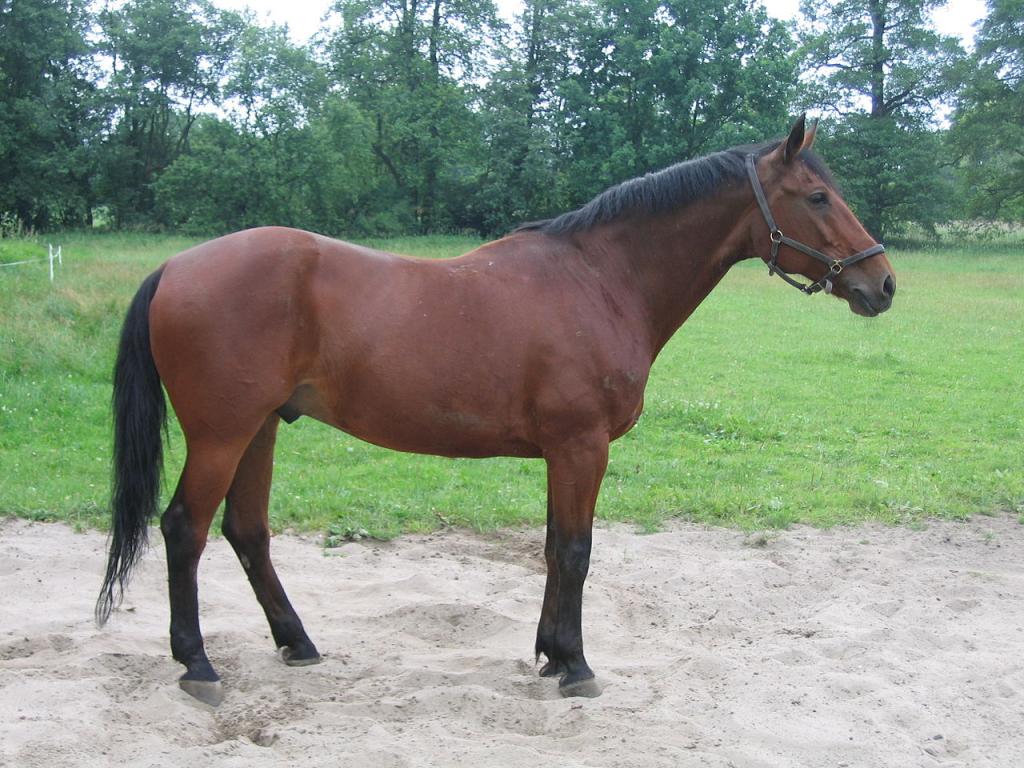
Württemberg – Elegant and sporty breed, ideal for dressage, jumping and driving.
By the Chevaux du Monde editorial team · Published on · Updated on
Type: Riding Horse
Continent: Europe
Country: Germany
Weight: 400 – 650 kg
Height: 160 – 170 cm
Name: Deutsches Sportpferd (DSP) Studbook — Baden-Württemberg
Founded: 1985
The Baden-Württemberger originated in Baden-Württemberg, in southwestern Germany. Its history is particularly associated with the former territory of Württemberg and the Marbach State Stud, an institution that has supported regional horse breeding for several centuries.
The name Baden-Württemberger primarily describes the historical and regional identity of this sport horse population. Under the current breeding organisation, these horses are registered as Deutsches Sportpferd, or DSP, by the Baden-Württemberg Horse Breeders’ Association. The Baden-Württemberger should not be confused with the Altwürttemberger, an older and heavier regional population maintained through a conservation programme.
Breeding remains strongly established in Baden-Württemberg through a network of breeders, stallion stations and institutions that includes the Marbach State Stud. The stud keeps sport horse stallions and mares while contributing to reproduction, training and performance testing.
Since 2014, the Baden-Württemberg breeding association has jointly managed the Deutsches Sportpferd studbook with four other German regional associations. This structure preserves local support for breeders while bringing their sport horses together under a common breeding identity.


The modern Baden-Württemberger is not a genetically closed or isolated population. Its transformation into a sport horse involved the carefully managed introduction of breeding animals from Trakehner, Thoroughbred and other German riding-horse populations.
This open breeding approach helped refine the former regional horse and develop its aptitude for dressage, show jumping and eventing. Within the current DSP programme, selection seeks to combine sporting ability with health, functional conformation and the preservation of diverse bloodlines. The Baden-Württemberger’s identity is therefore primarily historical, regional and institutional, rather than based on an entirely distinct genetic population.
Horse breeding in Württemberg is closely associated with the Marbach State Stud, whose history extends over more than five centuries. Regional horses were long selected for several purposes, including agricultural work, driving, transport and military service.
After the Second World War, agricultural mechanisation sharply reduced the demand for working horses. According to the official history of the Marbach State Stud, the transition towards a modern sport and leisure horse was completed by the end of the 1960s with the use of Trakehner and English Thoroughbred breeding animals, among others.
Southern German breeding associations began strengthening their cooperation in 1990. In 2014, five associations, including the Baden-Württemberg Horse Breeders’ Association, agreed to manage the Deutsches Sportpferd studbook jointly. Sport horses bred in Baden-Württemberg have since belonged to this shared breeding population, although the name Baden-Württemberger remains in use when referring to their regional origin.
Modern breeding seeks a sport horse that is cooperative, energetic and responsive, with the ability to work attentively in the Olympic equestrian disciplines. Rideability, balance and willingness to learn are important considerations when breeding animals are assessed.
Temperament cannot, however, be determined solely from the studbook. It also depends on the individual horse, its bloodlines, selection, training, living conditions and previous experiences. Horses from highly performance-oriented lines may be sensitive and require an experienced rider. Suitability should therefore be evaluated according to the horse’s actual temperament, level of training and intended use.
The future of this population lies within the Deutsches Sportpferd breeding programme. Selection must maintain a balance between athletic performance, rideability, quality of movement, jumping ability, soundness and health. Monitoring pedigree diversity and limiting inbreeding remain important in an open population where a small number of successful breeding animals can acquire considerable influence.
Preserving the equestrian history of Baden-Württemberg is also culturally important. It keeps the memory of the Baden-Württemberger alive while clearly distinguishing the modern sport horse from the Altwürttemberger, which is closer to the former regional multipurpose horse.
Available evidence does not identify a medical predisposition specific to the Baden-Württemberger that is sufficiently documented to be generalised across the population. Selection of breeding animals should take account of sound conformation, locomotor health, veterinary examination results and the requirements of the DSP breeding programme.
As with other sport horses, the limbs, back, hooves and overall physical condition should be monitored according to the intensity of work. Balanced nutrition, progressive training, suitable living conditions and regular veterinary care remain essential.
- Walk: A natural four-beat gait, wide, regular, and well-cadenced. The Wurttemberger engages the hindquarters effectively, resulting in a fluid walk that is highly rated in dressage.
- Trot: A two-beat, symmetrical gait, supple and with good suspension. It is distinguished by its natural bounce and expression, making it ideal for dressage and driving.
- Canter: A three-beat gait with a moment of suspension. The Wurttemberger shows a balanced, fluid, and energetic canter, capable of collecting and extending according to the demands of jumping or dressage.
Born in 2001
Talented Grand Prix dressage mare, ridden by Nadine Capellmann (Germany). She represented Germany in international competitions, earning multiple top placings in CDI 4★ and 5★ events, notably in Munich-Riem.
Girasol is renowned for her expressive gaits, suppleness, and powerful mind.
Born in 2014
German Dressage Champion in 2020 in the 6-year-old category at the Bundeschampionate, ridden by Jessica Lynn Thomas. Widely praised for his rhythmic trot and steadily improving temperament.
Born in 2006
Approved stallion, scored 7.96 in dressage and 7.63 in show jumping during his 30-day test in 2009. Competed at Petit Tour level (Prix St Georges) between 2011 and 2019.

The Wuerttemberg is one of Germany’s most historic breeds, since the Marbach Stud, where it was first developed, has been producing quality horses since the sixteenth century. The original, or old type of Wuerttemberg was a strong cob-like horse, capable of performing a wide range of tasks. They are now very rare, and people who buy a Wuerttemberg are helping to maintain an important part of Germany’s equine history. Few examples today exist of the old type, and so it has become increasingly difficult to find anyone who will sell a Wuerttemberg of this kind. Possibly interest will grow as more people discover the friendly nature and reliability of a more traditional style of horse.