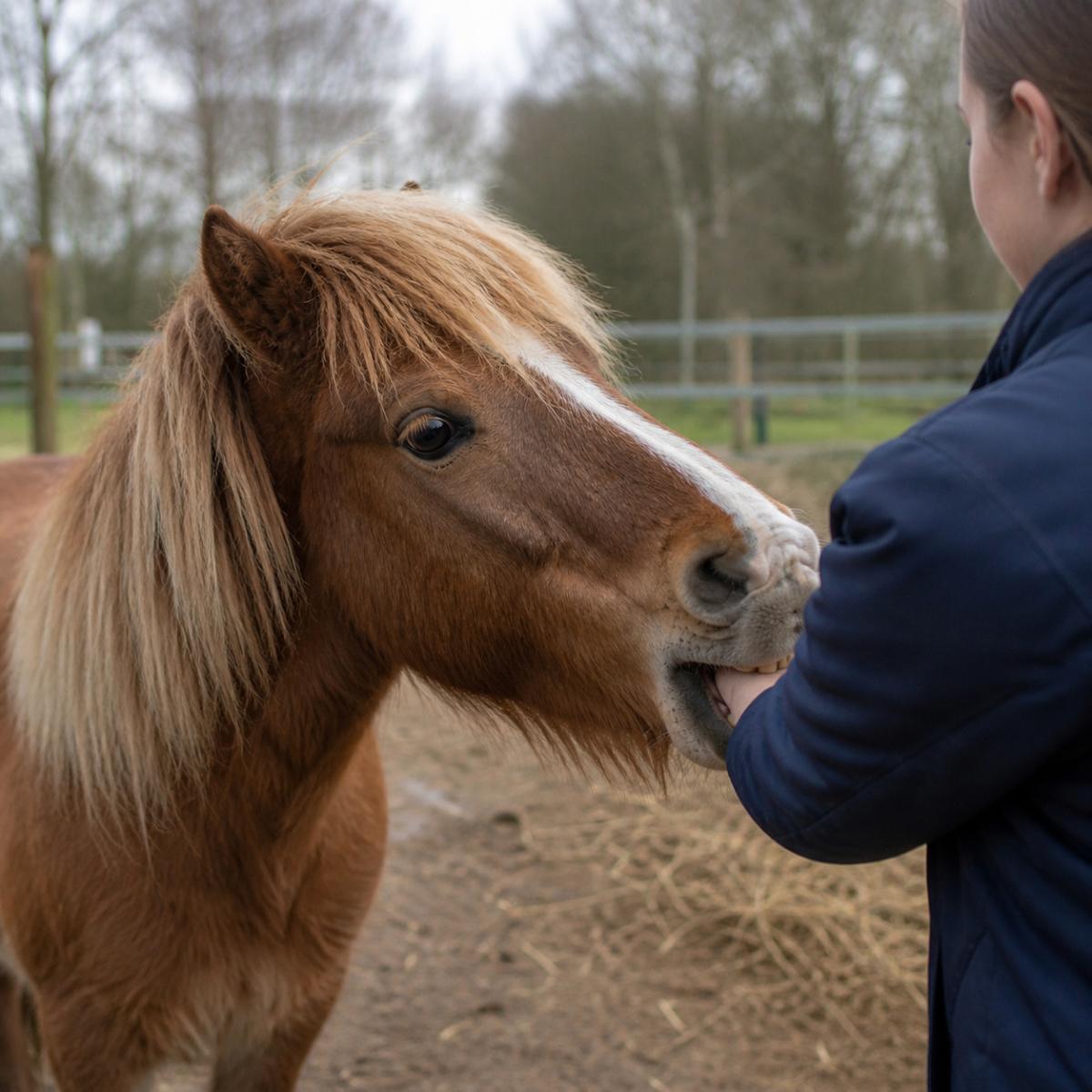
Biting in ponies can range from simply reaching toward a pocket with the lips to a genuine bite capable of causing a serious injury.
Yet explaining this behavior as “meanness,” a lack of respect or an attempt to dominate a person rarely helps us understand what is actually happening.
A bite is first and foremost a behavior.
It occurs in a particular context and may serve different functions: obtaining food, stopping an unpleasant interaction, increasing distance from someone, responding to fear or frustration, interacting with the environment, or repeating a behavior that has previously produced a useful outcome.
The first question should therefore not be:
“How should I punish my pony when it bites?”
but rather:
“When does my pony bite, and what does biting allow it to obtain or avoid?”
The answer to that question can help determine an appropriate response.
Not every use of the mouth is aggression
Horses naturally use their mouths in many situations.
They grasp food, investigate objects, manipulate parts of their environment and may use their teeth during social interactions.
Oral behavior can be particularly common in young equids.
It is therefore important to distinguish between different situations.
A young pony attempting to grab a lead rope or sleeve is not necessarily in the same emotional state as a pony that pins its ears, threatens and then bites while the girth is being tightened.
Both behaviors can nevertheless become dangerous.
The context and the pony's other body signals need to be considered before interpreting a bite.
Biting can be a learned behavior
A behavior that regularly produces a useful consequence is more likely to occur again.
This is one of the fundamental principles of learning.
Imagine a pony that reaches toward a person, searches their pockets and then nips at their jacket.
If this sequence sometimes results in a treat, interaction or simply causes the person to move away, parts of the behavior may be reinforced.
This does not mean that the pony has developed a deliberate strategy to “take control.”
It has simply learned that certain behaviors produce certain consequences.
This is why examining what happens immediately before and after a bite can be particularly useful.
Treats do not automatically cause biting
Saying that “feeding treats makes ponies bite” would be too simplistic.
Food can be used as positive reinforcement in training: a desired behavior is followed by a reward, increasing the probability that the behavior will occur again.
Research into horse-human interactions indicates that training methods and previous experiences with people can influence how horses subsequently respond to humans.
A review of horse-human interactions highlights the importance of handling and training experiences in shaping the relationship between horses and people. (Kelly et al. — The Effect of Human–Horse Interactions on Equine Behaviour, Physiology, and Welfare)
The problem is therefore not necessarily the treat itself, but how it is delivered and which behavior it reinforces.
Food can still encourage intrusive behavior
A pony can quickly learn which behaviors precede the arrival of food.
If a reward is given while the pony is pushing into a person, searching their clothes or repeatedly directing its mouth toward their hands, those behaviors may accidentally be maintained.
It is therefore useful to teach the pony what it should do to obtain the reward.
For example, food can be delivered when the pony:
- keeps its head in a defined position;
- waits calmly;
- performs a previously learned behavior;
- or responds correctly to a cue.
The aim is not to make food unpredictable. Instead, the criteria for earning the reward should be highly predictable.
The pony can then learn that using its mouth insistently is not the behavior that produces food.
A bite may be used to stop something
Some biting occurs in very specific situations:
- girthing;
- grooming;
- handling the feet;
- putting on a bridle;
- veterinary or routine care;
- touching a particular area;
- being made to move;
- entering a confined space.
In these situations, it is useful to consider what the bite accomplishes.
If the pony bites and the person immediately steps away, the behavior has allowed the pony to stop or remove something.
That can make biting more likely in a similar situation in the future.
But this does not mean the person should always prevent the pony from obtaining distance.
If the reaction is associated with pain or significant fear, forcing the procedure may make the problem worse.
The priority is to understand why the pony is trying to interrupt the interaction.
Sudden biting behavior should raise the possibility of discomfort
A pony that suddenly begins threatening or biting in a situation where it did not previously do so deserves particular attention.
Pain can alter equine behavior and may be associated with defensive or aggressive responses. Behavioral manifestations of pain vary considerably and need to be interpreted in context. (PubMed — Nociceptive pain and anxiety in equines: Physiological and behavioral alterations)
The possible source of discomfort depends partly on when the reaction occurs.
Biting during girthing does not necessarily have the same origin as biting during manipulation of the mouth or a limb.
Rather than simply checking a generic list of “back, teeth and saddle,” it is useful to look for a repeatable association between the behavior and a particular activity, manipulation or area of the body.
The mouth itself can be painful
When behavioral changes occur around bridling, handling of the head or work involving a bit, the mouth deserves particular attention.
Oral tissues are sensitive, and lesions or excessive pressure can cause pain.
A review of oral pain in horses discusses the potential effects of compression, tissue damage, inflammation and stretching of oral tissues. (Mellor — Mouth Pain in Horses: Physiological Foundations, Behavioural Indices, Welfare Implications, and a Suggested Solution)
This does not mean that every biting pony has a dental problem.
But an unusual change in behavior involving the mouth should not automatically be dismissed as disobedience.
Fear can also lead to biting
When an equid feels threatened, avoidance and escape are important parts of its behavioral repertoire.
But moving away is not always possible.
The pony may be:
- tied up;
- held on a lead rope;
- confined in a stable;
- restrained during treatment;
- trapped between a person and a wall.
In some situations, when the ability to move away is restricted, other defensive behaviors may appear.
A review of equine welfare in equestrian sport notes that avoidance is generally an important response to conflict, while restraint and certain handling situations can limit the horse's ability to escape. (Champing at the Bit for Improvements: A Review of Equine Welfare in Equestrian Sports in the United Kingdom)
A defensive bite should therefore not be interpreted in the same way as food-seeking behavior.
Experiences with humans can influence later behavior
Horses can learn from repeated interactions with people.
A study involving 59 adult horses found that their responses toward humans could be related to previous experiences and that some perceptions could generalize to unfamiliar people.
Aggressive behaviors were among the particularly consistent indicators of the horse-human relationship in that study. (PubMed — How horses see the world: humans as significant “objects”)
This does not mean that one negative experience permanently determines a pony's relationship with humans.
It does illustrate why repeated, predictable and appropriate interactions matter.
“Respect” can hide the real cause
In equestrian language, a pony that bites is sometimes described as “disrespectful” or as “testing” its handler.
These expressions describe how the interaction may feel to the person, but they do not identify the behavioral mechanism involved.
A pony may bite because it:
- anticipates food;
- wants an interaction to stop;
- is responding to pain;
- is afraid;
- is frustrated;
- has learned that biting works;
- or is affected by several of these factors at once.
Explaining everything in terms of respect risks producing the same response in every situation, even though the causes and appropriate solutions may be completely different.
Ponies do not bite because nobody has shown them “who is boss”
Explanations based on hierarchy between humans and horses have historically influenced some approaches to horse training.
Equitation science instead draws on ethology, equine cognition and learning theory to explain and modify behavior.
A review of equitation science highlights the value of these principles for improving training effectiveness, horse welfare and human safety. (McGreevy et al. — The Contribution of Equitation Science to Minimising Horse-Related Risks to Humans)
It is entirely possible to establish precise and safe behaviors without treating every interaction as a hierarchical confrontation.
Punishing a bite may hide its cause
When a pony attempts to bite, an instinctive human response may be to hit it immediately.
This can create several problems.
It may strengthen the association between the person's presence or movements and an unpleasant experience.
It may also increase fear or reactivity without addressing the original reason for the bite.
Approaches based on force, threat or punishment during routine care can make future responses more difficult and potentially more dangerous. (Moving toward Fear-Free Husbandry and Veterinary Care for Horses)
Most importantly, if the behavior is signaling pain, punishment obviously does nothing to resolve the pain.
Suppressing a warning is not necessarily the same as solving the problem that caused it.
Doing nothing is not always the answer either
Avoiding punishment does not mean allowing a pony to bite.
Biting is a genuine safety concern.
The aim is to create a situation in which the dangerous behavior becomes less likely to occur, while teaching the pony an alternative response.
Depending on the situation, this may involve changing:
- the distance between the pony and handler;
- the way rewards are delivered;
- how a procedure is performed;
- the handler's position;
- session duration;
- the cues being used;
- or the environment.
At the same time, it is necessary to determine what is maintaining the behavior.
Look at what happens immediately before the bite
Keeping a simple record can be extremely useful when biting occurs repeatedly.
You can note:
Context: Where is the pony?
What happened immediately before: What was the person doing in the previous few seconds?
Behavior: Was it a threat, a head movement, a nip or a full bite?
What happened afterward: Did the person move away? Did food appear? Did the procedure stop?
Other signals: What were the ears, body tension, tail, attempts to move and head orientation doing?
After several incidents, a pattern may become much clearer.
A pony that bites only when the girth is tightened does not present the same problem as one that immediately searches for hands whenever someone enters the field carrying food.
Teach a behavior that is incompatible with biting
Once pain and other medical problems have been appropriately considered, learning principles can be used to establish a safer response.
Rather than simply trying to teach:
“Don't bite,”
it is often clearer to teach the pony what to do instead.
Depending on the situation, this might involve:
- keeping the head straight;
- keeping the muzzle away from pockets;
- standing quietly;
- positioning the head toward a defined target;
- stepping back or moving away in response to a learned cue.
The desired behavior can then be reinforced consistently.
The pony now has a clear alternative response that can produce the expected outcome.
Positive reinforcement can be used appropriately
Using food as a reward is not incompatible with addressing biting behavior.
It simply requires precise criteria.
Positive reinforcement means adding a desirable consequence after a behavior in order to increase the likelihood of that behavior occurring again.
When food is used, timing matters: the reward should follow the behavior that the handler actually wants to strengthen.
The issue is therefore not automatically the use of food.
What matters is the timing of the reward and the behavior it is reinforcing.
Consistency matters, but not in the sense of “winning”
Consistency is indeed important in training.
If a behavior sometimes produces a reward, sometimes results in punishment and sometimes receives no response, the situation can become difficult for the pony to predict.
People handling the pony should therefore use cues and criteria as consistently as possible.
But consistency does not mean greater severity.
It means making interactions predictable:
a cue has an identifiable meaning, the desired response produces a consistent consequence, and difficult procedures are divided into manageable steps the pony can learn.
Established biting behavior may require changes to the environment
When biting has become frequent, teaching a new response can be difficult if the pony continues practicing the old behavior several times every day.
Environmental management can therefore form part of retraining.
Depending on the problem, temporary changes might include:
- altering how food is distributed;
- preventing several people from giving treats according to different rules;
- reorganizing a particular handling procedure;
- using facilities that allow greater distance and safety;
- or temporarily avoiding a specific trigger while a possible medical cause is investigated.
Management is not necessarily the final solution.
Its purpose is to reduce opportunities for the pony to repeat a dangerous behavior while an alternative response is being taught.
Some biting behavior requires veterinary investigation first
Veterinary assessment is particularly relevant when biting:
- appears suddenly;
- rapidly becomes more frequent;
- is associated with a specific manipulation;
- occurs during girthing or ridden work;
- accompanies changes in locomotion or performance;
- appears alongside other unusual signs;
- or seems to be triggered by touching a particular area.
This does not mean assuming that every bite is caused by disease.
It means avoiding intensive behavioral retraining without investigating pain when pain is a credible possibility.
Serious biting may also require professional behavioral help
A pony that regularly threatens, chases people or bites hard enough to cause injury represents a genuine safety problem.
This is especially important when children handle the pony.
A professional with appropriate knowledge of equine behavior and learning can observe the interactions directly, identify triggers and develop a suitable training plan.
When pain is a possibility, behavioral work and veterinary investigation can complement one another.
The objective is not simply to make the pony “more obedient.”
It is to make interactions safer and more predictable for both the pony and the people around it.
Understand the function of biting before trying to eliminate it
Two ponies can perform exactly the same movement for completely different reasons.
One may direct its mouth toward people's hands because it has learned that food appears there.
Another may bite during girthing because the situation causes or predicts discomfort.
A third may bite when it feels trapped and cannot increase its distance from a person.
A fourth may have learned over time that biting is enough to stop an unwanted procedure.
The solution cannot therefore be identical for every pony.
Biting is an observable behavior, not a diagnosis.
To change it effectively, we need to identify what triggers it, what maintains it and the physical and emotional state in which it occurs.
Only then can appropriate solutions be applied: making interactions safer, investigating possible pain, modifying triggering situations, making cues more predictable and teaching and reinforcing an alternative behavior.
This approach may require more observation than a simple reprimand.
But it addresses the more useful question:
not “How do I stop my pony from trying to dominate me?”, but “Why does this behavior work for my pony, and what can I teach it to do instead?”
Sources and references
- Kelly et al. — The Effect of Human–Horse Interactions on Equine Behaviour, Physiology, and Welfare
- Fureix et al. — How horses see the world: humans as significant “objects”
- Nociceptive pain and anxiety in equines: Physiological and behavioral alterations
- Mellor — Mouth Pain in Horses: Physiological Foundations, Behavioural Indices, Welfare Implications, and a Suggested Solution
- McGreevy et al. — The Contribution of Equitation Science to Minimising Horse-Related Risks to Humans
- Moving toward Fear-Free Husbandry and Veterinary Care for Horses
- Champing at the Bit for Improvements: A Review of Equine Welfare in Equestrian Sports in the United Kingdom