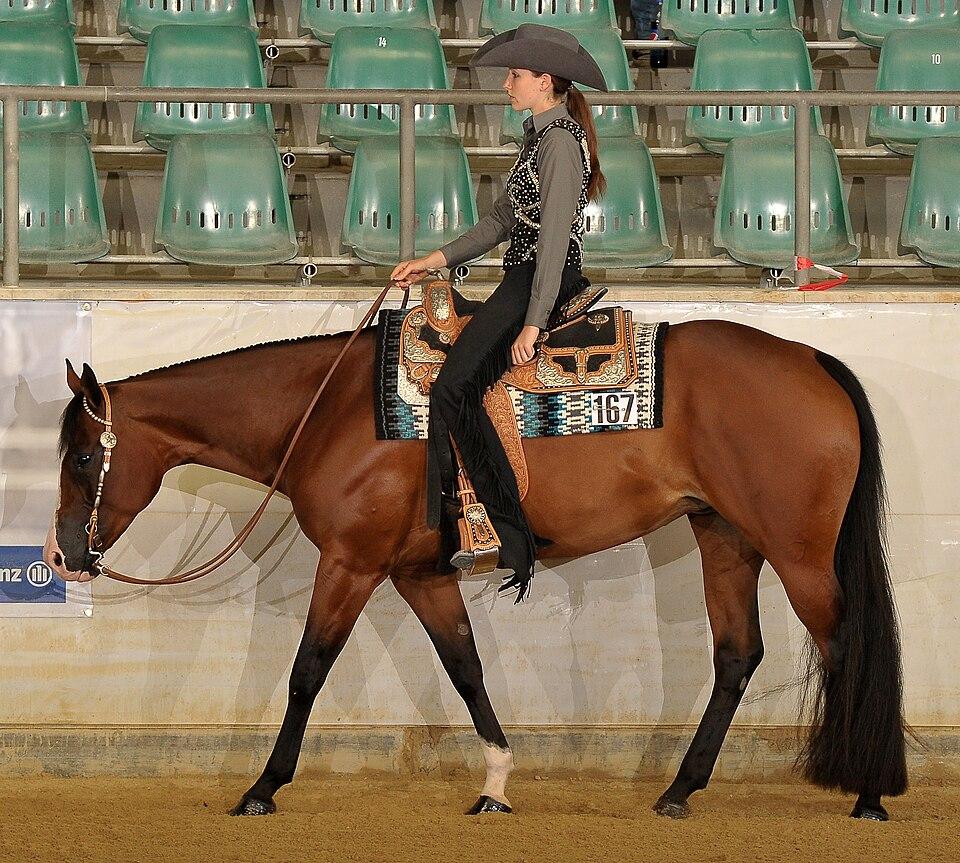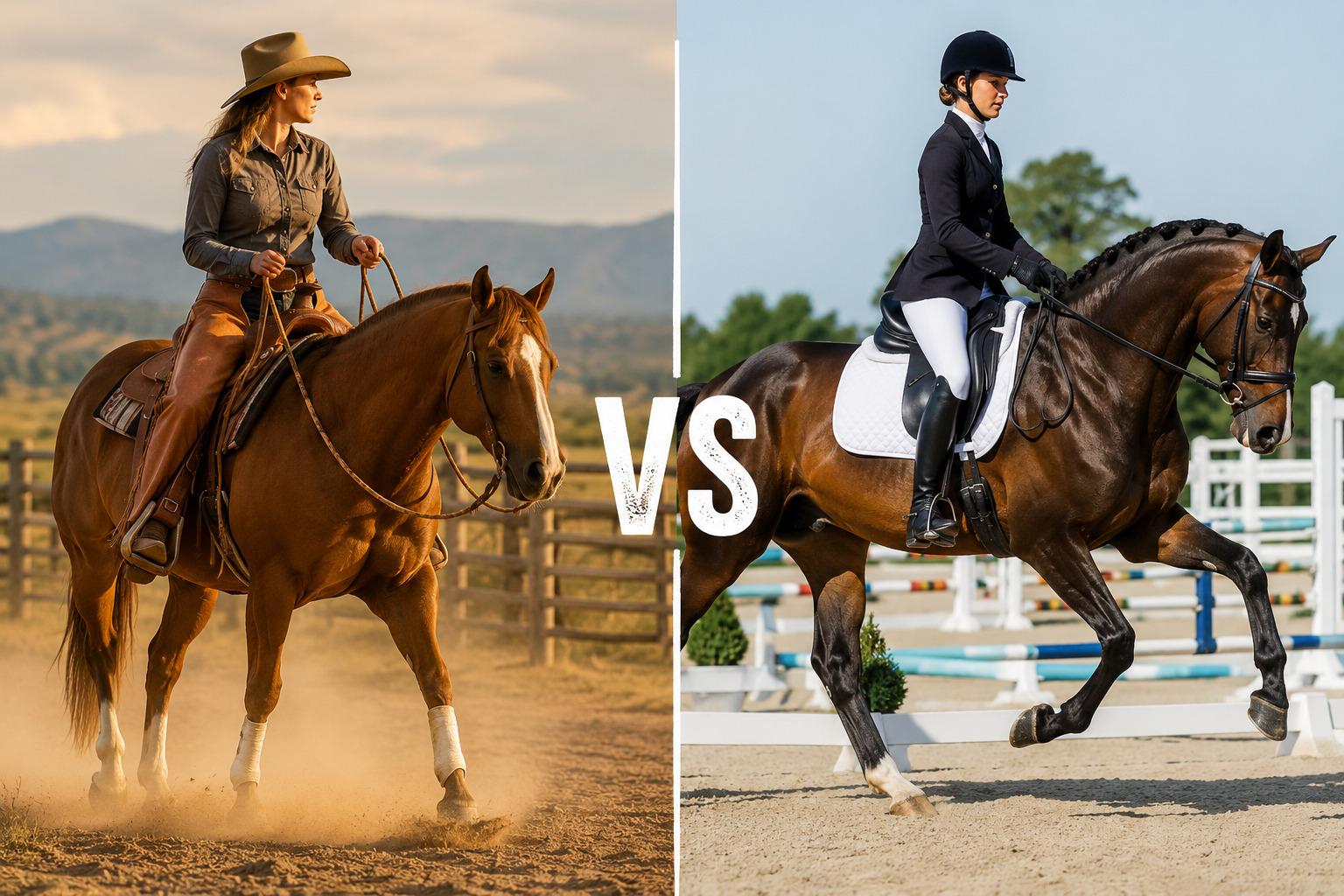
Western riding and English riding are often presented as two opposite worlds: on one side, the cowboy, the horned saddle and loose reins; on the other, the European rider, a lighter saddle and more consistent rein contact.
The reality is considerably more nuanced.
These two major equestrian traditions do have different histories, equipment, disciplines and technical conventions, but each also encompasses a wide variety of riding styles.
A reining horse is not ridden in exactly the same way as a western pleasure horse. A dressage rider does not use the same position or stirrup length as a show jumper.
Comparing western and English riding therefore means identifying broad differences without turning them into universal rules.
“Western” and “English” riding both encompass multiple disciplines
The first mistake is to imagine two perfectly uniform riding systems.
Western riding includes disciplines such as:
- reining;
- cutting;
- working cow horse;
- ranch riding;
- trail;
- western pleasure;
- barrel racing.
The term English riding is equally broad. In everyday use, it covers several practices derived from European equestrian traditions and modern equestrian sports, including:
- dressage;
- show jumping;
- eventing;
- hunter;
- various forms of recreational riding.
Differences in rider position, rein contact, equipment and the horse's way of going must therefore always be considered in relation to the discipline actually being practiced.
Different histories, but more complex than “Europe versus cowboys”
The European roots of English riding
The traditions now commonly grouped under the term English or classical riding developed in Europe over many centuries.
Military use of the horse played an important role, but it was far from the only influence.
Court riding, equestrian academies, hunting, transportation, military requirements and different regional traditions all contributed to the development of European horsemanship.
From the Renaissance onward, various schools and equestrian authors progressively developed sophisticated approaches to controlling movement, improving balance and training the horse.
These traditions continued to evolve considerably before the emergence of modern equestrian sport.
Modern dressage, show jumping and eventing are therefore not simply ancient practices preserved unchanged. They are also codified sports that have continued to develop over time.
Western riding also has European roots
Presenting western riding as something invented entirely on American ranches would be equally misleading.
Its history includes the equestrian traditions brought to the Americas by the Spanish and subsequently developed extensively in New Spain and Mexico.
Mexican vaqueros played a major role in developing cattle-working techniques, roping practices and equipment that later influenced riders in the southwestern United States.
American cowboy culture developed partly by inheriting and adapting these practices.
Modern western riding therefore has a North American history, but important parts of its lineage run through Hispanic and Mexican traditions that predate the American cowboy.
From everyday work to modern sport
Horses used for cattle work needed to travel considerable distances, control or follow livestock, negotiate different terrain and respond effectively to their riders.
This history helps explain some of the characteristics still found in several western disciplines.
However, it would be misleading to claim that every modern maneuver is a direct reproduction of historical ranch work.
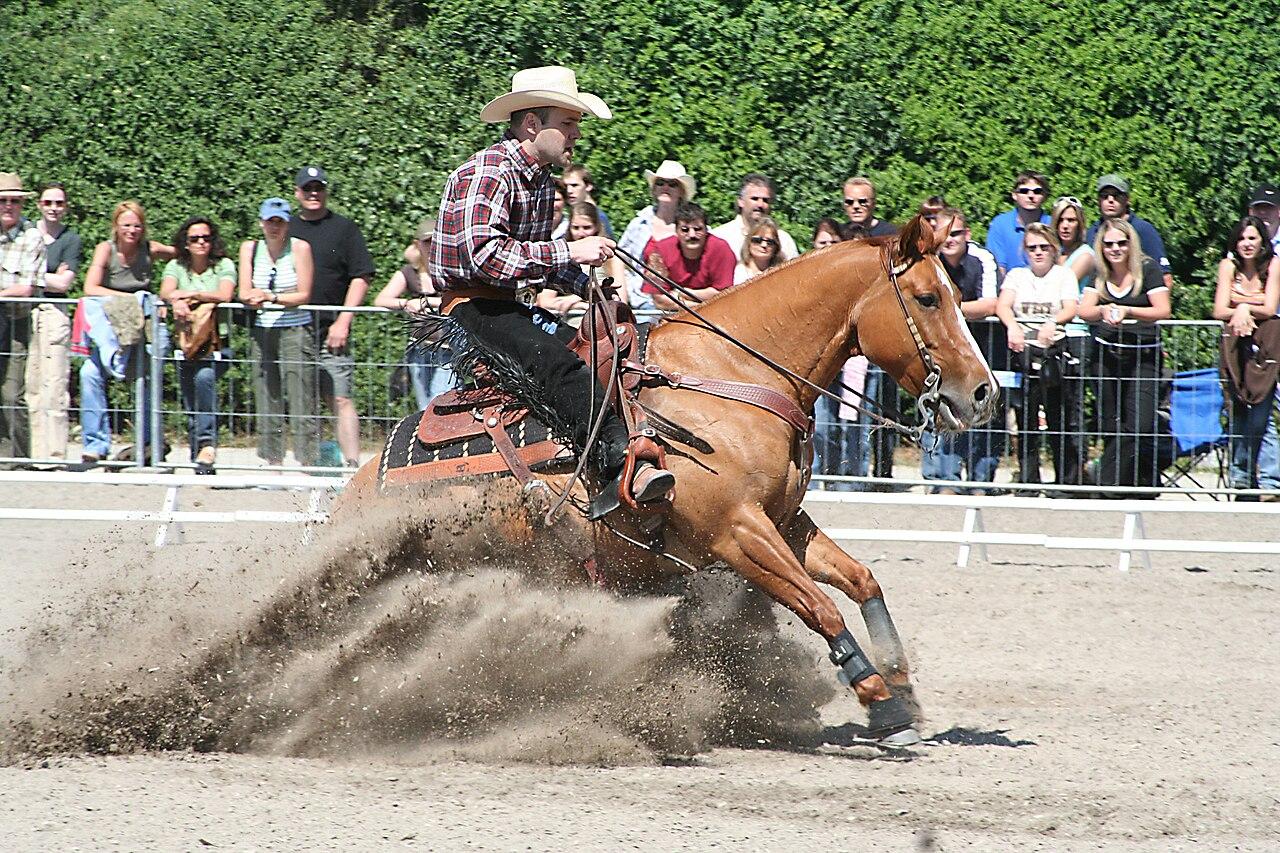
Reining, for example, has obvious connections with abilities valued in working horses, but its spins, sliding stops, circles and flying lead changes are now incorporated into a highly codified and specialized sport.
The same applies to cutting, ranch riding and western pleasure.
Contemporary western riding is therefore both the descendant of working horsemanship and a collection of modern equestrian sports.
The most visible difference: the saddles
Equipment is usually the first point of comparison because the two saddle types are immediately recognizable.
The western saddle
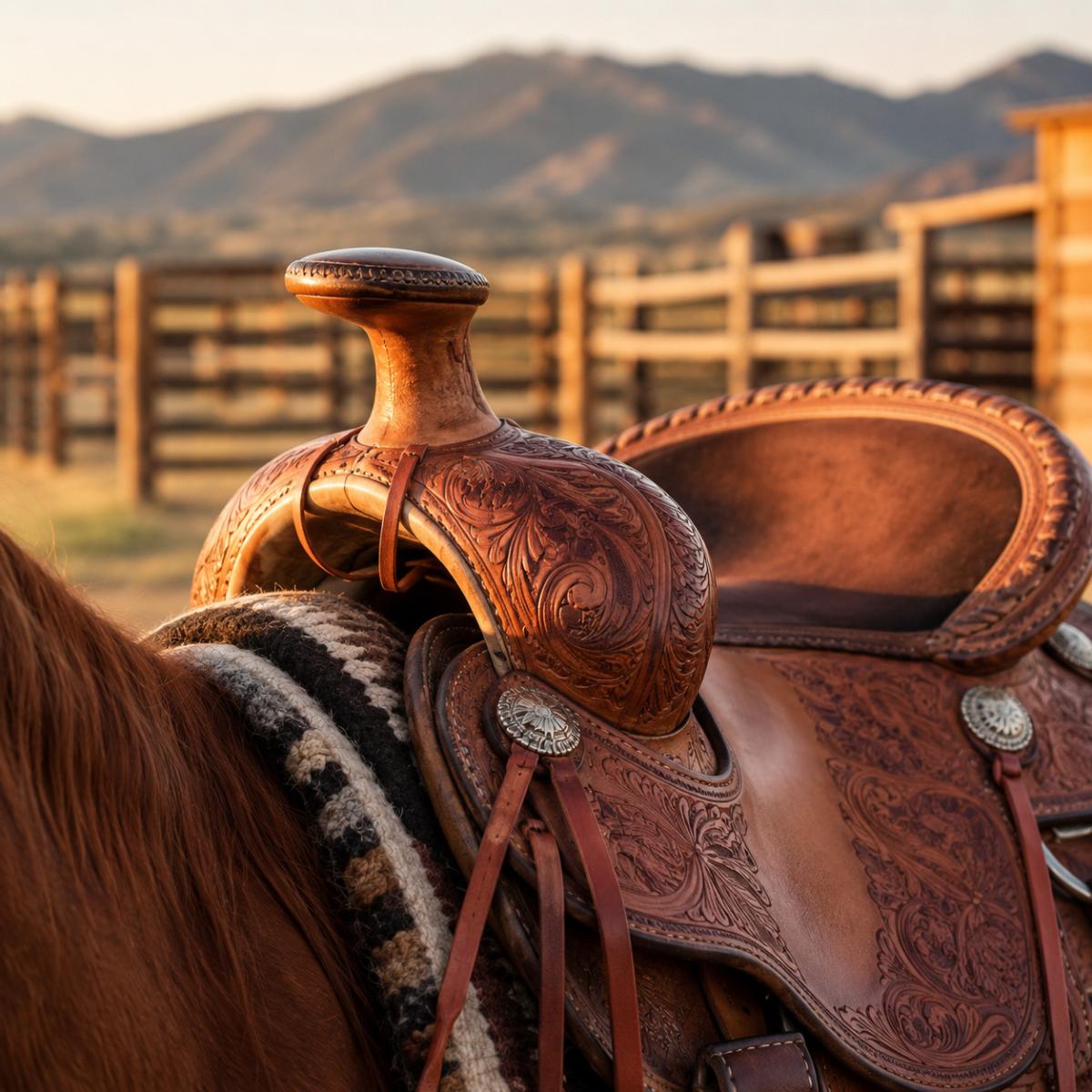
A western saddle typically has a substantial tree, broad skirts, wide stirrups and, on many models, a horn.
The horn was not developed as a handle for the rider.
Its history is closely connected with roping. On saddles designed for this purpose, the horn allows the rider to manage the rope while working cattle.
But not all western saddles are identical.
Roping, reining, cutting and barrel racing saddles can have different geometries, seats, horns and rigging systems.
The saddle therefore already reflects the specialization found within western disciplines.
The English saddle
English saddles do not represent a single design either.
A dressage saddle generally has relatively straight flaps and accommodates a longer leg position.
A jumping saddle has more forward-cut flaps to accommodate shorter stirrups and the rider's changing position over fences.
A general-purpose saddle seeks a compromise between different activities.
Here too, saddle design reflects the work expected of horse and rider.
Does a western saddle distribute weight better?
This claim is frequently repeated, but it requires considerable caution.
A saddle with a tree can distribute forces over a substantial surface area, but pressure on the horse's back depends on many factors:
- saddle fit;
- tree geometry and width;
- shape of the horse's back;
- rider weight and position;
- gait;
- movement of the horse;
- saddle pad;
- saddle construction.
Experimental research using pressure sensors has shown, for example, that an inappropriate saddle-tree width changes pressure distribution and can create areas of increased pressure. (PubMed — The influence of the width of the saddle tree on the forces and the pressure distribution under the saddle)
The important question is therefore not whether western saddles distribute weight better than English saddles in general, but whether a particular saddle fits the horse and rider and is appropriate for the activity.
Is a western saddle necessarily more comfortable?
For the rider, some western saddles provide a strong feeling of stability because of their seat, pommel, cantle and overall construction.
Some riders particularly appreciate them for long rides.
That does not make them objectively more comfortable for everyone.
Rider morphology, seat size, the position imposed by the saddle and the discipline all influence comfort.
For the horse, a comfortable saddle is first and foremost a correctly fitted saddle.
Pressure studies involving different saddles also demonstrate that the horse-saddle-rider relationship is dynamic: forces and their distribution change with gait and rider position. (PubMed — Evaluation of pressure distribution under an English saddle at walk, trot and canter)
Saddle weight alone is therefore not enough to determine comfort.
Is the western riding position really more “relaxed”?
This is another common generalization.
Some forms of western riding do indeed use a relatively deep position, with a long leg and a visually relaxed appearance.
But rider position varies considerably between disciplines.
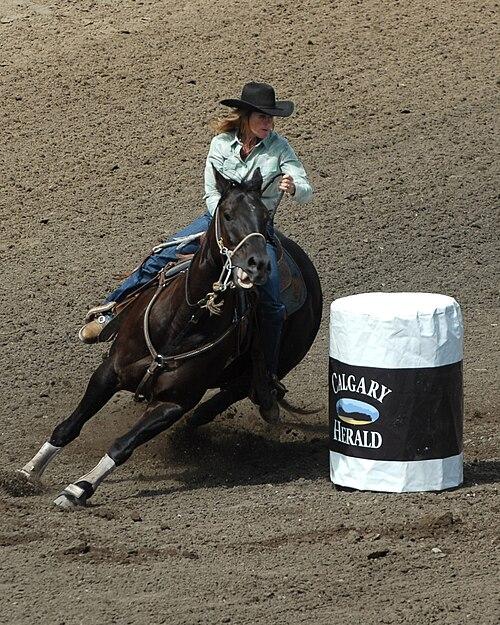
A western pleasure rider, a reiner during a sliding stop, and a barrel racer turning at speed around a barrel obviously do not use their bodies in the same way.
A barrel racer may adopt a highly dynamic position during acceleration.
A reining rider changes position according to the maneuver.
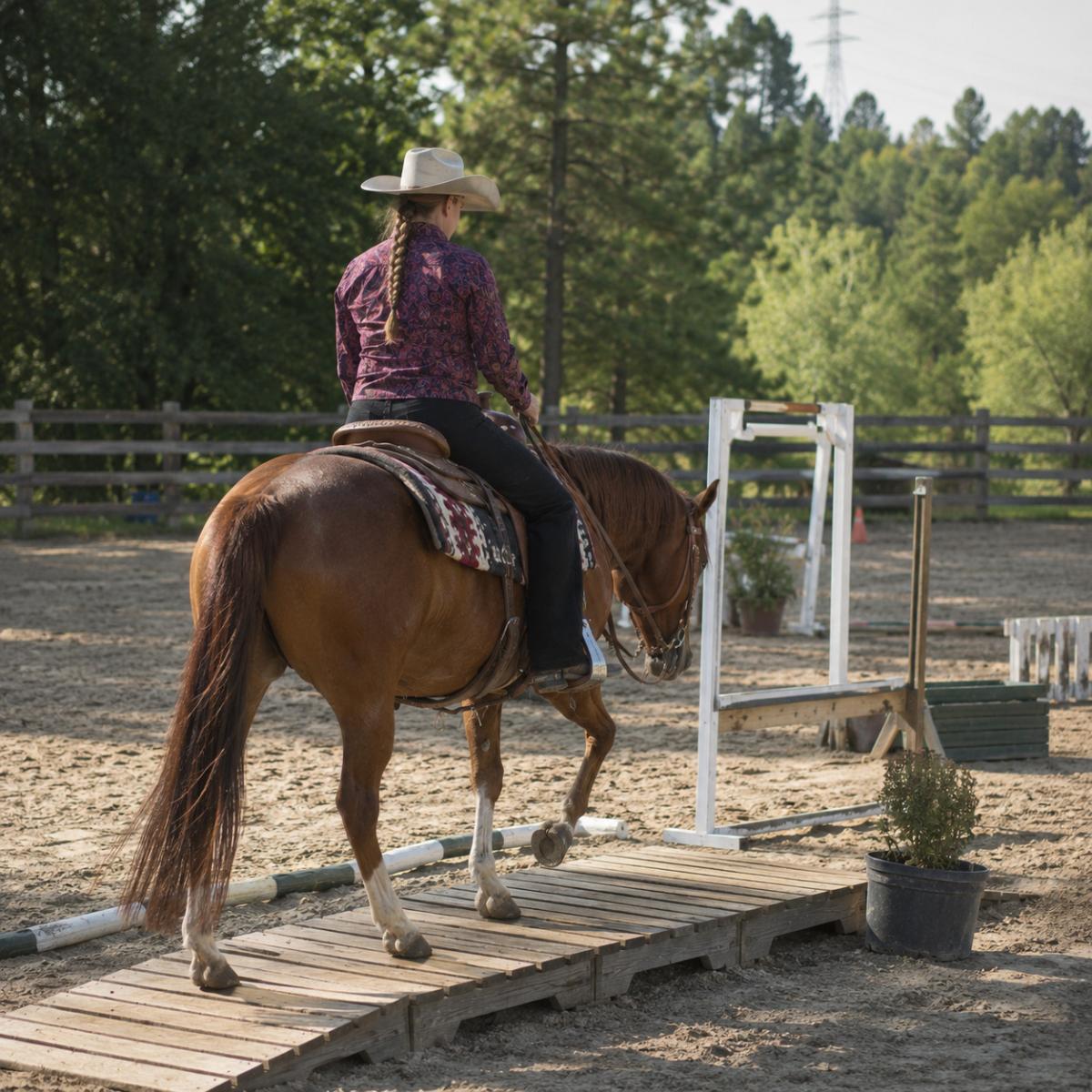
A trail rider adjusts balance while negotiating obstacles.
There is therefore no single western riding position.
What about English riding?
The same principle applies.
In dressage, the rider generally seeks a relatively upright position with a longer leg.
In show jumping, the stirrups are shortened and the rider can lighten the seat or move into a forward position over fences.
In eventing, position changes again between dressage, show jumping and cross-country.
Describing the English rider simply as having “a more active posture and more active legs” therefore fails to represent the diversity of these disciplines.
In both traditions, rider position is a response to the task being performed.
Loose reins versus constant contact?
This is probably the best-known distinction between western and English riding.
There is some truth behind it, but the comparison is too simplistic.
In western riding
In several western disciplines, and particularly with a sufficiently advanced horse, the reins may carry considerably more slack.
The horse is then expected to respond to a system of aids that does not depend on continuous rein tension.
But that does not mean all western riding is performed without contact.
The type of contact depends on the horse's training level, the exercise, the equipment and the discipline.
A young horse in training is not necessarily ridden in the same way as a finished horse competing at a high level.
In English riding
English riding cannot accurately be reduced to “constantly pulling on two tight reins” either.
In dressage, contact forms part of a much broader system of aids involving the seat, legs and hands.
The desired quality is not simply the presence of tension in the reins.
The Fédération Équestre Internationale dressage rules describe training and performance through concepts including balance, impulsion, straightness, submission and quality of movement rather than simply continuous control through the hands.
What is neck reining?
Neck reining is one of the techniques commonly associated with western riding.
In a horse trained for it, the rein comes into contact with the neck as part of a system of aids indicating a change of direction.
This should not be understood as the horse turning simply because a rein touches its neck.
Neck reining is a learned response, incorporated into the horse's overall training and combined with the rider's other aids.
It allows some western horses to be ridden with the reins held in one hand.
Rules concerning reins, bits and how the horse may be ridden vary according to discipline, class and the horse's age or level of training.
The American Quarter Horse Association (AQHA), for example, specifies permitted equipment and riding methods for different classes.
Is the western horse more independent?
This idea comes partly from cattle work.
In certain situations, an experienced horse can learn to follow or anticipate the movements of cattle.
Cutting provides perhaps the clearest example: once a cow has been selected and separated from the herd according to the rules of the event, the horse plays a highly active role in preventing it from returning.
But this ability is not a universal feature of western riding.
A reining pattern, for example, must be performed in a prescribed sequence under the rider's direction.
A trail course also contains specified obstacles and maneuvers.
Western riding therefore does not mean “letting the horse decide,” just as English riding does not mean directing every movement exclusively through the hands.
The amount of initiative given to the horse depends on the task.
Are the aids more subtle in western riding?
Subtle aids are valued in several western disciplines.
But subtlety is not exclusive to western riding.
High-level dressage also seeks communication that creates an impression of considerable ease.
In both traditions, an almost invisible aid can be the result of extremely sophisticated training.
The greater differences lie in the codes being used, competition rules, the desired way of going and the situations in which those aids are applied.
Very different disciplines
Major western disciplines
Western riding includes:
- reining: patterns involving circles, flying lead changes, spins, stops and rollbacks;
- cutting: separating a cow and preventing it from returning to the herd;
- working cow horse: combining precision work with cattle work;
- ranch riding: presenting a functional horse through a variety of maneuvers;
- trail: precise negotiation of obstacles;
- western pleasure: evaluation of the horse's gaits and overall performance according to the criteria of the class;
- barrel racing: a timed event around three barrels.
These disciplines differ enough to produce their own horse types, training methods and specializations.
Major English disciplines
English equestrian sport includes:
- dressage: performance of prescribed movements and figures;
- show jumping: negotiating a course of fences, with faults and time considered according to the class;
- eventing: combining dressage, cross-country and show jumping;
- hunter: a discipline whose judging criteria vary between circuits and which has a particularly strong tradition in North America.
Again, a high-level dressage horse and a show jumper are not selected, trained or evaluated in exactly the same way.
Endurance is not an “English riding discipline”
Endurance riding is sometimes placed under the English riding umbrella for convenience because its equipment may look closer to English tack than to the traditional image of western riding.
This classification is misleading.
Endurance is a distinct equestrian discipline, with its own objectives, specialized equipment and competition system.
It is therefore better not to describe it as an “English endurance” discipline.
Western or English: which is easier for beginners?
There is no universal answer.
A rider's first experience depends greatly on:
- the horse;
- the instructor;
- the exercises;
- the saddle;
- the discipline;
- and the pace of learning.
A beginner riding an experienced and calm western school horse may find the first lesson very accessible.
The same can be true of a suitably chosen school horse in English riding.
Conversely, an unsuitable horse can make learning difficult in either tradition.
The quality of instruction and the suitability of the school horse probably matter more during the first lessons than whether the riding is labelled western or English.
Are western horses calmer?
Not necessarily.
Western riding is often associated with Quarter Horses, Paint Horses, and Appaloosas, but none of these breeds guarantees a particular temperament in every individual.
More importantly, western disciplines select for different abilities.
A barrel racing horse must be capable of considerable acceleration.
A cutting horse needs to react extremely rapidly to the movements of cattle.
A reining horse must perform a sequence of technically demanding maneuvers.
The stereotype of the “western horse that is always calm and slow” therefore does not reflect the actual diversity of western horses.
Is western riding less physically demanding for the rider?
Not necessarily.
A quiet trail ride in a western saddle may obviously be less intense than riding a cross-country course.
But comparing the two in this way would tell us very little about western versus English riding.
A fast barrel racing run, a reining session, a day of ranch work, a dressage lesson, a jumping course and a cross-country round place very different demands on the rider.
Physical effort depends much more on the activity, its intensity, its duration and the rider's level than on whether the riding is labelled western or English.
Can the same horse be ridden both western and English?
Yes, particularly when the horse is not specialized at a very high level.
As explained in our article on whether any horse can practice western riding, breed alone does not determine which riding system a horse can learn.
A horse can understand multiple systems of aids when they are taught consistently.
It can therefore be ridden in different equipment and participate in different activities.
However, changing from one system to another still requires genuine training.
Switching from English to western is not as simple as replacing an English saddle with a western one.
Can a horse become confused by the two systems?
A horse may experience difficulties if the signals are contradictory or poorly taught.
But horses are capable of learning different cues and associating them with different contexts.
The problem is therefore not necessarily that the horse is ridden in two styles.
What matters is that the aids remain understandable and consistent for the horse.
At recreational level, versatility can be entirely compatible with appropriate training.
At high level, specialization becomes much more important because the physical and technical demands diverge.
Specialization changes the comparison
A recreational horse might go for a trail ride in a western saddle one day and work in an English saddle another day, provided both saddles fit correctly and the horse understands the aids being used.
Comparing a Grand Prix dressage horse with a high-level reining horse is a very different matter.
Years of selection and training produce horses specialized for:
- particular postures and ways of going;
- particular gaits;
- specific movements;
- particular speeds;
- specific mechanical demands.
As the level increases, it becomes less meaningful to treat western and English riding as two styles that can simply be interchanged.
A saddle must first fit the horse
Whatever tradition is chosen, saddle fit remains essential.
An experimental study involving nineteen horses found that incorrect saddle-tree width altered pressure distribution beneath the saddle, producing greater pressure concentrations in certain areas. (PubMed — The influence of the width of the saddle tree on the forces and the pressure distribution under the saddle)
Other research has also shown that rider position can influence the horse's biomechanics and the pressures measured beneath the saddle. (PubMed — Effect of the rider position during rising trot on the horse's biomechanics)
A saddle should therefore not be selected solely because it belongs to the riding tradition the rider wants to practice.
It must also be appropriate for both horse and rider.
Two traditions rather than two opposing philosophies
It can be tempting to summarize the comparison as:
western = independence and relaxation
English = contact and precision
But this opposition does not hold up well when the different disciplines are examined closely.
Western riding can require extreme precision.
English riding can seek extremely subtle aids.
Both traditions rely on learning, control of movement, rider balance and systems of signals that allow horse and rider to communicate.
What differs most are their histories, codes, equipment, desired ways of going and the tasks for which the horses are trained.
Western or English: which should you choose?
For a beginner, the choice may first depend on what they want to discover.
Western riding offers very different experiences, from trail and reining to cattle work and barrel racing.
English riding provides access to dressage, jumping, eventing and recreational riding based on these traditions.
The choice does not have to be permanent.
Learning about different equestrian systems can instead reveal how the same concept — balance, direction, transition or response to an aid — can be developed through different codes and objectives.
Two histories with many things in common
Western and English riding do have significant differences.
Their saddles are constructed differently. Their competition rules differ. Their disciplines seek different types of performance, and their histories have led to the development of particular techniques.
But the boundary is not as simple as the stereotypes suggest.
Western riding is not always relaxed riding on loose reins with an independent horse. English riding is not always a more rigid system in which the rider constantly holds the horse between the hands.
They are two broad equestrian traditions that each contain considerable diversity.
The difference becomes much clearer once we stop asking which is “better” or “easier” and instead examine what each discipline actually asks of horse and rider.
That is ultimately where their main similarity lies: in both cases, equipment and techniques only make sense when they allow horse and rider to perform a particular task using understood signals, appropriate balance and suitable equipment.
Sources and references
- American Quarter Horse Association — AQHA Handbook of Rules and Regulations
- Fédération Équestre Internationale — Dressage Rules
- Smithsonian Institution — Man Made Mobile: Early Saddles of Western North America
- PubMed — Evaluation of pressure distribution under an English saddle at walk, trot and canter
- PubMed — The influence of the width of the saddle tree on forces and pressure distribution under the saddle
- PubMed — Effect of the rider position during rising trot on the horse's biomechanics