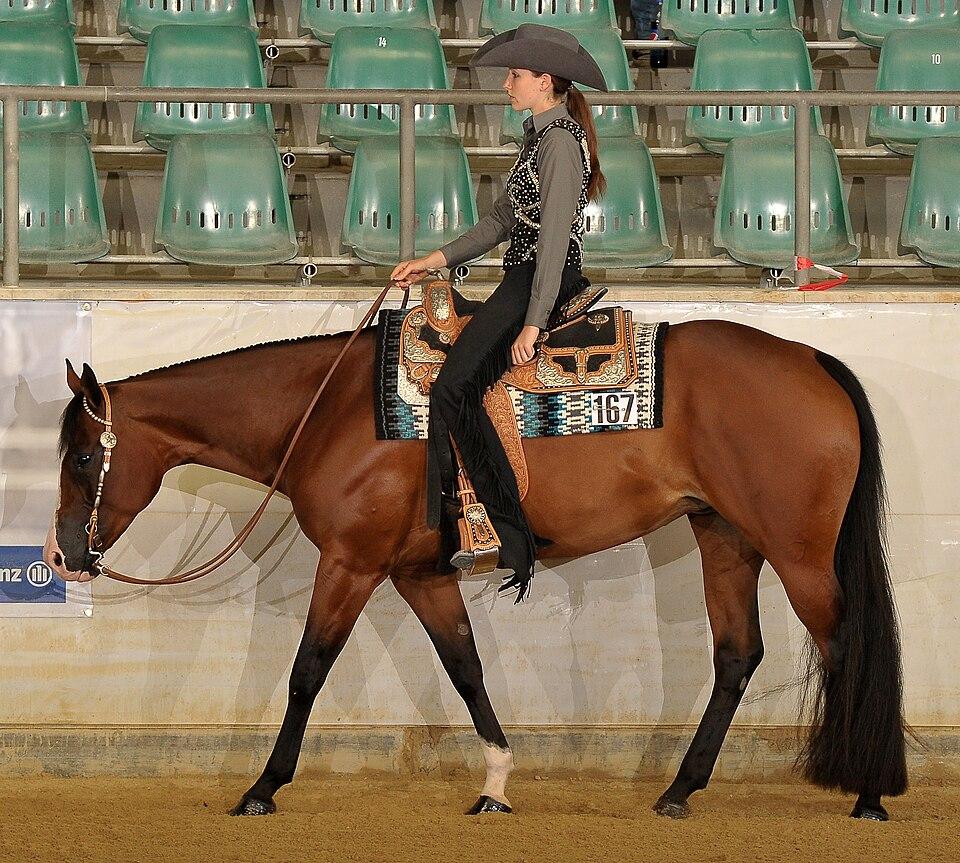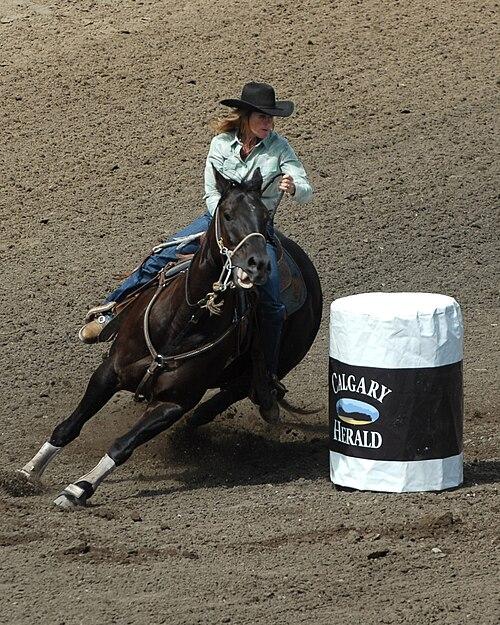
Western riding is closely associated with a few American breeds, particularly the Quarter Horse, the Paint Horse, and the Appaloosa.
This association is so strong that it can give the impression that riders necessarily need one of these breeds to ride western.
That is not the case.
Many horses and ponies can learn western riding, particularly for recreational riding, basic training, trail riding, or some disciplines practiced at a non-specialized level.
However, this does not mean that all horses are interchangeable.
The more a rider moves toward a specialized discipline and high-level competition, the more conformation, locomotor characteristics, training, experience, and sometimes genetic selection become important.
The real question, therefore, is not so much “Is my horse a western horse?” but rather: Is this horse suited to what I want to do?
There is no single type of “western horse”
There is no universal model of a “western horse.”
The term can refer to a horse trained according to western riding principles, but it can also refer to breeds historically associated with North American equestrian traditions.
More importantly, western riding encompasses very different disciplines.
A horse intended for reining does not perform the same work as a cutting, barrel racing, western pleasure, or trail horse.
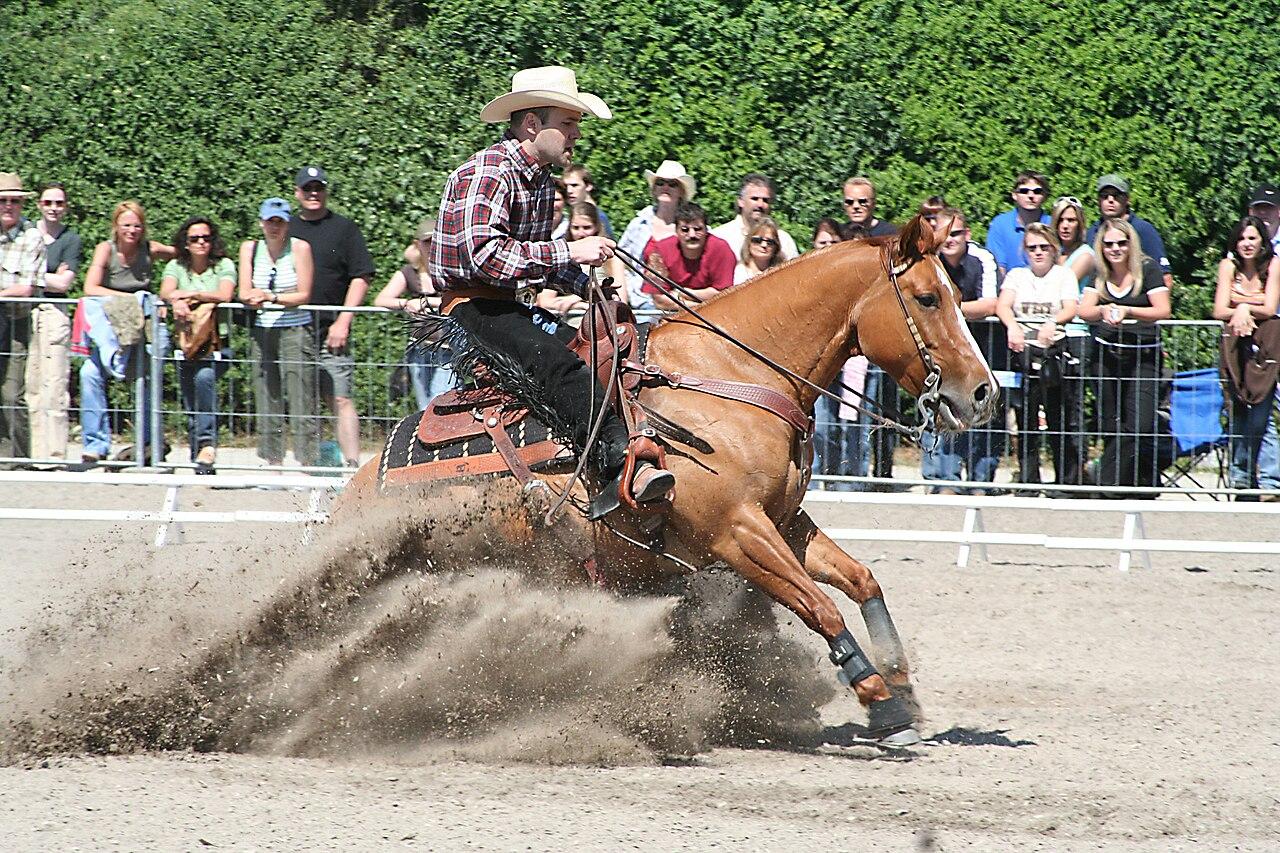
Reining involves acceleration, deceleration, spins, flying lead changes, and sliding stops.
Cutting requires a very particular interaction with cattle.
Barrel racing emphasizes speed and rapid changes of direction around the barrels.
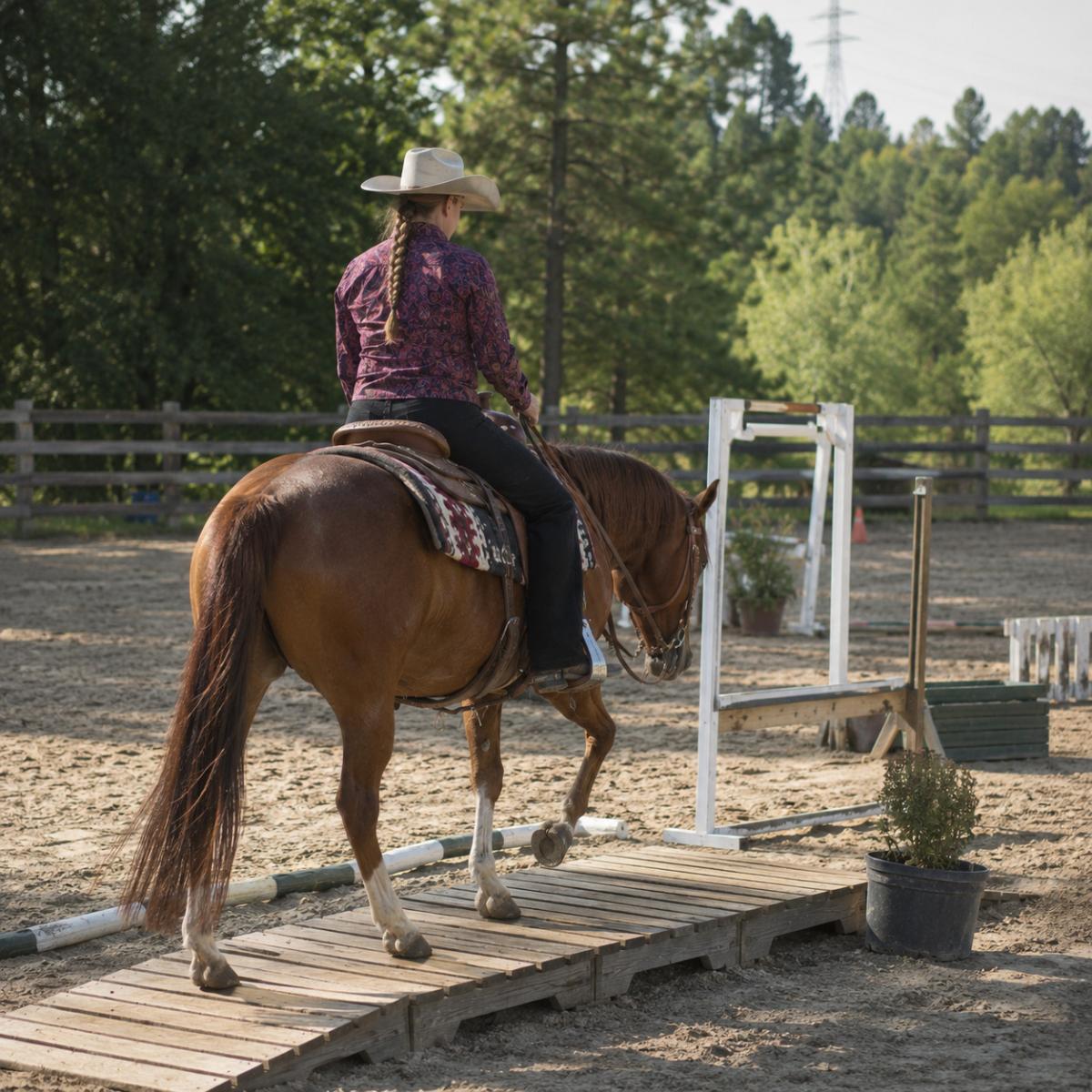
Trail focuses, among other things, on precision when negotiating different obstacles.
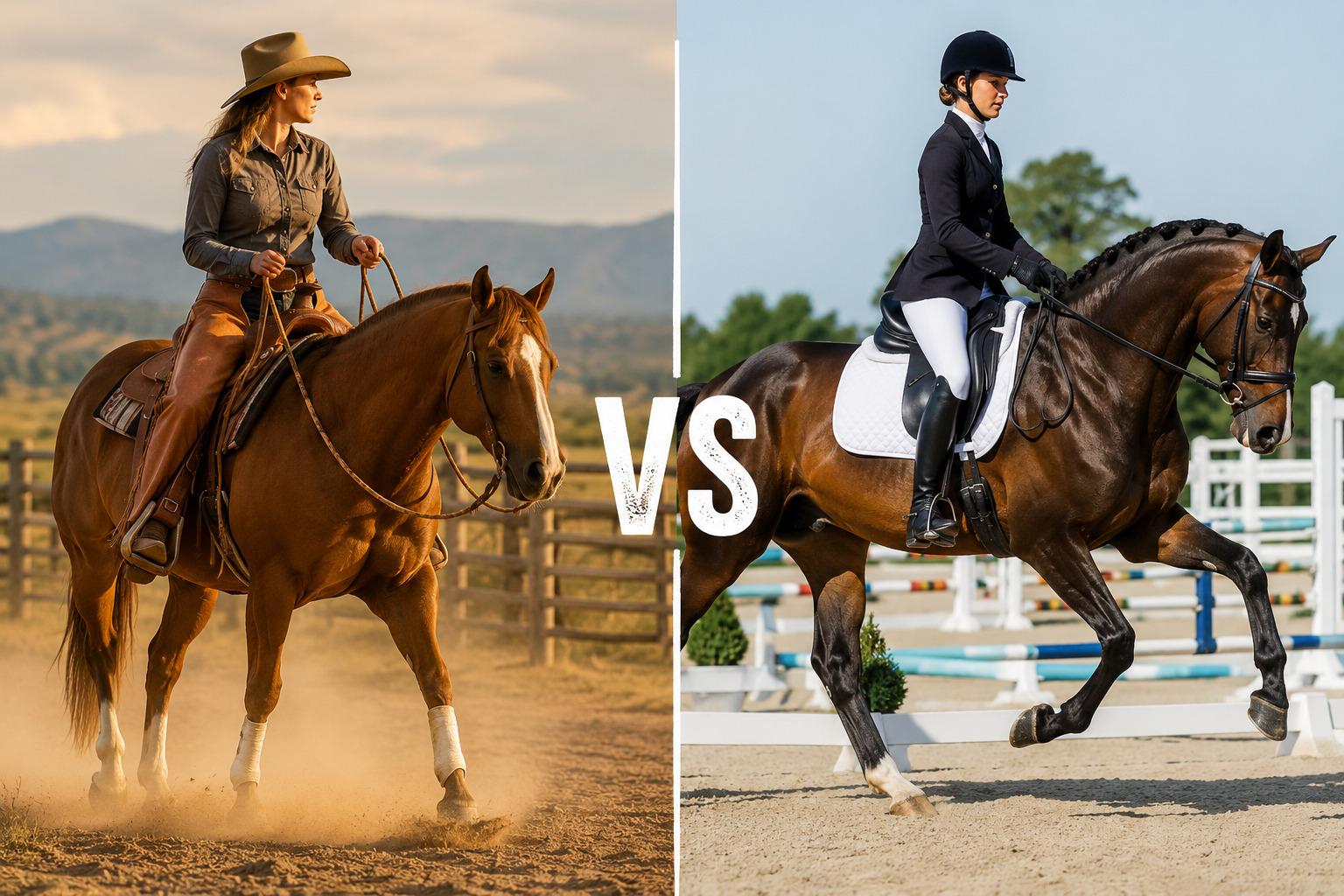
Talking about the qualities of “the western horse” without specifying the discipline is therefore somewhat like talking about “the English horse” without distinguishing between dressage, show jumping, and eventing.
For recreational riding, many horses can learn western
At an introductory or recreational level, breed is rarely the first criterion to consider.
A properly trained horse can progressively learn:
- the cues used by its rider;
- transitions;
- stops and backing;
- control of the shoulders and hindquarters;
- different lateral movements;
- maneuverability exercises;
- and simple trail obstacles.
A horse previously ridden in an English discipline does not need to “forget” everything it knows before starting western riding.
It mainly needs to understand new cues and new expectations.
Some skills are also shared across many equestrian traditions. Controlling direction and speed, performing transitions, moving different parts of the horse's body, and maintaining balance and responsiveness are obviously not exclusive to western riding.
Switching from English to western still requires training
Saying that a horse can change disciplines does not mean that simply changing its equipment is enough.
A horse accustomed to one set of signals will need to learn progressively how to respond to those used by its new rider.
Neck reining, for example, does not simply mean holding the reins in one hand.
The horse must have been taught to respond to the corresponding system of aids.
Likewise, riding with a looser rein does not mean eliminating all communication with the horse's mouth.
Western riding has its own conventions, which may also vary according to the discipline, the horse's level of training, and the equipment being used.
The transition should therefore be considered a new learning process, rather than simply a change of saddle.
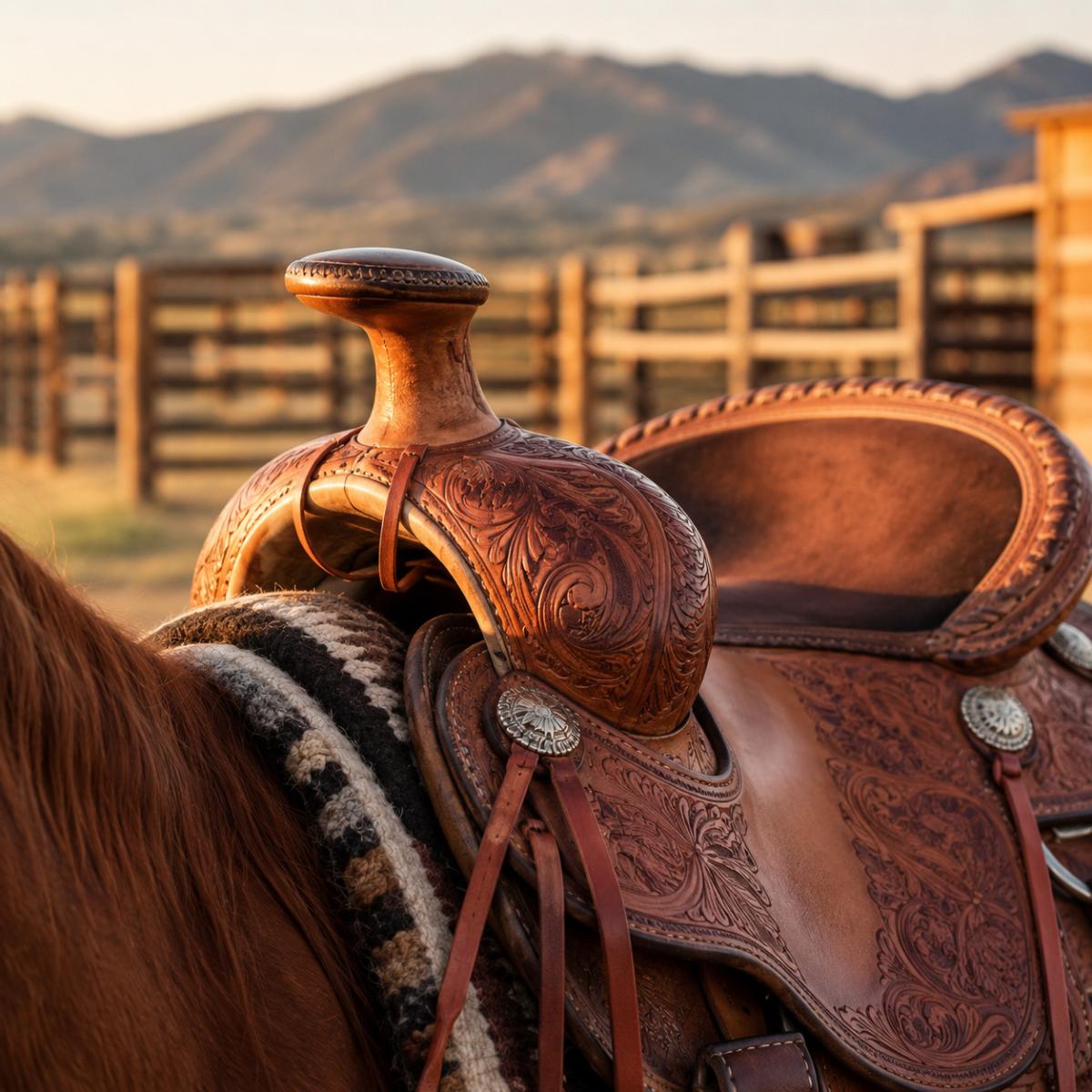
A western saddle does not turn a horse into a western horse
A western saddle, western pad, and matching equipment obviously do not change the horse's locomotion or training.
Above all, the saddle must fit both horse and rider appropriately.
Its shape does not guarantee that the horse knows how to perform the maneuvers required in western disciplines.
A horse wearing a western saddle for the first time is still exactly the same horse.
Conversely, skills learned through western training do not disappear simply because the equipment changes.
Equipment accompanies a riding practice; it does not create the training.
The Quarter Horse is not simply “naturally made for western riding”
The Quarter Horse occupies a major place in modern western riding.
But explaining this dominance solely through a supposedly calm temperament, powerful hindquarters, or mysterious cow sense would be far too simplistic.
The breed has undergone extensive selection for different types of performance.
A genetic study of Quarter Horses from six performance groups — halter, western pleasure, reining, working cow horse, cutting, and racing — identified genetic structure among several of these populations.
The researchers showed that breeding practices have progressively concentrated part of the breed's genetic diversity into subpopulations associated with different sporting uses. (PubMed — The American Quarter Horse: population structure and relationship to the Thoroughbred)
In other words, simply saying “Quarter Horse” is already insufficient to describe precisely the type of horse being sought.
A reining Quarter Horse and a racing Quarter Horse are not selected in the same way
This specialization can even be observed in conformation.
A study comparing Quarter Horses competing in Western Pleasure, Hunter Under Saddle, and reining found significant differences between the groups.
The Hunter Under Saddle horses studied were taller and had greater longitudinal measurements, while the reining horses showed the lowest values for several length measurements.
The researchers interpreted these findings as further evidence of specialized subpopulations within the breed. (PubMed — Comparison of American Quarter Horses Competing in Western Pleasure, Hunter under Saddle, and Reining Using Linear Traits)
Genomic research involving elite Quarter Horses has also identified different signatures of selection among performance groups, including cutting, reining, racing, western pleasure, and working cow horse. (PubMed — Genome-Wide Signatures of Selection Reveal Genes Associated With Performance in American Quarter Horse Subpopulations)
It is therefore more accurate to talk about selection for a particular discipline than to consider an entire breed uniformly suited to every form of western riding.
Genetics matter, but they do not determine everything
Selection does not mean that a pedigree can perfectly predict performance.
A study published in 2026 using 21,165 reining results from 1,603 Quarter Horses found relatively low to moderate heritability estimates depending on the method and age considered.
Permanent environmental and rider effects also accounted for an important part of the observed variation. (PubMed — Phenotypic Definition Influences Genetic Inference and Predictive Ability for Reining Performance in Quarter Horses)
This is an important distinction.
Genetic selection contributes to the abilities of a population, but the individual horse, its training, rider, environment, and management continue to play major roles.
Buying a Quarter Horse from a reining bloodline therefore does not guarantee a future reining champion.
What about Paint Horses and Appaloosas?
The Paint Horse also has a major presence in American western riding.
Its historical relationship with American stock horse populations helps explain some of the similarities that can be found between certain Paint Horses and Quarter Horses.
The Appaloosa likewise has its own competitive circuits and a long-standing presence in North American western riding.
However, this history should not be turned into a catalogue of supposedly guaranteed temperaments.
Not every Paint Horse is particularly calm or maneuverable, just as not every Appaloosa is automatically hardy, enduring, or suited to every western discipline.
A breed describes a population, not the guaranteed behavior of an individual horse.
Can you ride western with an Arabian horse?
Yes.
An Arabian can learn the aids, maneuverability exercises, and many of the skills used in western riding.
There is no fundamental incompatibility between being an Arabian horse and learning western riding.
The question changes when the goal becomes specialized competition.
A horse's conformation, locomotion, and individual characteristics may be more or less suited to the biomechanical requirements of a particular discipline.
A horse can therefore be perfectly enjoyable for recreational western riding without having the characteristics sought in a high-level reining or cutting horse.
What about Iberian horses?
A Spanish or Lusitano horse can also be trained for western riding.
Again, generalizations such as “Iberian horses are naturally maneuverable and balanced” should be treated with caution.
Conformation and ability vary between individuals and bloodlines.
An appropriately trained Iberian horse can learn many western exercises, but its suitability for a specialized discipline should be assessed at the individual level and according to the intended goal.
Can European sport horses switch to western riding?
A horse previously used for dressage, show jumping, or eventing can also discover western riding.
Its previous experience may even have provided useful skills, such as understanding aids, transitions, lateral movements, and control of different parts of the body.
It will nevertheless need to adapt to new cues and to the way these skills are requested.
For recreational riding, maneuverability work, or an introduction to trail, being a European sport horse is not in itself an obstacle.
At higher levels in a highly specialized discipline, the horse's individual physical suitability becomes increasingly important.
What about retired trotters?
The same reasoning applies to a retired harness racer.
There is no rule stating that a former trotting racehorse cannot learn western riding.
Retraining should, however, take into account the horse's individual history, physical condition, locomotion, and previous education.
Some aspects of the new training may require more time.
The reasonable objective is not to force the horse to resemble a specialized Quarter Horse, but to determine which activities are compatible with its abilities and comfort.
Can ponies practice western riding?
Yes.
Size alone does not determine whether an equine can learn the principles of western riding.
A pony can work on transitions, lateral movements, backing, maneuverability, and different obstacles.
Limitations may come more from the rules of a particular competition than from western riding itself.
As always, the pony's size and build must also be appropriate for the rider and equipment being used.
For recreational riding, there is therefore no requirement for a western mount to have the traditional silhouette of an American stock horse.
Does a “western temperament” really exist?
The expression is convenient, but it can be misleading.
A calm, attentive horse that remains responsive is obviously pleasant to work with.
But there is no single temperament that suits every western discipline.
A successful barrel racing horse does not face the same demands as a western pleasure horse.
A cutting horse must interact with cattle in a way that is not required from a trail horse.
Even within the same breed, the selection of different bloodlines can therefore favor different characteristics.
Rather than looking for a hypothetical “western temperament,” it is more useful to assess the horse's actual behavior in the context of the intended discipline.
Is an emotional horse necessarily unsuitable for western riding?
No.
Describing a horse as “too anxious” or “too emotional” for western riding without further analysis would be excessive.
A reaction may be related to temperament, but it can also depend on experience, learning, the environment, understanding of the exercise, or sometimes discomfort.
The emotional demands also differ considerably between western disciplines.
The important question is therefore whether the horse can learn and perform the required work under appropriate conditions, rather than whether it matches a behavioral stereotype.
“Cow sense” also requires some caution
The term cow sense is deeply embedded in American working-horse culture.
It is generally used to describe a horse's ability to read and anticipate the movements of cattle, particularly in disciplines such as cutting.
However, it should not be interpreted as a magical ability automatically possessed by every Quarter Horse.
Selection plays an important role.
A pedigree study involving 1,590 elite Quarter Horses competing in cutting demonstrated the considerable influence of particular bloodlines on this specialized population. Only a limited number of ancestors accounted for an important proportion of its genetic diversity. (PubMed — Analysis of the Pedigree and Ancestors of the Cutting Population of the Quarter Horse Breed)
Experience with cattle and appropriate training remain essential as well.
Not every discipline requires the same degree of specialization
This is probably the most important point when choosing a horse.
For discovering western riding or practicing recreationally, a very wide range of horses can be suitable.
As the objective becomes more specialized, the criteria become more demanding.
A rider interested in recreational trail does not necessarily need the same type of horse as a competitor aiming for high-level reining.
In cutting, aptitude for cattle work becomes particularly important.
In barrel racing, acceleration, trajectory, and rapid changes of direction at speed impose different demands.
In reining, sliding stops, spins, and flying lead changes require yet another combination of abilities.
The specialization of Quarter Horse bloodlines observed in scientific studies reflects precisely the diversity of requirements hidden behind the broad term “western riding.”
Can every horse do reining?
Learning some exercises used in reining and becoming a high-level reining horse are two very different goals.
Many horses can learn circles, transitions, changes of direction, and backing exercises that form part of the training.
The demands increase considerably when the goal involves fast spins, sliding stops, and competitive performance.
At that level, conformation, locomotor ability, health, training, and selection become particularly important.
This is precisely why specialized bloodlines play such a major role in the discipline.
What about cutting?
Cutting is probably one of the clearest examples of the limits of the idea that “any horse can do anything.”
A horse can learn to work around cattle without necessarily becoming a successful cutting horse.
At high level, the horse must respond extremely rapidly to changes in direction from the cow it has separated from the herd while working according to the specific rules of the discipline.
Training is extremely important, but decades of selective breeding within specialized bloodlines demonstrate that individual and heritable abilities have also been deliberately sought by breeders.
Recreational western riding offers much more freedom
For riders who are not aiming at specialized competition, the choice of horse is much broader.
A healthy horse that is suitable for its rider and appropriately trained can provide access to many aspects of western riding.
In this context, specifically seeking an American breed is not essential.
The choice can instead focus on:
- the horse's physical condition;
- level of training;
- actual behavior;
- experience;
- compatibility with the rider;
- and the intended activity.
These criteria often provide much more useful information than the breed written on the horse's papers.
The horse must also be physically suited to the discipline
The question of breed should not overshadow the question of health.
A horse may have an excellent temperament and understand the exercises perfectly while having a physical limitation that makes a particular activity unsuitable.
Conversely, conformation that does not resemble the traditional Quarter Horse type does not automatically mean that the horse cannot participate in western riding.
Assessment should focus on the actual horse, its locomotor function, any relevant medical history, and the specific demands of the intended activity.
This becomes particularly important in specialized athletic disciplines.
Breed does not guarantee health either
Choosing a breed historically selected for western disciplines does not remove health considerations.
Several mutations responsible for inherited diseases occur within Quarter Horse and Paint Horse populations, with frequencies that can vary between performance groups.
Research has documented differences between subpopulations for mutations associated with conditions including PSSM1, HERDA, HYPP, GBED, and MYH1. (PubMed — Evaluation of allele frequencies of inherited disease genes in subgroups of American Quarter Horses)
This further illustrates why breed alone should not determine the choice of a horse.
Bloodline, relevant genetic testing, individual health, and intended use can provide much more useful information.
So, can you really practice western riding with any horse?
Many more horses can enjoy and learn western riding than the traditional image of a cowboy on a Quarter Horse might suggest.
An Arabian, Iberian, European sport horse, a horse retrained from another discipline, or even a pony can learn many western principles and exercises when the work is appropriately adapted.
However, “being able to practice” does not mean “being equally suited to every discipline.”
As the objective becomes more demanding, individual characteristics and specialization become increasingly important.
The success of the Quarter Horse in modern western riding illustrates this distinction particularly well. It is not simply a breed universally “made for western riding,” but a population in which bloodlines have been increasingly selected for very different and highly specialized types of performance.
The best western horse is therefore not necessarily the one belonging to the most iconic breed.
It is first and foremost the horse whose abilities, health, training, and experience are appropriate for the discipline and the rider's goals.
Sources and references
- Petersen et al. — The American Quarter Horse: population structure and relationship to the Thoroughbred
- Comparison of American Quarter Horses Competing in Western Pleasure, Hunter under Saddle, and Reining Using Linear Traits
- Genome-Wide Signatures of Selection Reveal Genes Associated With Performance in American Quarter Horse Subpopulations
- Phenotypic Definition Influences Genetic Inference and Predictive Ability for Reining Performance in Quarter Horses Using Random Regression Models
- Analysis of the Pedigree and Ancestors of the Cutting Population of the Quarter Horse Breed
- Evaluation of allele frequencies of inherited disease genes in subgroups of American Quarter Horses
- American Quarter Horse Association — AQHA Handbook of Rules and Regulations