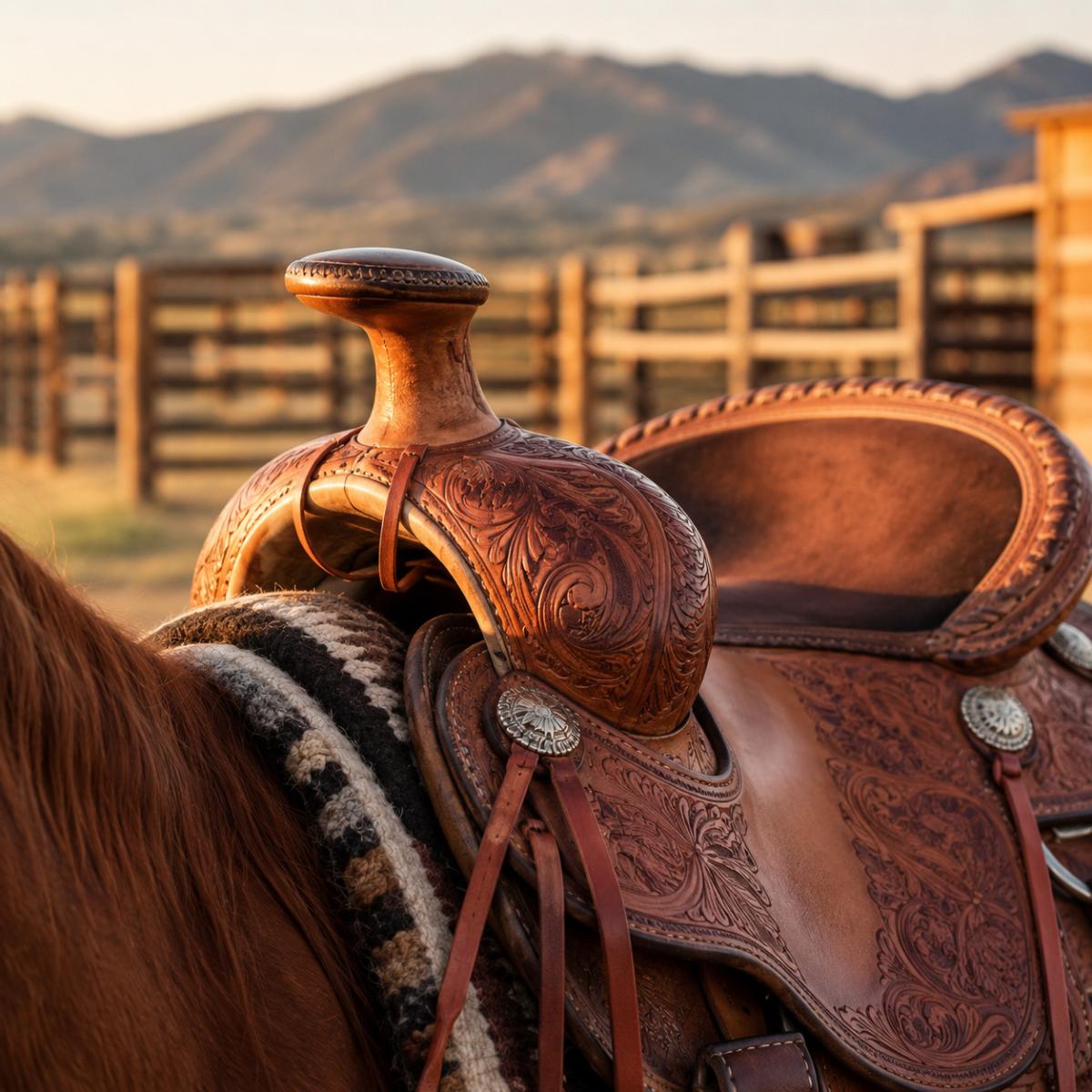
The horn of a western saddle is probably one of the most recognisable features of American horsemanship. Positioned at the front of the saddle, it has become so closely associated with the image of the cowboy that it can easily look like little more than a traditional design feature.
Its origins, however, are deeply functional.
The saddle horn developed through the saddles and roping traditions used by Mexican vaqueros and cattle workers. One of its most important functions is to help manage a rope after an animal has been caught, allowing forces to be transferred through the saddle, its tree and ultimately the horse rather than requiring the rider to hold the animal entirely with their arms.
Its history therefore explains much of the western saddle's distinctive construction: the western saddle was originally, above all, a piece of working equipment.
What is the horn on a western saddle?
The saddle horn is located at the top of the front portion of the saddle tree.
On a traditional western saddle, it is structurally associated with the fork or swell, the front section of the tree that forms the pommel area.
A horn generally consists of a relatively narrow section called the neck, topped by a broader cap.
Its height, diameter, shape and proportions can vary considerably between saddles.
These differences are not purely decorative. A saddle designed for roping does not necessarily require the same type of horn as one intended for reining, cutting, barrel racing or recreational riding.
The saddle horn is older than the American cowboy
Popular accounts of the western saddle often begin directly with cowboys in the United States.
The history starts earlier.
Research published by the Smithsonian Institution on the development of early saddles in western North America demonstrates the fundamental importance of Mexican equestrian traditions in the evolution of the western saddle.
By the early nineteenth century, saddles used by Mexican horsemen already possessed many of the structural characteristics that would influence saddles in the American West. (Smithsonian Institution)
The saddle associated with the vaqueros of northern Mexico included a pommel horn.
By around the 1830s, this type of saddle was already present in the Texas region and could influence Anglo-American riders settling in the Southwest.
The American cowboy therefore did not simply invent the saddle horn.
He inherited and subsequently adapted an equestrian culture that had already developed in Mexico and the southwestern borderlands.
Spanish roots, followed by extensive development in Mexico
The origins reach further back still.
Spanish colonisation introduced horses, cattle and several European equestrian traditions to the Americas. Over the following centuries, these practices changed considerably within New Spain and later Mexico.
Extensive cattle ranching contributed to the emergence of a specialised horse culture.
The vaqueros developed techniques suited to managing and catching cattle from horseback, including sophisticated methods of working with a rope.
Smithsonian research notes that what Anglo-Americans in the first half of the nineteenth century often called a “Spanish saddle” was actually equipment whose development had occurred to a substantial extent in Mexico during the Spanish colonial period. (Smithsonian — Man Made Mobile: Early Saddles of Western North America)
This distinction matters.
The western saddle has Spanish roots, but a major part of its lineage passes through Mexican horsemanship and the vaquero tradition.
Why did a working saddle need a horn?
The answer lies primarily in roping cattle.
After a bovine has been caught with a rope, it may continue moving, suddenly change direction or exert considerable force on the rope.
Attempting to control that force using only the rider's hands and arms would be extremely difficult and potentially dangerous.
The horn provides a point around which the rope can be managed.
Instead of the rider's body carrying the entire load, forces can be transferred through the saddle and ultimately to the horse.
The horn therefore needs to function as part of a saddle tree and rigging system designed for the stresses associated with cattle work.
This is also why simply having a horn does not make every western saddle suitable for roping.
The rope is not always tied to the horn
This is one of the more interesting details of western roping traditions.
It is easy to imagine a cowboy catching a steer and simply tying the rope around the saddle horn.
In practice, different roping traditions developed different ways of using the horn.
The dally
In dally roping, after catching the animal, the rider quickly takes one or more turns of rope around the saddle horn.
These turns are known as dallies.
The rope is therefore not necessarily tied permanently to the saddle. Instead, friction around the horn helps the rider manage the rope and its tension.
The shape and covering of the horn consequently become important.
Ropers may use a horn wrap to protect the horn and provide the friction characteristics required for their particular technique.
Hard-and-fast roping
Other roping traditions use a rope secured to the saddle horn in a system commonly described as hard-and-fast.
The way forces are transmitted through the rope and saddle is therefore different.
These historical and regional variations help explain why western saddle horns do not all have the same shape.
The horn is part of a complete structural system
It would be misleading to think of the horn as a hook simply attached to the top of a saddle.
During roping, the forces involved must be carried through the complete structure.
The saddle tree forms the structural framework of the saddle. The rigging connects this structure to the cinch system that secures the saddle to the horse.
Tree construction, horn attachment, rigging and the overall design of the saddle must therefore work together.
A saddle specifically built for roping is designed with these stresses in mind.
For that reason, a saddle should never be assumed to withstand heavy roping forces simply because it has a horn.
Why don't English saddles have horns?
The difference is primarily explained by their history and intended functions.
The European saddle traditions that eventually produced modern dressage, jumping and eventing saddles did not develop around the same system of catching and controlling cattle with a rope from horseback.
They therefore evolved under different requirements, including rider position, freedom of movement, close contact with the horse and the specific demands of different equestrian activities.
A horn would provide no comparable function for a dressage or jumping rider.
It could even interfere with some riding positions.
The difference between English and western saddles, however, extends far beyond the presence of the horn. The saddle tree, skirts or panels, stirrup system, rigging or girthing arrangement, seat and overall construction are also different.
Not every western-style saddle necessarily has a horn
The horn is emblematic of western saddles, but it is not absolutely universal across every saddle derived from western traditions.
Some saddles designed for particular purposes or influenced by western construction may be made without one.
Historically, western saddles themselves have also varied considerably according to region, period and intended use.
Smithsonian research on early western North American saddles demonstrates that the modern western saddle emerged through several influences rather than from one single, unchanging design. (Smithsonian Institution)
What we now recognise as the classic cowboy saddle is therefore better understood as part of a family of related saddle designs.
Why are western saddle horns different shapes?
Function has a major influence on their design.
A roping saddle must withstand the demands associated with working a rope and cattle. Its horn is therefore designed for this purpose and forms part of a robust overall construction.
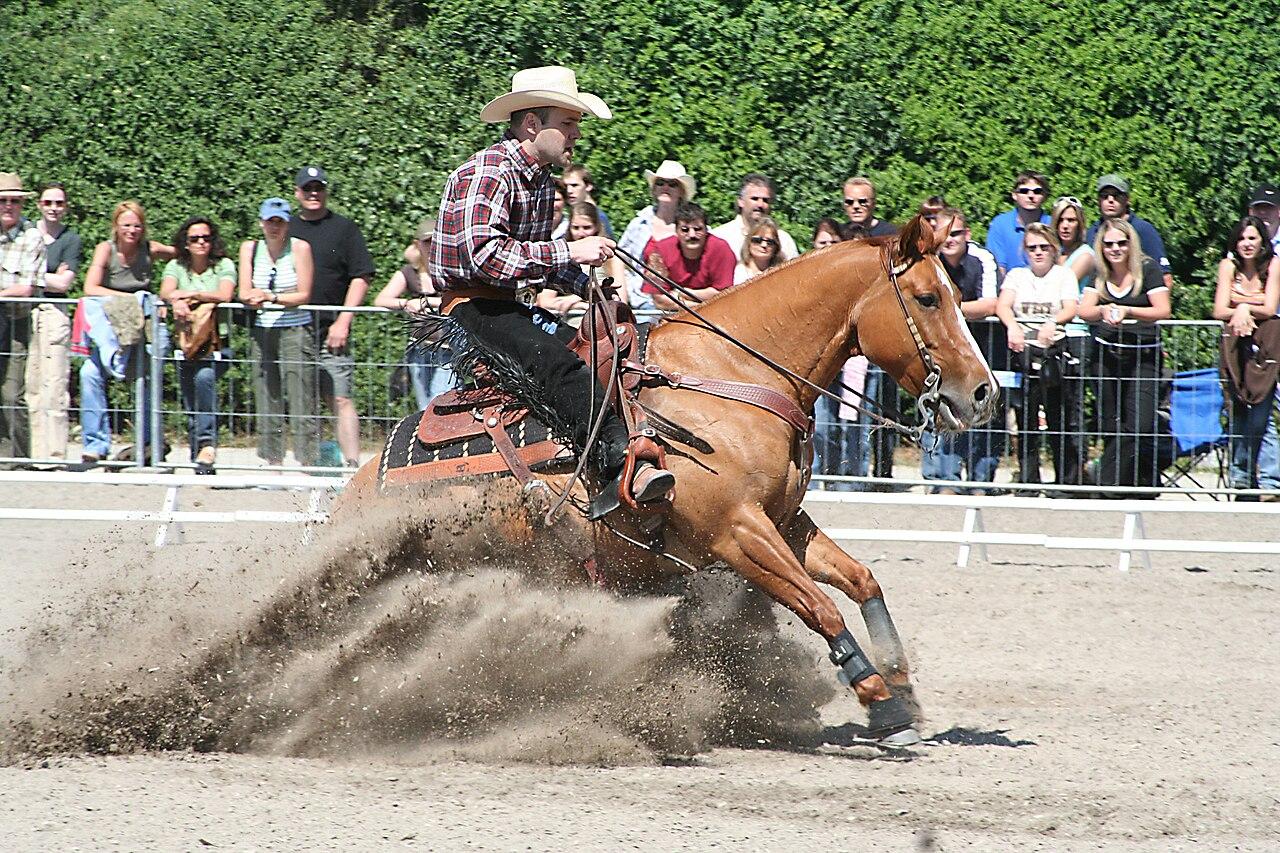
A reining saddle has different requirements. During a reining pattern, the rider is not using the horn to hold a roped bovine. Saddle geometry instead needs to accommodate the acceleration, circles, flying changes, spins and sliding stops characteristic of the discipline.
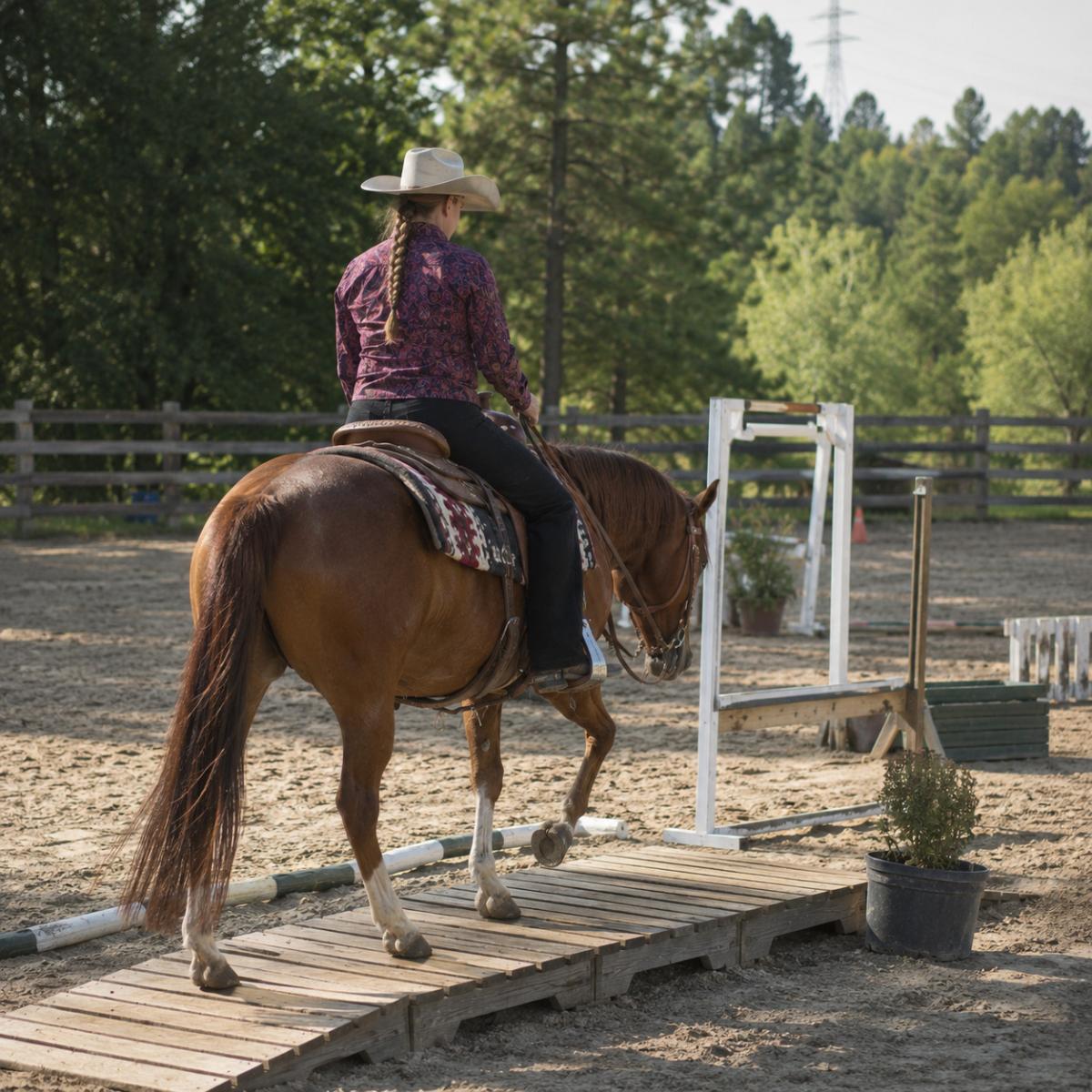
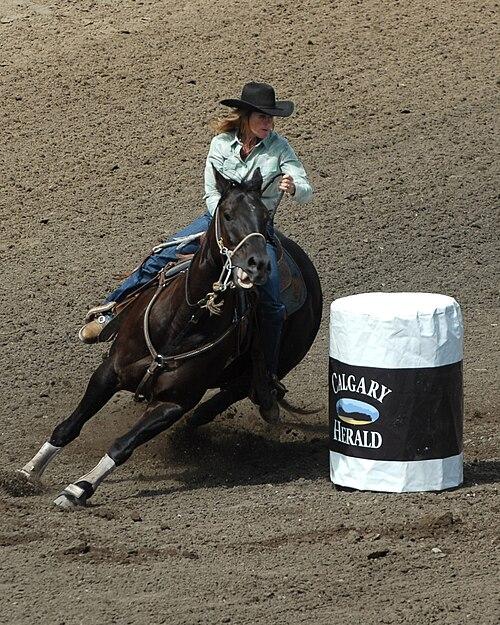
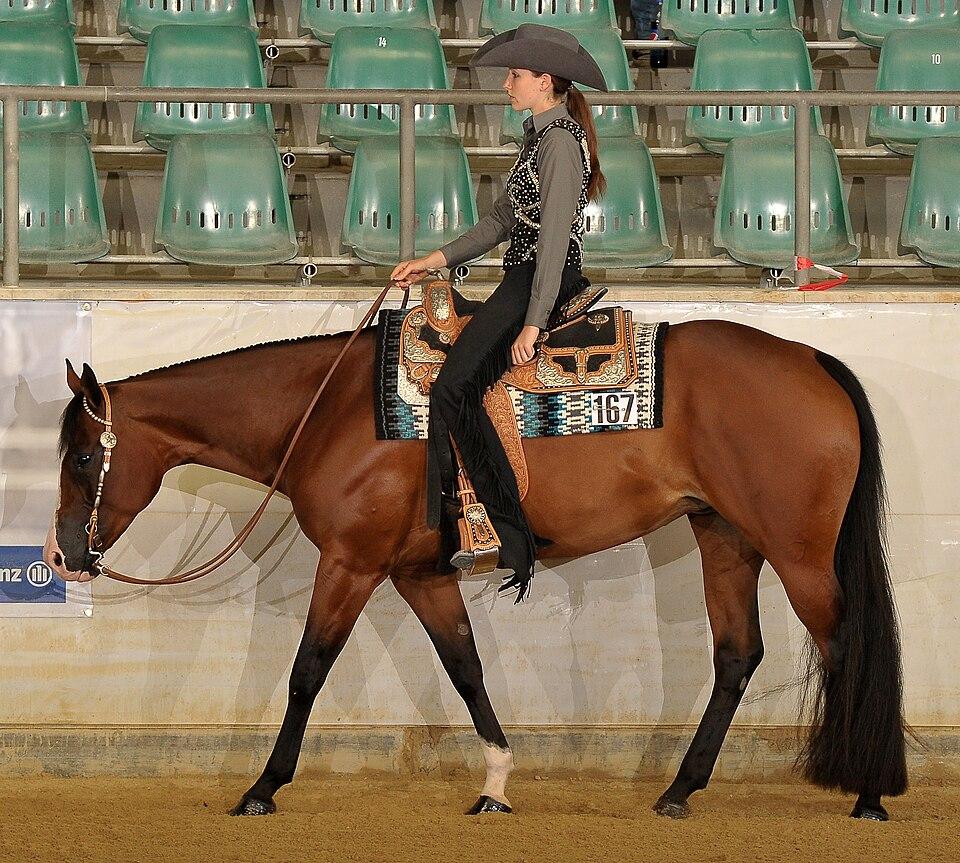
Cutting, ranch, barrel racing and recreational saddles also have their own requirements.
The width of the cap, height of the horn and thickness of the neck can consequently differ between saddles and saddlemaking traditions.
It is more accurate to think in terms of families of horn designs suited to different purposes than to assume that every discipline has one fixed set of dimensions.
A reining saddle horn is not necessarily a roping horn
This distinction has an important practical consequence.
Seeing a horn on a reining, barrel or recreational saddle does not mean the saddle was designed to withstand roping loads.
A saddle intended for cattle roping needs an appropriate structural design.
Before using a saddle to stop or control cattle with a rope, riders should therefore consider the purpose for which the manufacturer designed the saddle, rather than simply checking whether it has a horn.
The difference may involve the horn itself, but also the tree and rigging system.
Is the saddle horn still useful today?
In ranch work and roping disciplines, absolutely.
It continues to perform the function that contributed to its development: allowing a rider to work a rope from the saddle.
In those contexts, the horn remains a genuine working tool.
In other western disciplines, it may never be used for roping at all.
On a recreational saddle, the horn may remain primarily because of traditional construction, saddle type and western identity.
The same basic feature can therefore be essential on one saddle and almost unused on another.
Can you hold onto the saddle horn while riding?
Physically, yes.
It is also an understandable reaction for someone riding in a western saddle for the first time: the horn looks very much like a handle.
But it was not originally designed as a handle for keeping the rider in the saddle.
A rider's stability primarily comes from balance, position and the ability to follow the horse's movement.
There are situations in which a rider may briefly place or grip a hand on the horn. That does not make the horn a substitute for developing an independent seat.
There is also no need to turn this into an absolute rule. The significance of briefly using the horn depends on the rider, the situation and the type of riding being performed.
Why shouldn't a rider rely on the horn for balance?
The horn is a rigid structure positioned directly in front of the rider.
Grabbing it when balance is already being lost may alter the rider's upper-body position without addressing the underlying cause of the instability.
For a beginner, safety therefore depends much more on a suitable horse, a correctly fitted saddle, appropriate instruction and the gradual development of balance than on having something to hold.
The horn can be useful in particular situations, but it should not become the rider's primary means of staying mounted.
Can a saddle horn be dangerous?
Like any rigid and projecting part of equestrian equipment, the horn can contribute to certain injuries.
A rider thrown forwards may strike it. Clothing or equipment positioned poorly around the saddle can also create undesirable situations.
However, it would be difficult to claim that accidents specifically caused by saddle horns are “rare” without appropriate epidemiological evidence.
The more defensible conclusion is simply that the horn is a rigid projecting component that riders need to remain aware of, particularly when mounting, dismounting or in situations where the rider may be thrown forwards.
Are saddle horns merely decorative today?
On some modern saddles, their practical role may be very limited, but the horn itself is not historically decorative.
A rider using a western saddle exclusively for recreational riding or for a discipline without roping may never use the horn for its original working purpose.
In that context, it can function largely as part of the traditional construction and appearance of the saddle.
On a genuine roping saddle, however, the horn remains functional equipment.
The relevant question is therefore not whether “the western saddle horn” is functional or decorative in general, but what a particular saddle was designed to do.
A feature that tells the story of western horsemanship
The saddle horn became an enduring symbol of the American cowboy, but its history began before the cowboy culture of the United States reached its familiar form.
It reflects the meeting of equestrian traditions brought to the Americas by the Spanish, their transformation in Mexico, the development of vaquero culture, and the subsequent adaptation of these techniques and equipment throughout the American West.
Smithsonian historical research identifies the Mexican vaquero saddle as one of the essential predecessors of the modern western saddle. Following the American Civil War, western saddle design continued to evolve in the United States according to regional traditions and the practical demands of cattle work. (Smithsonian Institution)
The horn is therefore much more than the feature that makes a saddle look “western”.
It is the visible legacy of a function that profoundly shaped the equipment: working cattle from horseback with a rope.
That is also one of the best ways to understand the western saddle itself. Much of its characteristic appearance did not develop simply to create a style, but to meet the practical needs of riders for whom horses and saddles were everyday working equipment.
Sources and references
- Smithsonian Institution — Man Made Mobile: Early Saddles of Western North America
- Smithsonian Studies in History and Technology — Early Saddles of Western North America
- National Museum of American History — Western saddle collections
- Smithsonian Magazine — A Brief History of the Rodeo