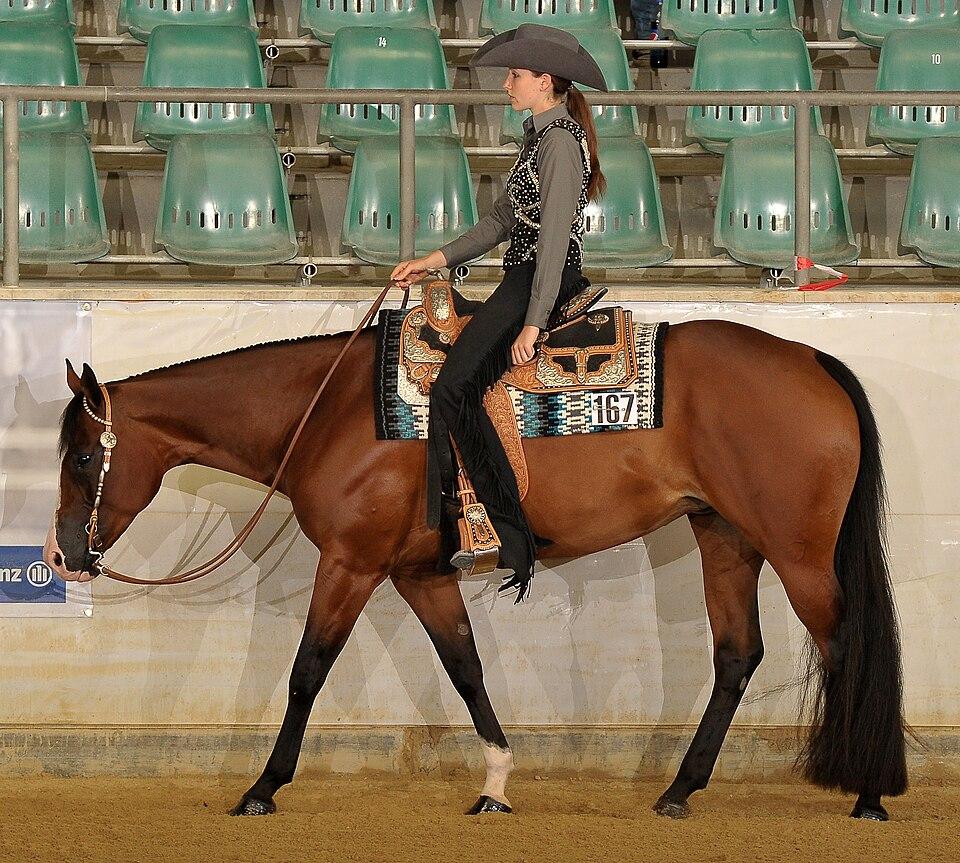
Reining is one of the most recognisable disciplines in western riding. Its sliding stops, rapid spins and flying lead changes can make it look like a succession of spectacular manoeuvres, but competition is built around a much more precise principle: control of the horse while performing a prescribed pattern.
The definition used by the National Reining Horse Association (NRHA) is particularly revealing: to rein a horse is not simply to steer it, but to control its movements. The rules seek a horse that is willingly guided with little or no apparent resistance, while rewarding smoothness, finesse, attitude, quickness and authority in the execution of the various manoeuvres.
Speed can increase the degree of difficulty and therefore the quality of a performance, but it never replaces precision.
The origins of reining
Reining belongs to the tradition of North American working horses.
When working cattle, a horse needed to be able to accelerate, slow down, change direction rapidly and remain responsive when a bovine suddenly altered its path.
Several abilities seen in modern reining therefore have clear parallels with ranch work.
The rollback, for example, combines a stop, a 180-degree change of direction and an immediate departure at the lope. The ability to reverse direction quickly had an obvious practical value when a horse needed to react to the movement of cattle.
It would nevertheless be misleading to present every modern reining manoeuvre as an exact reproduction of a historical cowboy technique.
Contemporary reining is a codified sport, in which movements have been standardised, refined and judged according to criteria developed specifically for competition.
1966: the birth of the NRHA
A major step in the transformation of reining into an organised sport came in 1966 with the creation of the National Reining Horse Association.
The NRHA was founded that year, and the first NRHA Futurity was also held in 1966 in Columbus, Ohio.
The organisation progressively developed rules, patterns and a judging system that allowed performances to be compared according to common criteria.
Another major change came in 1985, when the NRHA introduced a new judging system based on scoring individual manoeuvres rather than relying primarily on an overall impression of the performance.
That remains the fundamental logic of the modern scoring system.
International development followed. According to the NRHA's official historical milestones, the International German Championship became the first NRHA-approved competition in Europe in 1987.
Reining also had a FEI era
The international history of reining includes an important chapter that can sometimes cause confusion today.
In 2000, reining was recognised by the Fédération Équestre Internationale and became a FEI discipline.
It remained within the FEI international system for more than two decades.
That situation ended in 2021, when reining was officially removed from the list of FEI disciplines.
It would therefore be incorrect to describe modern reining as an international discipline still governed by the FEI.
The NRHA remains one of the principal organisations governing the rules, competition structure and sporting development of modern reining.
What exactly happens in a reining competition?
A reining class requires horse and rider to perform a pattern: a predetermined sequence of manoeuvres.
The NRHA currently uses twelve official patterns.
Depending on the pattern, the combination may be required to perform:
- large fast circles;
- small slow circles;
- flying lead changes;
- spins;
- run-downs;
- sliding stops;
- rollbacks;
- and backing manoeuvres.
The rider must memorise the pattern and perform its elements in the prescribed order.
A major pattern error can have much more serious consequences than simply performing one manoeuvre poorly.
Reining is therefore not about accumulating the most spectacular movements possible: the rider must perform the exact pattern required.
The sliding stop
The sliding stop has become the iconic manoeuvre of reining.
The horse approaches at the lope during a run-down, then performs the stop while the hind feet slide along the ground and the front legs continue to move until the horse comes to a halt.
A high-quality stop is not simply about producing the longest possible slide.
The approach, straightness, commitment to the manoeuvre, quality of the stop and continuity into the following elements all contribute to the performance.
The arena surface also plays an essential role. Reining footing is specifically prepared to provide conditions suitable for sliding manoeuvres and the work required of the horse.
The spin
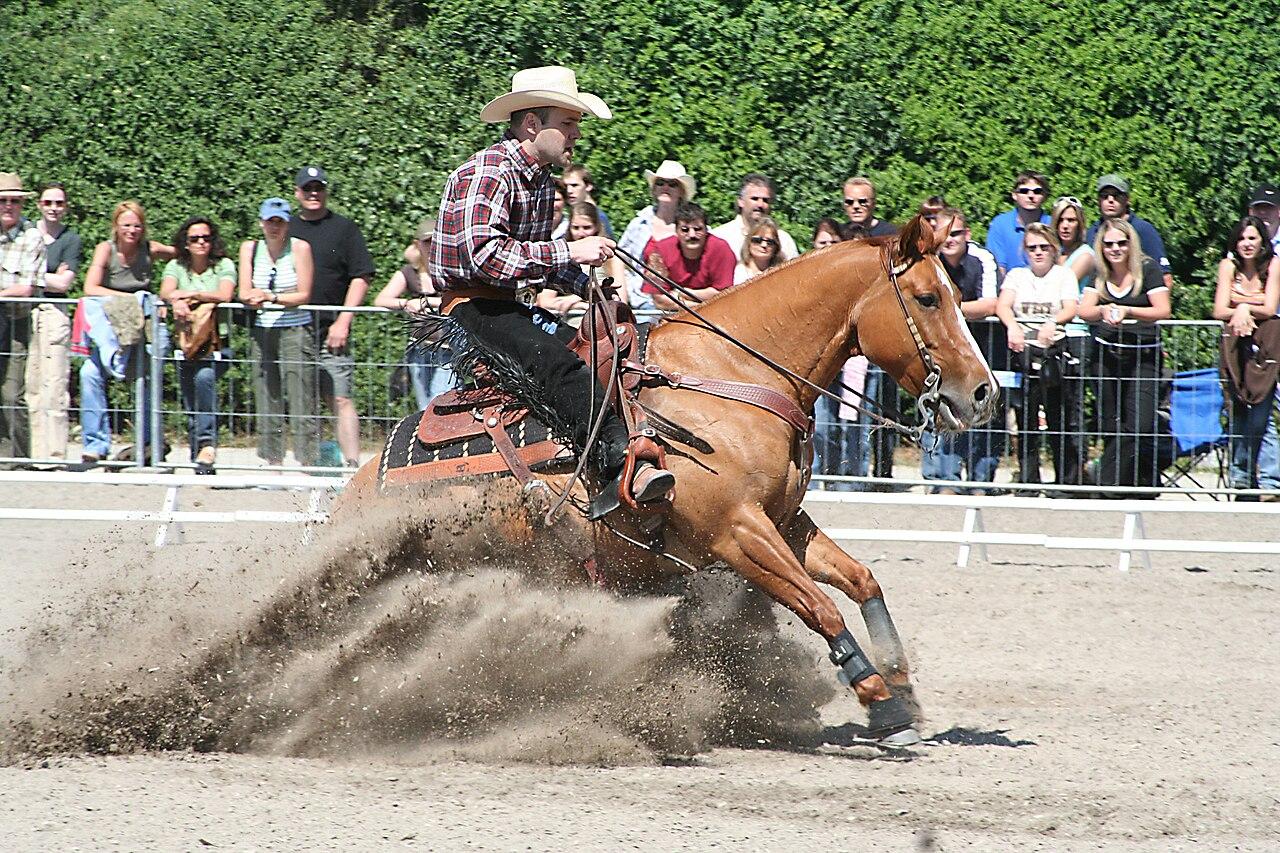
The spin consists of a series of rapid rotations around the hindquarters.

Reining spin at the Maimarkt in Mannheim, Germany, in 2007. Photograph by AllX — CC BY 2.5 — Wikimedia Commons.
The movement is sometimes described by saying that the horse simply turns around one hind foot that remains completely stationary.
That description is too rigid.
Judging focuses more broadly on correctness, cadence, smoothness and control of the rotation.
The required number of turns must also be performed accurately.
NRHA rules therefore include penalties for over- or under-spinning. A small amount of over- or under-rotation does not have the same consequence as a much larger error.
At high speed, maintaining this degree of precision is one of the major challenges of the spin.
Fast and slow circles
Circles may appear less dramatic to spectators than sliding stops, but they are fundamental components of reining patterns.
When required by the pattern, the horse must demonstrate a clearly controlled difference between large fast circles and small slow circles.
The change in speed should demonstrate the rider's control rather than giving the impression that the horse has simply decided to accelerate or slow down.
The shape and placement of the circles also matter.
The objective is therefore not merely to lope very quickly and then very slowly. Horse and rider must demonstrate the ability to change speed while maintaining the prescribed line and control.
Flying lead changes
Lead changes allow the horse to change its leading leg at the lope when changing direction.
In reining, these changes must fit smoothly into the pattern.
A delayed change or remaining on the wrong lead results in penalties under the competition rules.
The longer the horse remains out of lead, the greater the consequences can become.
The difficulty therefore lies not only in teaching the horse to perform a flying change, but in performing it at the required moment without disrupting the continuity of the pattern.
The rollback
The rollback is defined by the NRHA as a 180-degree reversal of forward motion performed after a stop.
The horse comes into the stop, turns its shoulders in the opposite direction over the hocks and departs again at the lope as part of a continuous movement.
The rollback illustrates particularly well the relationship between the heritage of the western working horse and modern competitive reining.
It requires:
- a controlled stop;
- a rapid reversal of direction;
- and a new departure without an excessive break in fluidity.
Backing
The back-up may seem far less spectacular than the other manoeuvres.
It nevertheless forms part of the assessment of control.
The horse must back according to the requirements of the pattern while remaining responsive and directed.
As with the rest of reining, the visual spectacle of a manoeuvre is not necessarily proportional to its importance in judging.
A pattern is much more than its few most dramatic seconds.
How does reining scoring actually work?
The NRHA scoring system is much more precise than a simple overall mark.
A horse begins the pattern with a base score of 70, representing an average performance.
Each manoeuvre or group of manoeuvres is then scored from −1.5 to +1.5, in half-point increments:
- −1.5: extremely poor;
- −1: very poor;
- −0.5: poor;
- 0: correct;
- +0.5: good;
- +1: very good;
- +1.5: excellent.
A manoeuvre scored 0 is therefore not a failed manoeuvre.
It means that the manoeuvre was performed correctly without showing sufficient quality or degree of difficulty to receive additional credit.
This distinction is essential for understanding reining scores.
A score of 70 does not mean “70 out of 100”
Reining scores can easily be misunderstood by newcomers.
70 is not a percentage or a score out of 100.
Under the NRHA system, 70 is the starting point representing an average performance before manoeuvre scores are added and penalties are subtracted.
A completed pattern can therefore finish above or below 70.
The NRHA describes horses as being theoretically scored on a scale from 0 to infinity, although actual competition scores naturally occupy a much narrower range.
Manoeuvre quality and penalties are two different things
This distinction is fundamental to understanding the sport.
A manoeuvre can lose credit because it is poorly executed, resulting in a negative manoeuvre score.
But a specific rule violation can additionally result in a separate penalty.
NRHA penalties range from fractions of a point to much more serious consequences.
For example, a relatively small error in the number of rotations during a spin can result in a 0.5-point penalty, while some major faults carry 5-point penalties.
Other errors can result in a score of zero for the entire pattern.
The judge therefore evaluates both the quality of the performance and compliance with the rules.
Difficulty only has value when the horse remains controlled
The NRHA judging philosophy includes an important nuance.
Controlled speed can increase the degree of difficulty of a manoeuvre and make a performance more impressive.
But speed alone is not rewarded.
An extremely fast spin that loses cadence or precision, or a fast circle in which the horse is no longer properly guided, does not automatically become an excellent manoeuvre.
The principle is instead to increase difficulty while maintaining correctness and control.
That combination separates a merely spectacular performance from one that receives high marks.
Should the rider appear almost invisible?
Much of the aesthetic of reining comes from the apparent discretion of the rider's aids.
The ideal performance gives the impression of a horse that is willingly guided with little or no visible resistance.
That obviously does not mean the rider is doing nothing.
The rider must control the line, speed, transitions and sequence of manoeuvres.
But the more discreet the communication appears and the more readily the horse responds, the stronger the impression of control can become.
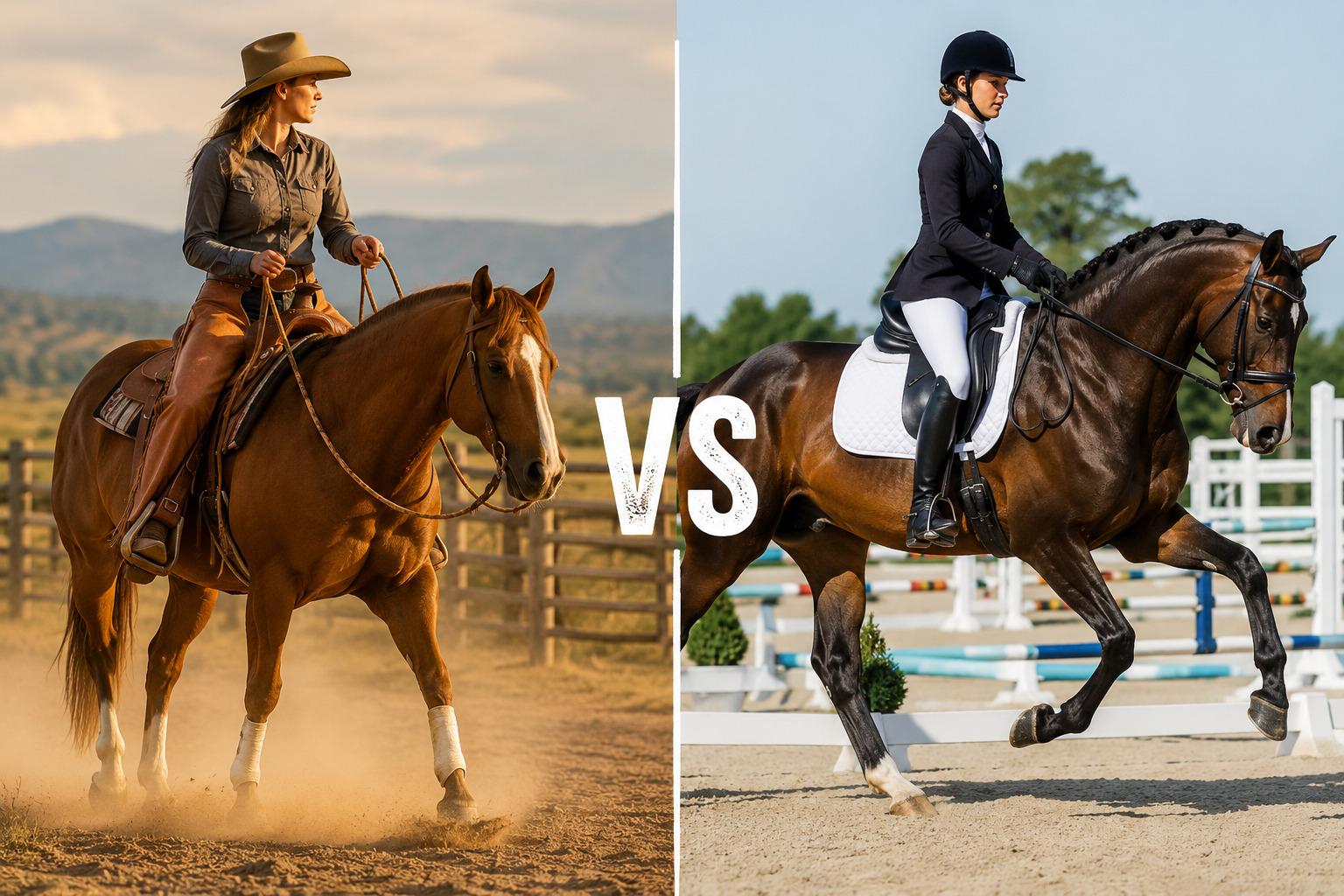
This is one reason why reining is sometimes described as “western dressage.”
The comparison can be useful for explaining that reining is a discipline involving training, precision and subtle control, but classical dressage and reining have different histories, biomechanics, equipment and judging systems.
Why is the Quarter Horse so common in reining?
The Quarter Horse is extremely prominent in modern reining.
The explanation is more complex than simply claiming that the breed is naturally “calm, powerful and manoeuvrable.”
Specialisation has become increasingly important.
Certain Quarter Horse bloodlines have been selected over several generations specifically for western performance and reining.
Breeders select individuals with combinations of morphological, locomotor and behavioural characteristics considered desirable for the discipline.
Competitive success then strongly influences breeding decisions.
Modern reining is therefore associated not only with the Quarter Horse as a breed, but with specialised bloodlines within the breed.
Other horses can participate in reining, and different organisations may accept other breeds according to their own rules.
Breed alone obviously guarantees neither individual ability, quality of training nor competitive performance.
What physical qualities does reining require?
Different manoeuvres place different demands on the horse.
A reining horse must be able to accelerate and decelerate, maintain circles at different speeds, perform flying lead changes, rotate rapidly and execute specialised stops.
Reducing these abilities to having “very powerful hindquarters” would be insufficient.
Performance depends on the entire locomotor system, coordination, balance, physical conditioning, arena footing, shoeing where used and technical training.
Two horses with similar conformation can also have very different athletic abilities.
Reining places real demands on the locomotor system
The spectacular movements of reining are not mechanically neutral.
Western performance horses experience locomotor disorders that have been investigated in veterinary research.
A retrospective study published in 2021 analysed 2,267 lameness examinations in western performance horses presented at major competitions over a ten-year period.
Among the reining horses included in this clinical population, isolated forelimb lameness was the most common presentation.
Across the western performance horses studied, the distal forelimb and distal tarsal/proximal metatarsal regions were among the frequently identified locations. (PubMed — Retrospective analysis of lameness localisation in Western Performance Horses)
These results cannot be used to calculate the overall “injury risk of reining”: the study examined horses presented for lameness evaluation rather than the entire population of horses participating in the discipline.
They do, however, demonstrate why the locomotor demands placed on western performance horses deserve serious consideration.
Is the sliding stop dangerous for horses?
There is no scientifically useful answer that can simply be reduced to “yes” or “no.”
The sliding stop is a specialised athletic manoeuvre that places particular mechanical demands on the horse.
Individual risk, however, depends on many factors, including conditioning, repetition, arena surface, shoeing, conformation, previous injuries, technical execution, recovery and the horse's overall health.
Veterinary literature describes a range of musculoskeletal disorders in performance Quarter Horses and horses used in western disciplines. (PubMed — Musculoskeletal injuries in nonracing Quarter Horses)
This evidence neither demonstrates that reining is inherently dangerous nor supports the claim that appropriate training generally eliminates the risks.
A more accurate conclusion is that reining is an athletic sport with specific physical demands that must be considered when training and managing the horse.
The age of the horse also requires nuance
Reining competitions include events restricted to particular age groups, including the well-known futurities.
The training and competition of young horses therefore regularly forms part of discussions about the discipline.
However, simplistic statements such as “young horses should not work” or, conversely, “progressive training makes every exercise safe” are not particularly useful.
Development of the skeleton, joints, tendons and other tissues does not occur uniformly, while intensity, frequency, type of exercise and recovery matter alongside chronological age.
The relevant issue is therefore how workload is managed throughout the horse's development.
Can beginners learn reining?
Yes, but a beginner obviously does not start by galloping a horse at full speed before attempting a competition-level sliding stop.
Learning begins with fundamental skills:
- controlling speed and direction;
- understanding western aids;
- performing clean transitions;
- learning circles;
- practising the back-up;
- and progressively controlling the shoulders and hindquarters.
More complex manoeuvres come later, as the rider gains experience and works with an appropriately trained horse.
The NRHA also provides different levels and competition formats, including Green Level classes and entry-level Ride & Slide events intended to make the discipline more accessible.
Reining can therefore be introduced progressively without immediately reproducing the demands placed on a high-level competition horse.
A discipline where spectacle comes from control
The images that have made reining famous often show a horse surrounded by a huge cloud of arena dirt during a sliding stop or rotating at remarkable speed.
They tell only part of the story.
A sliding stop is not rewarded simply because it is long. A spin is not excellent simply because it is fast. A circle is not successful merely because the horse is travelling quickly.
The NRHA judging system is built around the combination of correctness, difficulty, smoothness, precision and control.
That is perhaps the best way to understand modern reining.
Its heritage comes from the western working horse, but more than half a century of organised competition has transformed it into a highly specialised equestrian sport.
Behind its most spectacular manoeuvres, the fundamental principle remains the same: the more the rider increases the difficulty, the more evident the control must remain.
Image credits
Spin — Mannheim Maimarkt 2007
- Subject: horse and rider performing a reining spin
- Event: Maimarkt, Mannheim, Germany
- Photographer: AllX
- Date: 1 May 2007 at 12:43 p.m., according to the EXIF metadata
- Source: photographer's own work
- Wikimedia Commons file page: Reining spin.jpg
- Licence: Creative Commons Attribution 2.5 Generic — CC BY 2.5
- Modification: no modification to the original image in this version of the article
Sources and references
- National Reining Horse Association — 2026 Handbook
- National Reining Horse Association — Judges Program and scoring system
- National Reining Horse Association — Historic Milestones
- National Reining Horse Association — Learn to Speak Reiner
- Fédération Équestre Internationale — Reining removed from FEI disciplines in 2021
- PubMed — Retrospective analysis of lameness localisation in Western Performance Horses: A ten-year review
- PubMed — Musculoskeletal injuries in nonracing Quarter Horses