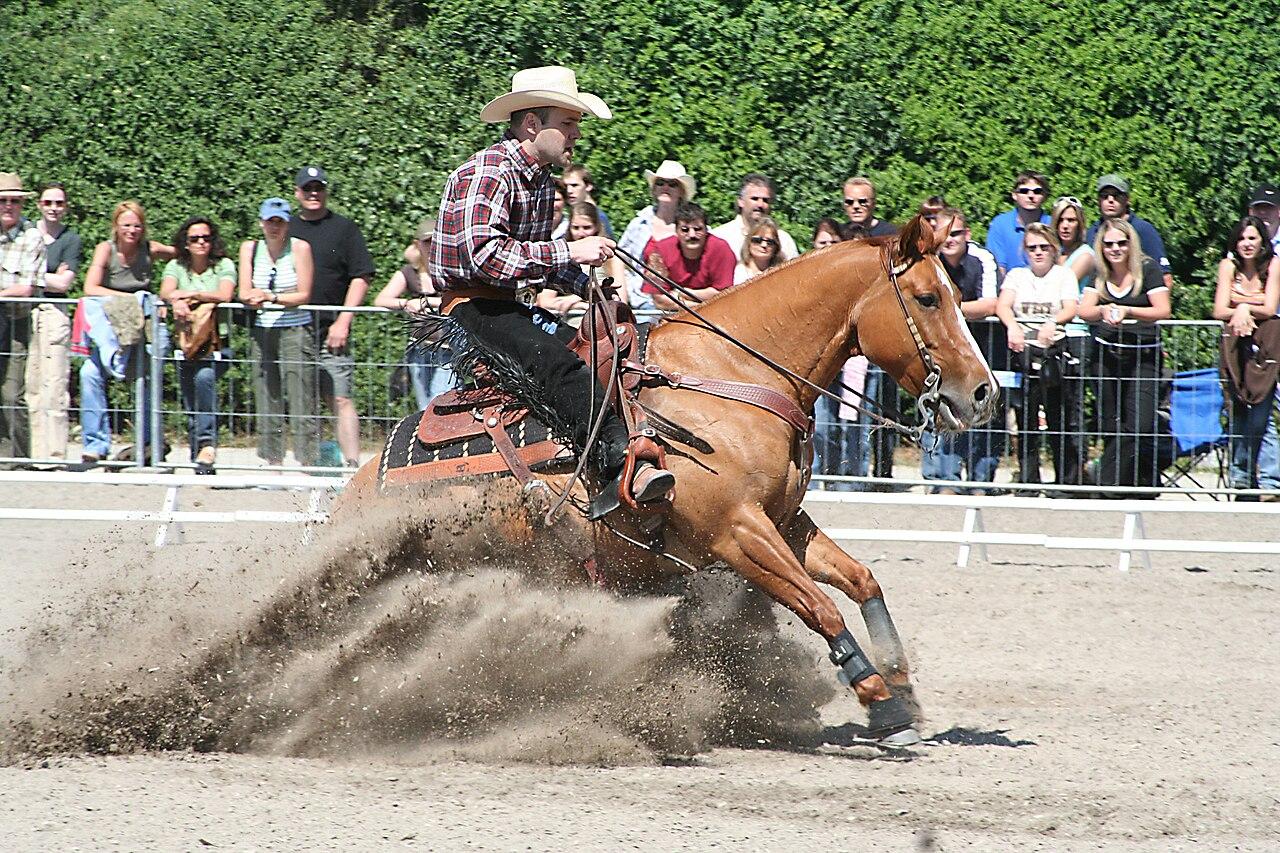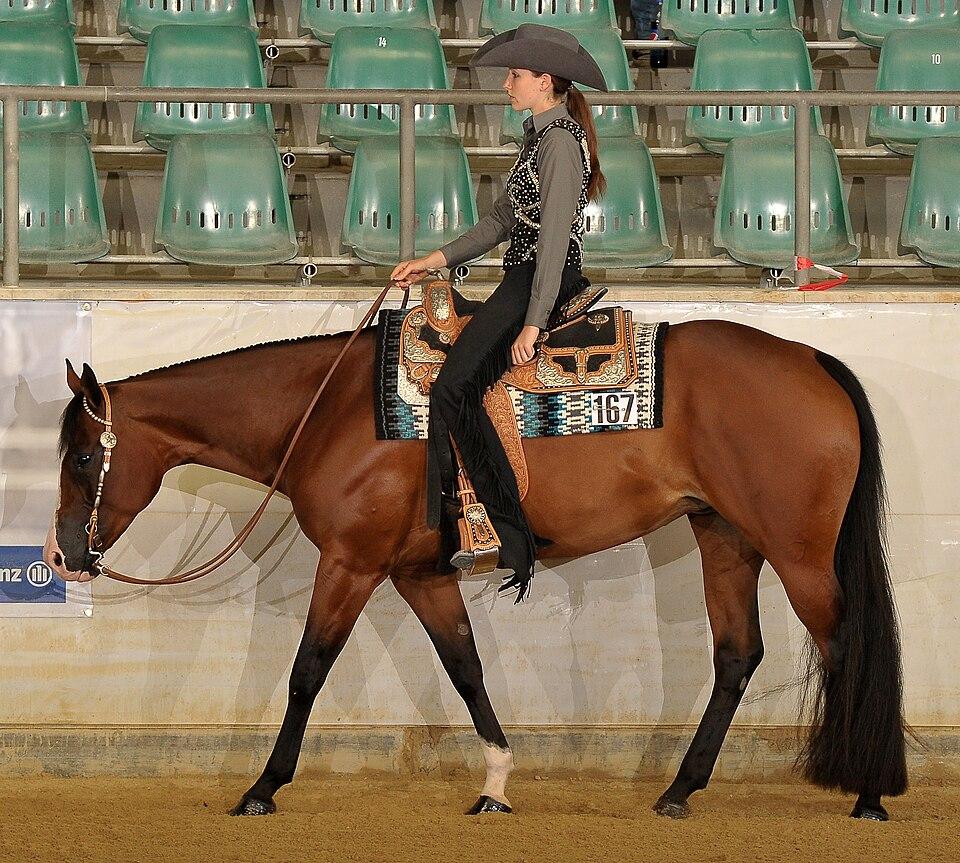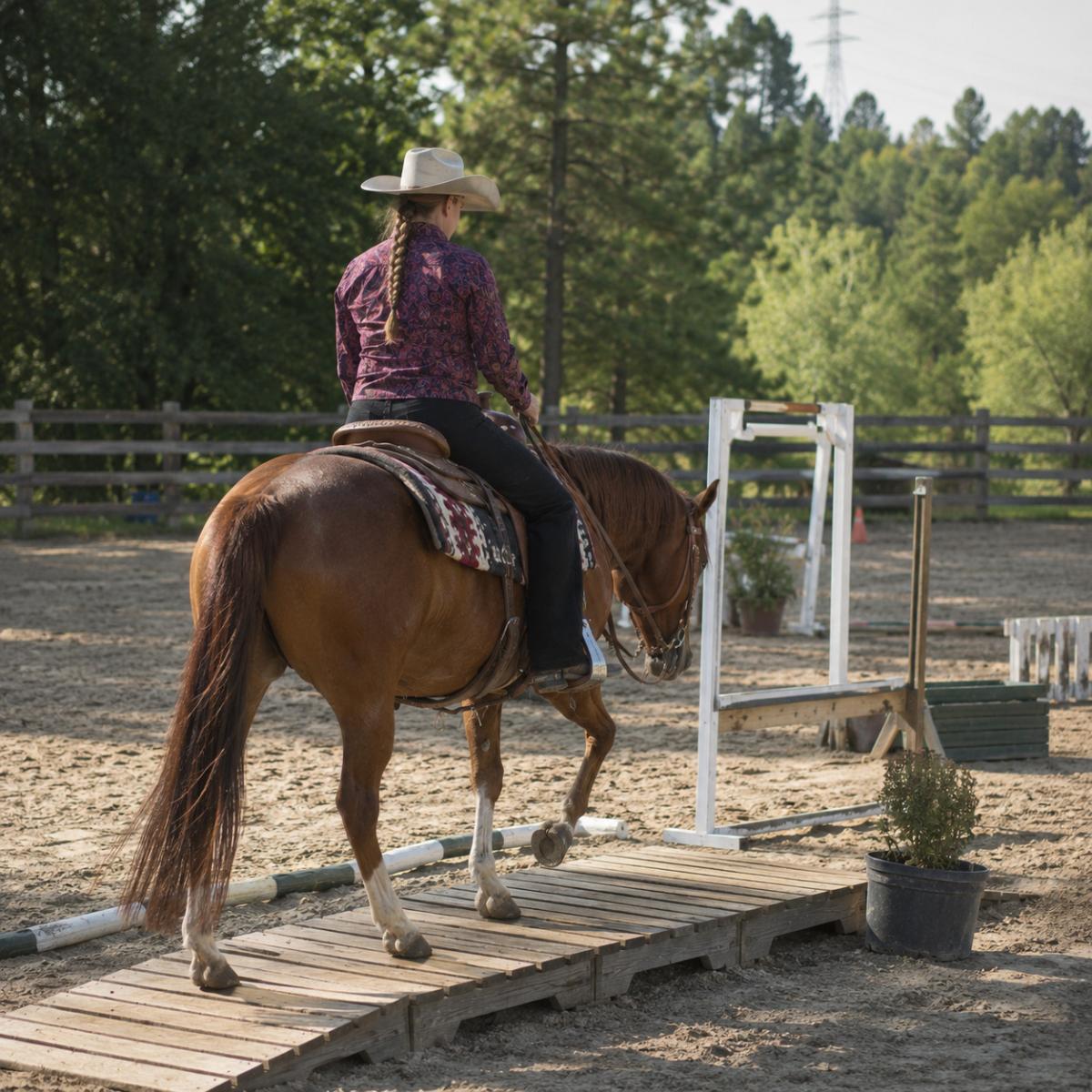
Western trail is one of those disciplines that can look surprisingly simple from outside the arena. There is no race against the clock and no need for the dramatic sliding stops associated with reining. Instead, horse and rider negotiate a course of obstacles that may include ground poles, a gate, a bridge, narrow spaces or backing patterns.
The emphasis is on precision, control, responsiveness and the quality of the horse's movement through each obstacle.
This relatively calm appearance helps explain why trail can be an excellent introduction to western riding. Basic exercises can be introduced progressively and without relying on speed.
But trail should not be confused with an easy discipline.
As the level increases, a few centimetres in the approach to a pole, an incorrectly placed hoof, a break of gait or a poorly prepared turn can make a significant difference. The best trail performances look effortless precisely because horse and rider have developed enough control to negotiate complex obstacles smoothly.
What is trail in western riding?
In western competition, Trail is a class in which horse and rider individually complete a prescribed course containing a series of obstacles.
The objective is not simply to get to the other side of each obstacle.
Major American organisations such as the American Quarter Horse Association (AQHA) and American Paint Horse Association (APHA) regulate Trail as a competitive performance class.
The horse is expected to negotiate the course willingly and accurately while maintaining the required gait and following the prescribed route.
Trail is therefore largely an exercise in controlling the horse's movement: moving forward, stopping, backing, travelling laterally and placing the body and feet accurately in relation to an obstacle.
Trail and Ranch Trail are not exactly the same discipline
The names are sometimes used interchangeably, but Trail and Ranch Trail are distinct competitive classes.
Modern Trail is a highly codified performance discipline. Its obstacles may resemble situations a horse could encounter outside an arena, but they are arranged specifically to test manoeuvrability, accuracy and quality of execution.
Ranch Trail belongs more directly to the family of ranch classes. Its purpose and presentation place greater emphasis on the qualities expected from a versatile ranch-type horse, and the obstacles can more directly represent practical ranch tasks.
The precise requirements depend on the organisation.
This distinction matters because there is no single universal “western trail rulebook”. AQHA, APHA and other organisations establish their own regulations, obstacle requirements and penalty systems.
Where do trail obstacles come from?
The imagery surrounding Trail is closely connected with the practical use of western horses.
A horse working or travelling outdoors may need to pass obstacles, negotiate restricted spaces, stop and back accurately or remain controllable while its rider handles a gate.
Competitive Trail transformed these kinds of abilities into standardised exercises.
It would nevertheless be misleading to describe today's Trail course as an exact reconstruction of everyday cowboy work.
Modern Trail is a specialised competitive discipline.
Pole spacing, lines and combinations can require a degree of precision that clearly belongs to the show arena.
Ground poles are more technical than they appear
Ground poles or logs are among the most characteristic elements of Trail.
Depending on the pattern and division, the horse may have to cross them at the walk, jog or lope.
From a distance, the exercise looks elementary: the horse simply steps over them.
In practice, the rider needs sufficient control over the line and stride to allow the horse to place its feet accurately between the poles without hitting them.
An approach that is slightly off-centre or a poorly adjusted stride can compromise an entire combination.
Competition rules therefore include penalties for contacting, hitting or stepping on elements of the course.
The horse must learn to organise its limbs accurately while maintaining the required gait and rhythm.
The gate requires precise control
The gate is another iconic Trail obstacle.
Horse and rider must negotiate it according to the prescribed pattern, which generally involves approaching the gate, opening it, passing through and closing it again.
What makes the exercise interesting is that the rider must manipulate the gate while controlling the horse's movement.
Depending on the pattern, this can involve:
- a precise halt;
- lateral steps;
- movement of the shoulders or hindquarters;
- backing;
- and then moving forward again.
A well-executed gate can look almost uneventful.
That apparent simplicity is precisely what demonstrates good preparation: the horse remains responsive while the rider coordinates several movements in a confined area.
A bridge tests more than courage
A bridge or similar platform is another familiar Trail obstacle.
The horse must approach it, step onto a different surface, cross it and leave without unnecessary rushing.
It is often described simply as a test of bravery.
The exercise involves more than that.
The horse may have to process a different texture beneath its feet, unfamiliar sounds and clearly defined visual boundaries while continuing to respond to the rider.
A horse that hesitates is not necessarily inherently “fearful”. Familiarity with unusual surfaces, previous experiences and the way the obstacle was introduced can all affect its reaction.
Good training therefore aims to teach the horse how to understand and negotiate the obstacle, rather than simply forcing it across.
Backing exercises quickly reveal inaccuracies
Trail frequently includes a backing obstacle.
The horse might have to back in a straight line, through an L-shaped arrangement or between poles.
Again, simply being willing to move backwards is not enough.
The horse needs to maintain an accurate enough line to avoid contacting the elements defining the obstacle.
The rider therefore learns to control direction even while the horse is moving backwards.
It is an excellent illustration of the difference between performing a manoeuvre and performing it with competition-level accuracy.
Lateral movement is part of the same skill set
Some patterns also require the horse to move sideways over or alongside a pole.
The rider must control the direction of travel while maintaining the horse's position relative to the obstacle.
These exercises require coordinated aids and careful preparation.
They also demonstrate why Trail is not simply a series of confidence tests. A substantial part of the discipline is based on manoeuvrability and precise control of the horse's body.
How is a Trail course scored?
The exact scoring system depends on the organisation, but Trail is fundamentally different from a speed event.
Under systems such as those used by the APHA, obstacles are evaluated according to the quality of their execution, while specific mistakes result in penalties.
A correctly performed obstacle provides the expected standard, while particularly smooth and accurate execution can be rewarded.
Errors, meanwhile, can produce penalties of different severity.
Lightly contacting an obstacle does not necessarily have the same consequence as stepping on a pole, leaving the prescribed obstacle boundaries, refusing an obstacle or performing an element incorrectly.
This distinction is fundamental: Trail rewards the quality of the performance, not simply completion of the course.
Touching a pole can really cost points
Competition rules reveal just how important accuracy becomes.
Depending on the organisation and class, penalties can apply to errors such as:
- contacting an obstacle;
- hitting or stepping on a pole;
- breaking gait;
- incorrect strides within certain combinations;
- stepping outside an obstacle's defined boundaries;
- refusing an obstacle;
- or incorrectly negotiating a gate.
Not all mistakes carry the same penalty.
A minor error may cost only a small number of points, while a major mistake can have a much greater effect on the final score.
At high levels, a course that appears nearly flawless to an inexperienced spectator may therefore contain several small errors that are immediately apparent to a judge.
Why can Trail be useful for beginners?
Trail has several characteristics that make it particularly interesting for learning.
First, it forces the rider to think about exactly where they want the horse to go.
When approaching a line of poles or a narrow passage, vaguely travelling in the right direction is no longer enough. The rider must prepare the line, control the gait and anticipate the next obstacle.
Trail also makes the consequences of the rider's aids very visible.
A cue given too late may allow a shoulder to drift. A poorly prepared approach can make a pole difficult to negotiate. An unnecessarily strong aid may produce a larger response than intended.
Obstacles therefore make concepts such as line, timing and body control much more tangible.
A beginner can learn a lot at the walk
Discovering Trail does not require completing a complicated course at the lope.
Elementary work can begin with very simple exercises:
- walking over a single pole;
- stopping at a precise point;
- backing in a straight line;
- passing between widely spaced elements;
- performing a simple lateral movement;
- calmly approaching an unfamiliar surface.
The difficulty can then be increased progressively.
Some organisations explicitly provide divisions that reflect this kind of progression. The APHA, for example, has an Amateur Walk-Trot division, and Trail within that division omits the lope. APHA also offers Novice Amateur competition intended for less-seasoned exhibitors. (APHA – Amateur Program)
APHA's youth training programme similarly includes progressive Trail exercises such as poles, bridges, working gates, backing patterns and control of the forehand and hindquarters. (APHA – Youth Futurity Project)
Trail can therefore genuinely be adapted to different levels, rather than requiring a beginner to perform the complete range of advanced obstacles immediately.
Beginner-friendly does not mean risk-free
Obstacles introduce their own risks.
A horse can step on a pole, lose balance, hesitate on an unfamiliar surface or react suddenly when frightened.
A gate handled from horseback or a narrow passage can also become unsafe when the exercise is poorly prepared.
For a genuinely inexperienced rider, learning Trail should therefore involve:
- a horse suited to the rider's ability;
- correctly designed and stable obstacles;
- sufficiently easy distances and lines;
- competent supervision;
- and a progression appropriate to both horse and rider.
The best first obstacle is not necessarily the one that looks most like a championship course.
The horse has to learn too
A horse is not automatically a good Trail horse simply because it has a calm temperament.
It must learn how to organise its body through different exercises.
Training can progressively include poles, backing, lateral movement, transitions and familiarisation with different surfaces and objects.
Confidence should not simply mean preventing the horse from avoiding something it finds worrying.
A carefully structured progression instead gives the horse opportunities to investigate, understand and eventually negotiate the challenge successfully.
This distinction becomes particularly important with inexperienced horses.
Quarter Horses are not the only horses that can compete in Trail
The Quarter Horse, Paint Horse and Appaloosa are strongly associated with western disciplines and are frequently seen in Trail competition.
Their prominence is closely connected with the history and organisation of western competition around major American breed associations.
It does not mean that every individual from these breeds automatically has the ideal temperament for Trail.
Nor does it mean that other horses cannot perform these exercises successfully.
For a rider discovering Trail outside breed-restricted competition, training, experience, health, locomotion and suitability for the rider are generally more useful considerations than the breed label alone.
Individual variation within a breed can be considerable.
Can Trail skills be useful outside the arena?
Many skills developed in Trail can transfer to riding outside competition.
Accurately controlling the line, stopping, backing, moving laterally and calmly negotiating unfamiliar surfaces all have obvious practical applications.
That does not mean a horse that performs perfectly on an artificial Trail course will automatically be confident in every outdoor situation.
A carefully constructed show bridge is not the same as a stream, fallen branch, deep puddle, rocky trail or unexpected obstacle encountered away from home.
Experience in real environments remains valuable.
Trail can nevertheless provide communication and control skills that transfer to many other situations.
Can Trail make an anxious horse more confident?
This idea requires some caution.
Gradual exposure to new situations can contribute to a horse's learning and habituation.
But Trail is not a universal treatment for anxiety.
A horse displaying strong or sudden reactions may be frightened, confused by the exercise, experiencing pain or responding to previous negative experiences.
Adding more obstacles is not necessarily the solution.
Trail exercises can help broaden a horse's experience when challenges are introduced progressively and appropriately, but the reasons behind the horse's behaviour still need to be considered individually.
At high level, Trail becomes a very different challenge
The best Trail performances often look remarkably easy.
The horse travels quietly, crosses poles without touching them, backs accurately between elements and seems to arrive perfectly positioned for each obstacle.
That apparent simplicity is exactly what requires so much preparation.
At higher levels, the rider must simultaneously manage:
- the line;
- stride length;
- gait;
- body positioning;
- preparation for the next obstacle;
- and the overall quality of execution.
Trail consequently becomes a discipline of finesse, planning and anticipation, rather than simply obstacle negotiation.
Trail or Ranch Trail for a beginner?
Both can be interesting introductions to western riding, but they do not have exactly the same competitive purpose.
Classic Trail places considerable emphasis on technical accuracy and the execution of each obstacle.
Ranch Trail belongs to the wider ranch-event family and places the horse's performance in a more explicitly ranch-oriented context.
The rules and permitted obstacles also vary between organisations.
Interestingly, this area continues to evolve. APHA approved Amateur Walk-Trot Ranch Trail as a new recognised class in 2026, with the rule scheduled to take effect in 2027. (APHA – 2026 rule changes)
For someone discovering western riding, the better choice will usually depend on the instructor, available horse, local facilities and the type of western riding they ultimately want to pursue.
So, is Western Trail ideal for beginners?
Western Trail can be an excellent gateway into western riding, but not because it is an easy version of the sport.
Its value for beginners comes largely from the way it makes fundamental riding skills concrete.
Approaching a pole teaches the importance of the line. Stopping beside a gate requires control. Backing between obstacles requires directional accuracy. Negotiating a new surface provides an opportunity to develop confidence through progressive training.
The first exercises can be extremely simple, while advanced courses can demand exceptional precision.
That scalability is one of Trail's greatest strengths.
A beginner can learn from walking over a few poles, while an experienced competitor can spend years refining the same underlying skills.
Trail therefore illustrates one of the most interesting aspects of horsemanship: an exercise can be simple to understand without being simple to master.
Sources and references
- American Quarter Horse Association – AQHA Handbook of Rules and Regulations
- American Paint Horse Association – 2026 Official APHA Rule Book
- American Paint Horse Association – Amateur, Novice Amateur and Walk-Trot divisions
- American Paint Horse Association – Walk-Trot FAQ
- American Paint Horse Association – Youth Futurity Project and progressive Trail exercises