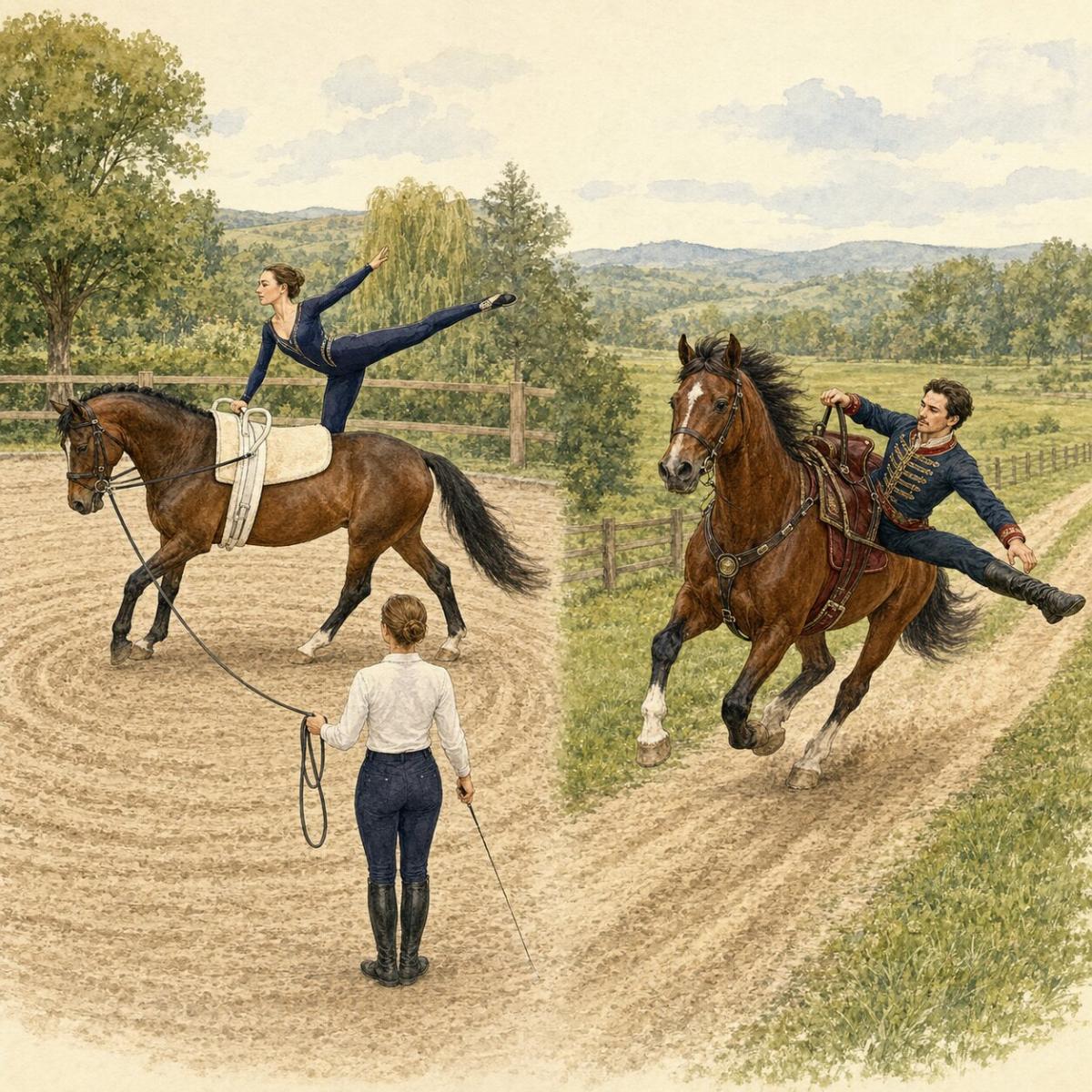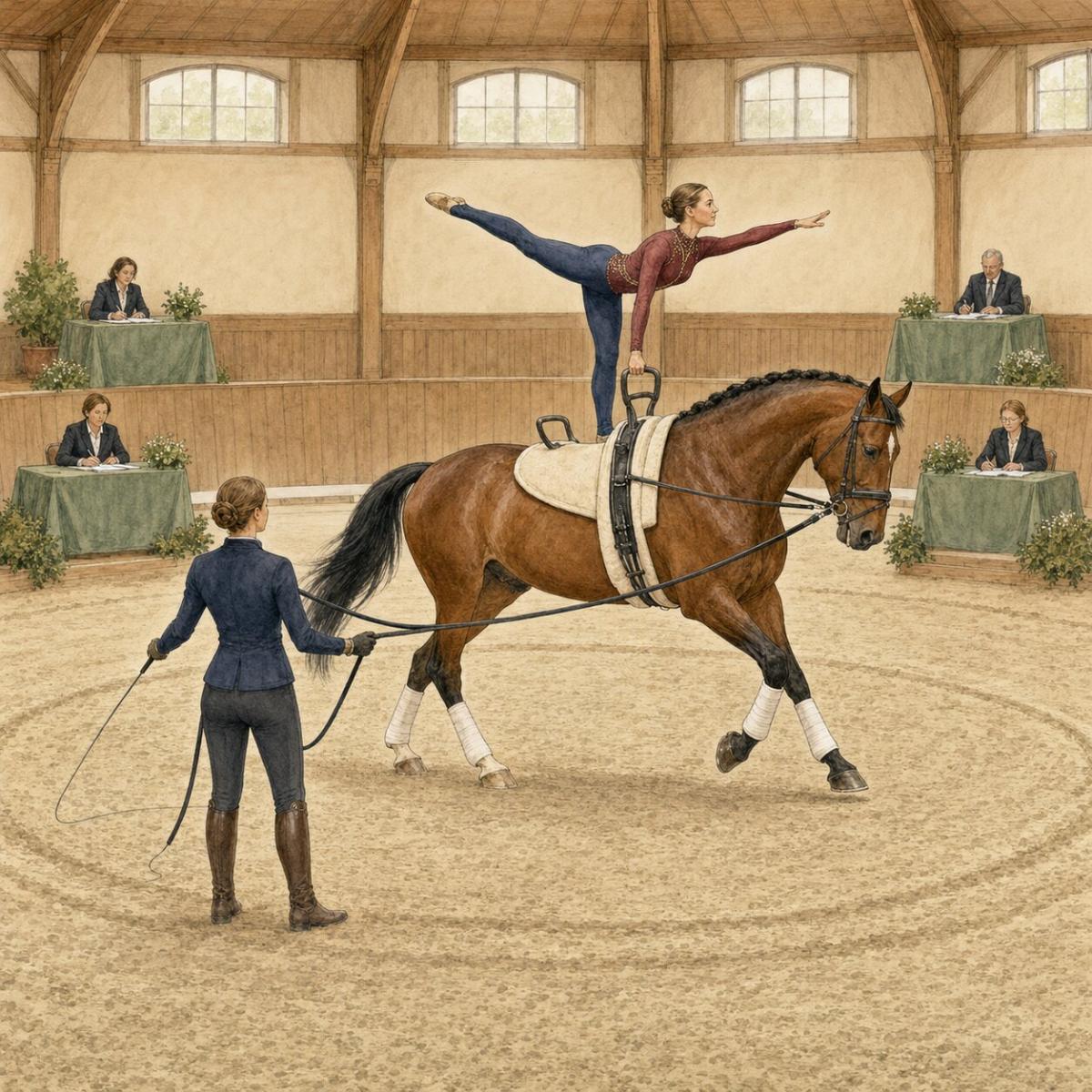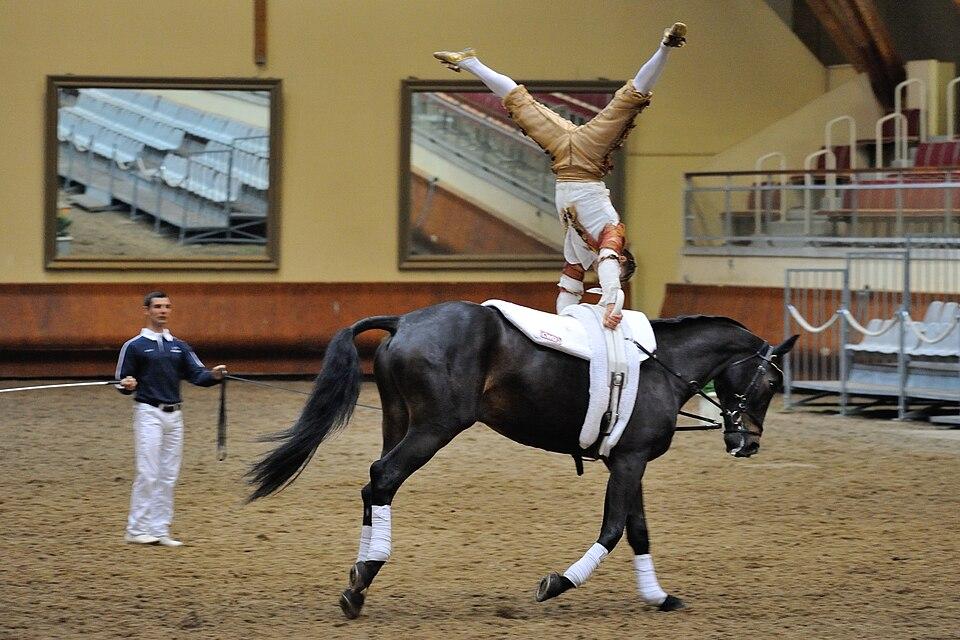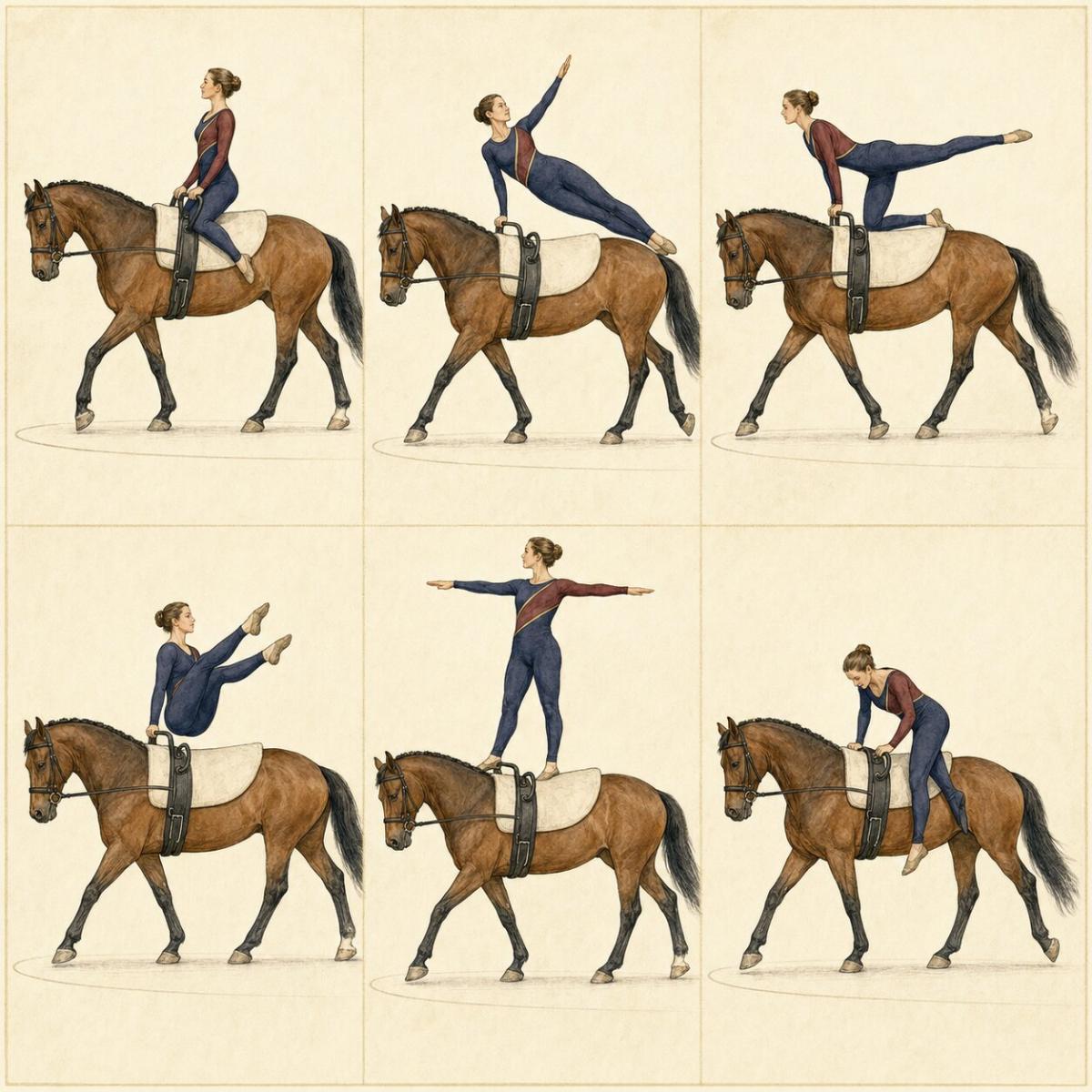
Equestrian vaulting figures are positions and movements performed on a horse or pony moving on a circle under the control of a lunger. Some involve maintaining balance for several strides, while others incorporate an impulse, swing, rotation or change of direction.
The basic seat, flag, mill, scissors and stand are among the classic figures of the discipline. They form part of the technical repertoire used in compulsory programmes, alongside a much broader range of freestyle movements, transitions, dismounts and figures involving several vaulters.
Vaulting, however, is not simply gymnastics performed on a stationary apparatus. As described by the French Ministry of Sports, figures are performed on a horse at walk or canter, equipped with a vaulting surcingle and pad. The vaulter must therefore continuously adapt their balance to the horse's movement.
What is an equestrian vaulting figure?
A vaulting figure may be a position, a complete movement or a combination of several actions.
Two broad categories help explain how these figures work: static and dynamic exercises.
Static figures
A static figure is primarily characterised by holding a position. The flag and stand are two classic examples.
The term "static" can be misleading: the vaulter is never completely motionless. The horse continues to move and its back changes position with every stride. The vaulter therefore makes continuous small adjustments to maintain the figure.
A 2018 biomechanical study published in Acta Facultatis Educationis Physicae Universitatis Comenianae distinguished three static exercises among the compulsory movements analysed: the basic seat, flag and stand. The researchers differentiated them from movements involving greater displacement of the body, such as the vault-on and scissors.
Dynamic figures
Dynamic figures involve a deliberate movement of the body along a recognisable trajectory, such as an impulse, swing, change of orientation or displacement of the centre of gravity.
The vault-on, scissors and several types of dismount belong to this category.
This distinction is also used in the FEI Vaulting Guidelines, which distinguish static and dynamic exercises as well as transitions when describing and evaluating vaulting movements.
The vault-on
Before performing figures on the horse, the vaulter first has to reach its back while it is moving.
The vault-on is therefore a technical exercise in its own right.
The vaulter initially moves alongside the horse, takes hold of the surcingle handles and coordinates an impulse from the ground with a leg swing and support through the arms.
The objective is not simply to get onto the horse. The movement should lead progressively into a controlled position.
The vault-on is one of the classic dynamic movements studied in vaulting biomechanics. Breaking the movement down into phases makes it possible to analyse the initial impulse, elevation of the pelvis, support through the handles and final arrival on the horse.
At introductory levels, the movement may be simplified or performed with assistance before the vaulter learns to complete the entire vault-on independently.
The basic seat
The basic seat is a position in which the vaulter sits astride the horse behind the surcingle, facing the direction of travel.
Its apparent simplicity makes it particularly useful for developing the foundations of vaulting. The pelvis must accompany the horse's movement while the upper body remains balanced.
The position develops several fundamental skills:
- pelvic stability;
- upper-body alignment;
- independence of the arms;
- relaxation of the legs;
- awareness of the rhythm of the strides.
The aim is not to resist the horse's movement. Excessive rigidity makes it difficult to follow the motion of the back, while insufficient muscular control makes the position unstable.
The basic seat therefore illustrates a principle found throughout vaulting: the vaulter needs stability without rigidity.
When included in compulsory programmes, the position is maintained long enough for its stability to be assessed. International rules similarly require static exercises to be held for a specified number of strides.
The flag
The flag is one of the most recognisable figures in equestrian vaulting.
The vaulter supports the body on the horse with one hand and one knee while extending the opposite arm and leg. The result is an elongated line above the horse's back.
The exercise requires considerable cross-body coordination. The vaulter must simultaneously control the supporting limbs, extension of the free limbs and position of the pelvis.
Reducing the number of support points is one of its principal challenges. Each stride slightly changes the balance of the entire position, requiring the vaulter to adapt without allowing the pelvis to rotate or collapse to one side.
Training may begin with preparatory positions in which fewer limbs are released before progressing to the complete flag.
The mill
The mill gradually changes the vaulter's orientation while they remain seated on the horse.
Starting from a forward-facing position, the vaulter moves the legs successively over the horse's neck and hindquarters. This produces a sequence of orientations: forward, sideways, backward, sideways again and finally forward.
The complete movement therefore forms a rotation divided into several phases.
The mill requires hip mobility, but the height of the legs alone does not determine its quality. The vaulter must move them without losing upper-body organisation or producing abrupt contact with the horse.
The sideways positions introduce another challenge: for a short period, the vaulter's support and perception of the horse's strides differ from those experienced when sitting astride.
Partial versions, including the half mill, can be used to introduce these changes of orientation progressively.
Scissors forward
Scissors forward is one of the major dynamic exercises in vaulting.
The vaulter begins seated facing forward. A swing raises the pelvis while the legs change position around the body, with the movement finishing in a backward-facing seat.
The exercise takes its name from the movement of the legs, which resembles the opening and crossing action of a pair of scissors.
Unlike the mill, scissors involve a much more dynamic phase. The vaulter has to coordinate support through the handles, the swing, elevation of the pelvis and movement of the legs.
Height is not an objective in itself. The trajectory must remain controlled and allow the vaulter to return smoothly to the horse.
Scissors backward
Scissors backward returns the vaulter from a backward-facing seat to a forward-facing position.
It is considered a separate exercise rather than simply the reverse of scissors forward. The different starting orientation changes both the vaulter's perception of the horse's movement and the mechanics of the swing.
Once again, the vaulter uses a controlled swing and coordinates the movement of the legs with the horse's strides.
Forward and backward scissors illustrate the dynamic nature of vaulting particularly well: balance no longer depends mainly on maintaining a position, but on controlling the body throughout an entire trajectory.
The stand
The stand involves standing on both feet on the horse's back.
Together with the flag, it is one of the figures most readily associated with vaulting.
Yet balancing in the stand is very different from standing on the ground. The horse's back rises, falls and moves with every stride. The vaulter's joints therefore need to remain responsive enough to absorb these movements.
The ankles, knees and pelvis contribute to these adjustments while the trunk maintains the overall organisation of the posture. The arms also contribute to balance.
Biomechanical research into compulsory vaulting exercises classifies the stand as a static exercise, together with the basic seat and flag. This does not mean that the vaulter remains motionless: the centre of gravity must stay sufficiently stable while the surface beneath the feet continues to move.
Swing exercises
The swing may appear less spectacular than a completed figure, but it is fundamental to many dynamic vaulting movements.
Using the surcingle handles for support, the vaulter coordinates the movement of the legs with the rhythm of the horse to raise the pelvis. This action prepares various changes of position, scissors and dismounts.
Depending on the intended movement, swings may be performed in different directions.
Their biomechanics have also been studied scientifically. Researchers at Masaryk University compared kinematic parameters of a vaulting swing performed on a barrel and on a horse. Their work illustrates the value of a simulator for studying and preparing technique while also showing that transferring a movement to a moving horse changes the conditions under which it is performed.
The flank and the French amazone
French vaulting terminology uses amazone for a dynamic movement found in some advanced programmes.
It combines a swing with movement of the pelvis and legs and may lead into another position or a dismount.
International terminology uses flank for related compulsory exercises.
The two terms should nevertheless be treated with some caution. The precise form of the movement depends on the programme and rules concerned, so amazone and flank should not automatically be treated as exact translations in every context.
For competition purposes, the technical description in the relevant rules remains the best reference for identifying the required movement.
Dismounts
A dismount is the movement by which the vaulter leaves the horse.
Introductory dismounts can be relatively simple, such as moving a leg across the horse before returning to the ground in a controlled manner. At higher levels, they may incorporate a swing, rotation or more substantial aerial phase.
The landing is part of the movement.
The vaulter needs to return to the ground in balance and control the trajectory to avoid moving dangerously close to the horse's legs. A well-performed figure followed by an uncontrolled dismount therefore loses part of its technical continuity.
Dismounts also illustrate the sometimes indistinct boundary between a figure, transition and movement: within a complete routine, all three contribute to the quality of the performance.
Why are some figures compulsory?
In competition, compulsory exercises allow several vaulters to be compared while performing the same movements.
The programmes are not identical at every level.
Introductory categories may use simplified exercises or perform some movements at walk, while advanced programmes include more demanding exercises at canter.
At international level, the classic compulsory repertoire includes movements such as the vault-on, flag, mill, scissors, stand and flank. The precise programme depends on the category and current rules, while the FEI Vaulting Guidelines provide the technical descriptions used for the exercises.
For this reason, there is no single definitive list of "compulsory vaulting figures" without first specifying the level and competition format.
Figures in freestyle programmes
Compulsory exercises represent only part of the vaulting repertoire.
In a freestyle programme, the vaulter or team selects and combines exercises within the limits established by the relevant rules.
The possibilities are much broader and may include:
- seated and kneeling positions;
- balances;
- plank positions;
- arm-supported figures;
- dynamic movements;
- rotations;
- changes of orientation;
- transitions;
- dismounts.
Figures can also be combined to form a complete composition.
Visual difficulty is not the only objective. As the French Ministry of Sports explains, competitive vaulting involves both technical and artistic assessment.
A successful freestyle therefore does not simply consist of accumulating the most difficult possible movements.
Pas-de-deux figures
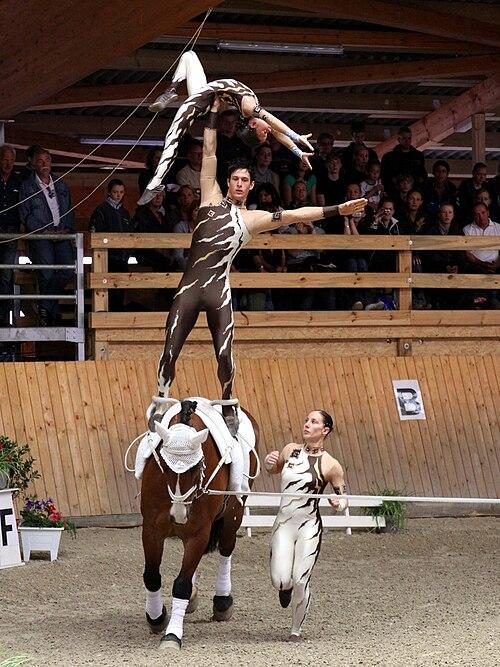
Pas-de-deux involves two vaulters performing together on the same horse.
This considerably expands the range of possible figures. The two partners may create symmetrical positions, face different directions or use each other's bodies as support points.
Some constructions involve a base vaulter, who provides stability, and another vaulter positioned above. Their roles may change throughout the programme.
The difficulty lies not only in the final position. Both partners also have to coordinate the construction of the figure, its stabilisation and the transition into the next movement.
All of this must be achieved without excessively disturbing the horse's balance.
Squad figures
Squad freestyle programmes allow figures involving several vaulters.
These constructions may use several levels, different body orientations and changes of role. Some vaulters form the base while others use them as support.
Their complexity depends on several factors:
- the height of the construction;
- the type of support points;
- body orientation;
- overall stability;
- changes of level;
- transitions into and out of the figure.
A spectacular construction is therefore not automatically technically superior.
Weight distribution also becomes particularly important because every movement is performed on a horse that continues to travel around the circle.
Can a vaulting barrel really prepare figures?
A vaulting barrel is a stationary apparatus that approximately reproduces the shape of a horse's back and is fitted with handles.
It allows a figure to be broken down into its individual components, support points to be repeated and trajectories to be corrected without requiring the horse to carry every repetition.
Its value is not based solely on coaching experience. Several biomechanical studies have compared vaulting movements performed on simulators and on horses.
A 2018 study of compulsory exercises used three-dimensional analysis to examine aspects of technique in both situations. The researchers concluded that incorporating barrel training could contribute to the technique later used on the horse.
Another study involving researchers from the Faculty of Sports Studies at Masaryk University compared kinematic parameters of a swing performed on a barrel and on a horse by nine high-level vaulters.
The barrel is not, however, a perfect reproduction of a horse. It does not produce strides, movement through the back or the accelerations to which the vaulter must adapt in actual vaulting.
The horse's movement is part of the figure
The horse is not simply a support carrying the vaulter around a circle.
Its gait determines a significant part of the mechanical conditions to which the vaulter must adapt.
A veterinary thesis from the École nationale vétérinaire d'Alfort examined the kinematics of vaulting horses cantering on a circle, analysing horses used at a high level of the discipline. This work demonstrates that their locomotion under these specific conditions can be studied objectively, including the regularity of their gait.
This helps explain why a figure mastered on a barrel is not automatically mastered on a horse.
The vaulter has to synchronise their movement with another moving body. A swing, for example, must be timed appropriately within the stride if the vaulter is to work with the movement rather than simply react to it.
Vaulting figures and horse comfort
The quality of a figure does not concern the vaulter alone.
A heavy vault-on, poorly controlled return to the horse or unbalanced group construction can directly affect the animal. Equipment and working conditions are also relevant.
A 2024 study involving 39 international-level vaulting horses measured rein and lunge-line tensions associated with different rein configurations while the horses were cantering. The researchers also recorded behavioural indicators associated with discomfort and found that rein configuration significantly influenced the measured tensions.
This study does not, by itself, establish which individual vaulting figures are comfortable or uncomfortable for a horse. It does demonstrate that the biomechanics, equipment and responses of vaulting horses can themselves be objectively investigated, rather than treated as secondary to the vaulter's performance.
Barrel training is useful in this respect as well: many repetitions required to learn a movement can be completed without asking the horse to carry every attempt.
How is the difficulty of a figure determined?
Difficulty does not simply correspond to how spectacular a figure appears.
Height, the type and number of support points, position of the centre of gravity, body orientation and the complexity of a dynamic movement can all contribute to the technical value of an exercise.
It is particularly important to distinguish difficulty from quality of execution.
A complex movement is not automatically well performed. Loss of balance, an uncontrolled trajectory or a heavy return to the horse remain technical faults regardless of the initial difficulty.
Scoring systems can therefore assign technical value to elements while separately assessing how successfully they are performed.
How are new vaulting figures learned?
Complex figures are generally constructed from simpler movements.
The flag can be preceded by kneeling work and versions using additional support points. The mill can be prepared through sideways positions and controlled leg movements. Scissors build on swing exercises practised separately.
Breaking the movement down allows the vaulter to develop:
- support points;
- trajectory;
- coordination;
- pelvic position;
- control of the landing or return.
The movement may first be studied on the ground and then on a barrel before being transferred to the horse.
This final stage remains essential. Biomechanical research into vaulting demonstrates precisely why performing a movement on a simulator and performing it on a moving horse are not identical situations.
Frequently asked questions about vaulting figures
What are the main equestrian vaulting figures?
The basic seat, flag, mill, scissors forward and backward, and stand are among the classic figures. The repertoire also includes vault-ons, swings, dismounts, flanks and a very large number of freestyle exercises.
What is the best-known vaulting figure?
The flag and stand are among the most immediately recognisable positions. The mill and scissors are also important elements of the traditional compulsory repertoire.
What is the easiest vaulting figure?
There is no universal ranking. Seated positions and elementary movements are generally introduced early in training, but even a simple position requires the vaulter to adapt correctly to the horse's strides.
How many vaulting figures are there?
There is no definitive number. Compulsory exercises represent only a small part of the repertoire. Freestyle vaulting adds numerous figures, variations, transitions and constructions performed in pas-de-deux and squad competitions.
Are vaulting figures always performed at canter?
No. Training and some competition categories use walk. More advanced exercises are more commonly associated with canter.
What is the difference between a static and dynamic figure?
A static figure primarily involves maintaining a position despite the horse's movement. A dynamic figure involves significant movement of the body along a trajectory, such as an impulse, swing or change of orientation.
What is the difference between compulsory and freestyle figures?
A compulsory exercise belongs to a programme established by the rules so competitors can be compared while performing common technical movements. In a freestyle programme, vaulters select and combine figures within the limits of the relevant scoring code.
Figures built around movement
The principal figures illustrate the technical logic of equestrian vaulting.
The basic seat teaches the vaulter to follow the horse's strides. The flag reduces and separates the support points. The mill introduces changes of orientation. Swing exercises prepare dynamic movements, while scissors involve a much greater trajectory of the body. The stand requires the vaulter to maintain balance on a surface that continues to move beneath the feet.
From these foundations develops a much broader repertoire of freestyle figures, transitions, lifts and group constructions.
This diversity should not obscure one of the defining characteristics of equestrian vaulting: the visible shape of a figure is only one part of the exercise. Its execution also depends on rhythm, support points, transitions and, above all, the vaulter's ability to coordinate their own movement with that of the horse.
Sources and references
- French Ministry of Sports – Equestrian Vaulting
- Vaváček, Lednický & Hajduová – Biomechanical analysis in equestrian vaulting
- Masaryk University – Use of biomechanical analysis in vaulting riding
- École nationale vétérinaire d'Alfort – Kinematic study of the vaulting horse cantering on a circle
- Biau et al. – Rein tensions and behaviour with five rein types in international-level vaulting horses
- International Equestrian Federation (FEI) – Vaulting Guidelines
- International Equestrian Federation (FEI) – Vaulting Rules
- French Equestrian Federation (FFE) – Vaulting assessment framework