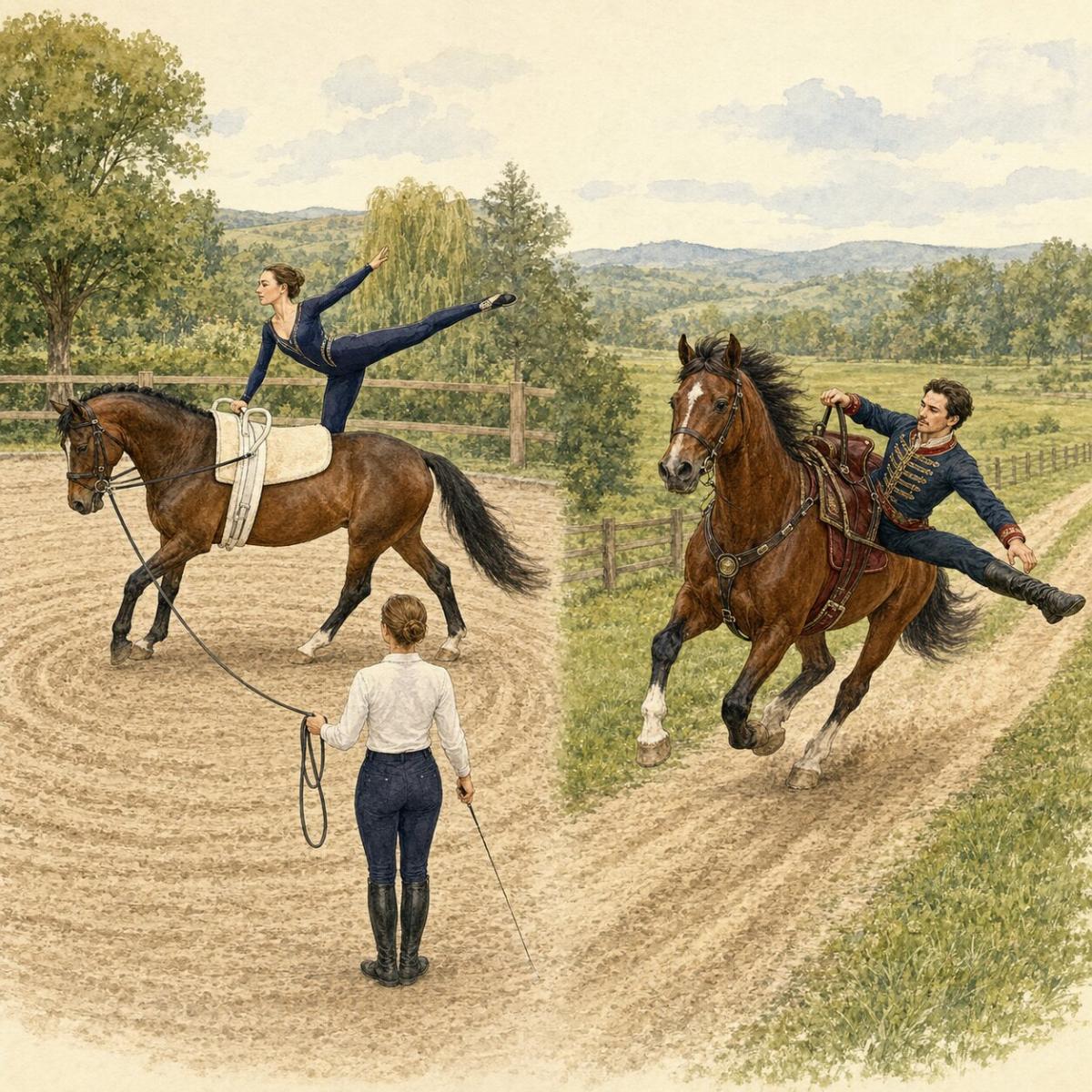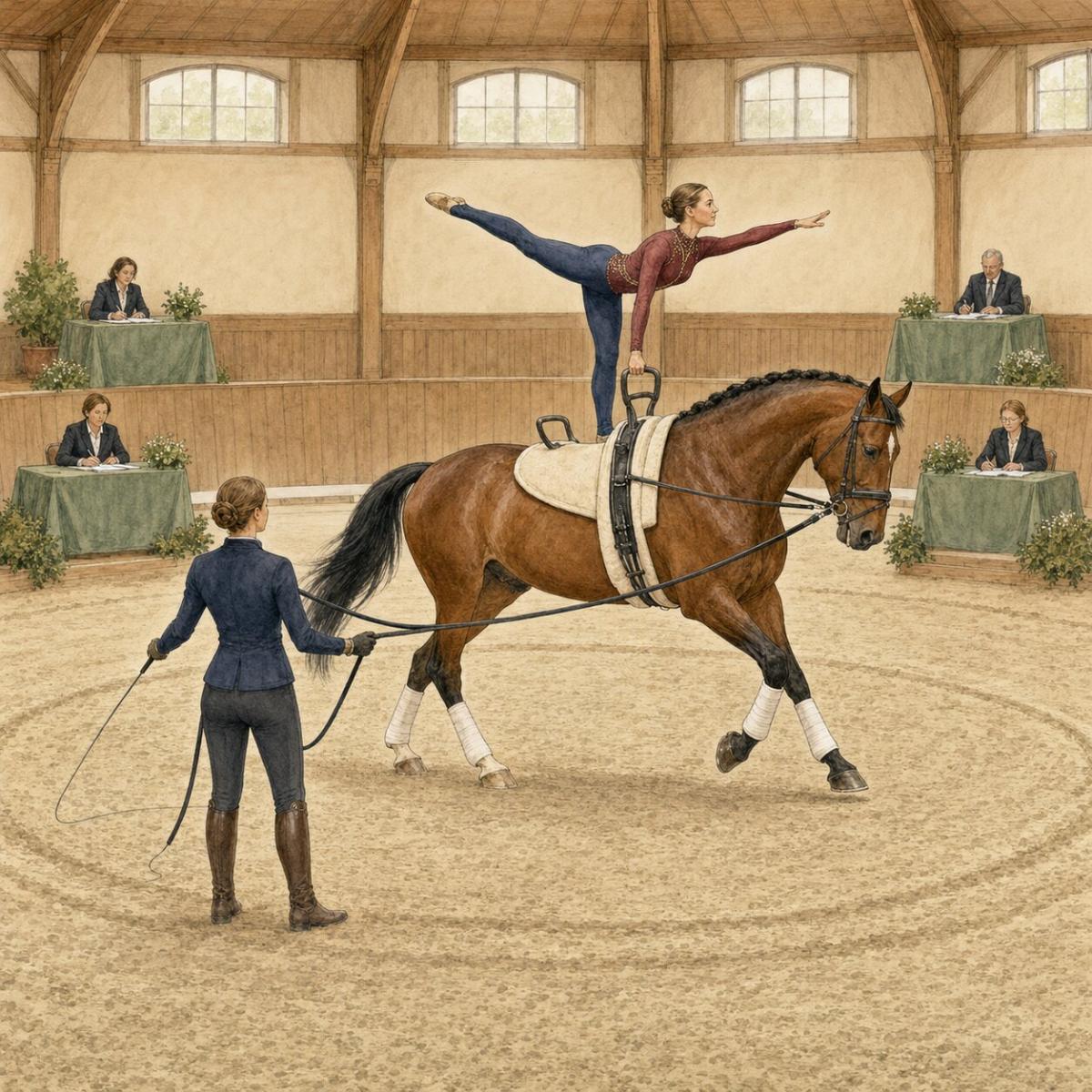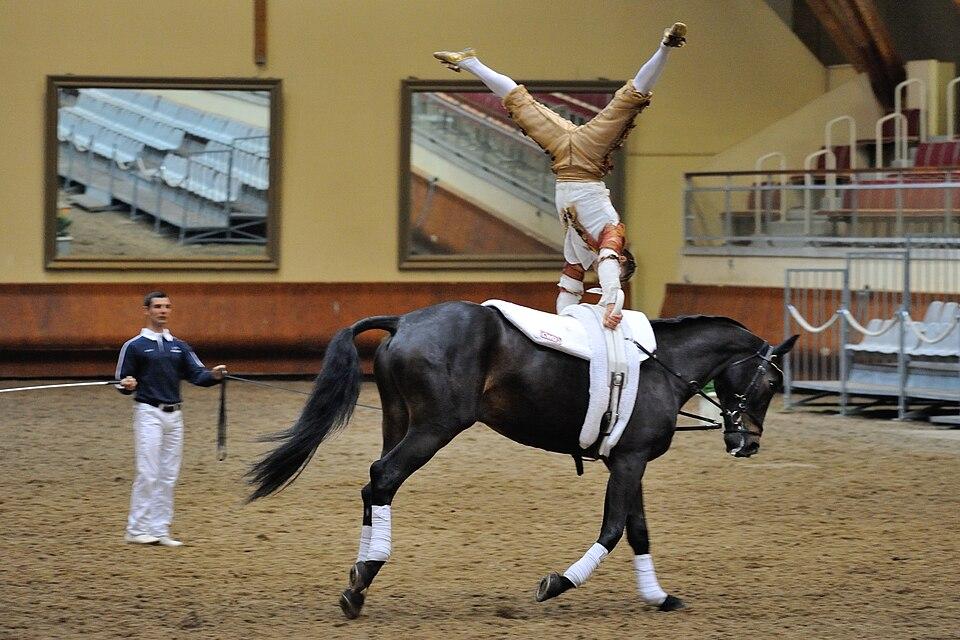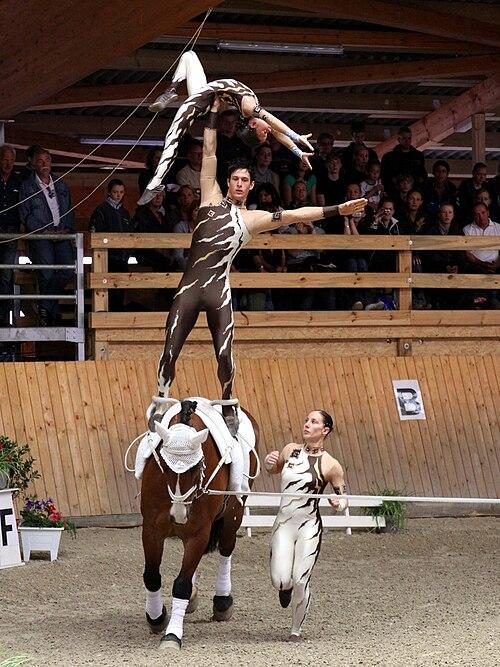
Equestrian vaulting combines horsemanship, gymnastics and teamwork. The vaulter performs exercises on a horse or pony moving on a circle under the control of a lunger. This makes the discipline quite different from conventional riding: beginners do not have to steer the horse themselves and can concentrate on balance and movement.
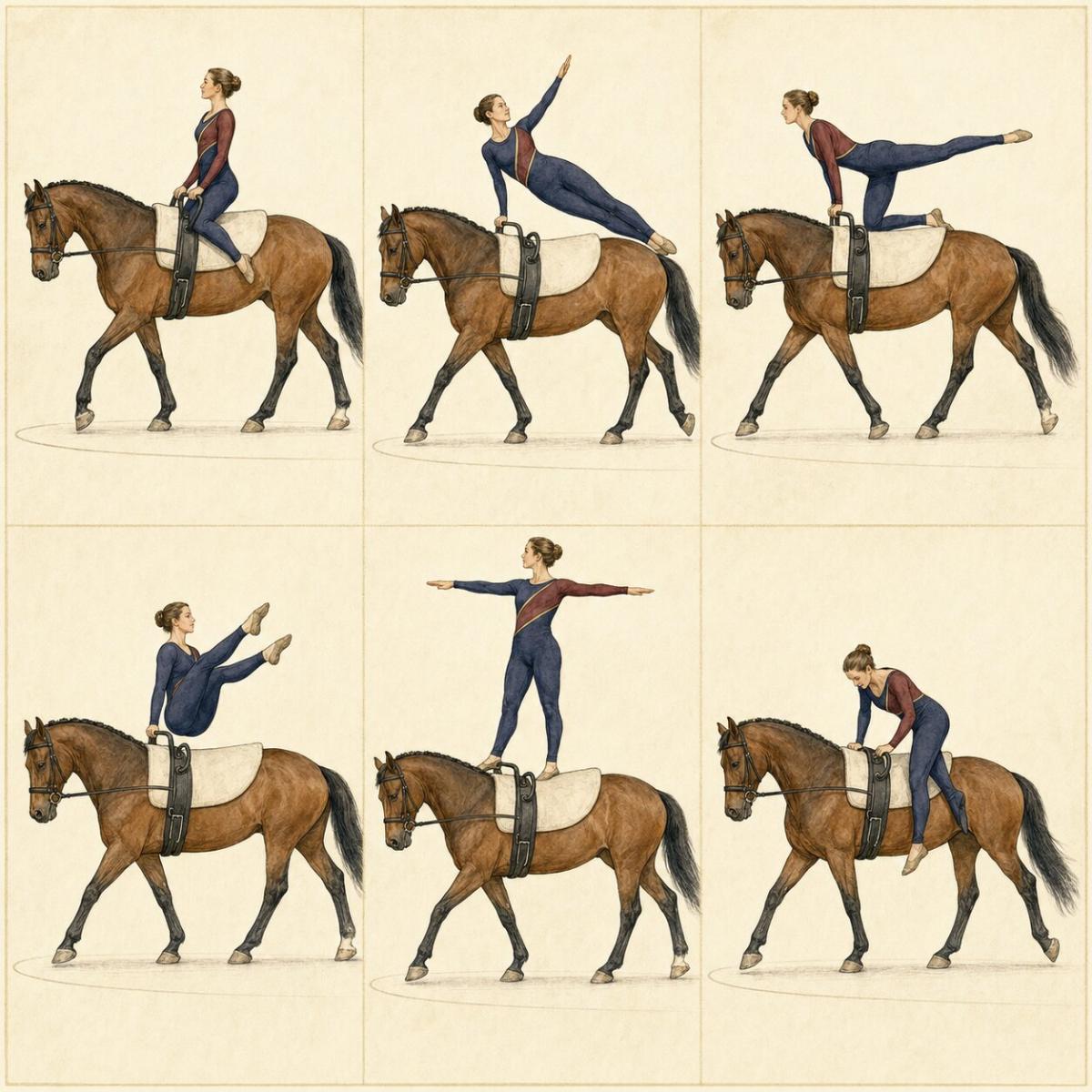
Training is progressive. The first sessions are not about reproducing the acrobatic figures seen in competition. They are primarily an opportunity to become familiar with the horse's movement, learn basic support positions and coordinate movements with its gaits.
The International Equestrian Federation (FEI) describes a progression combining physical preparation, groundwork, exercises on a vaulting barrel and basic movements before moving towards more advanced vaulting.
Do you need to know how to ride before starting vaulting?
Previous riding experience is not essential for discovering circle vaulting.
This is largely explained by the way the discipline works. The horse is controlled by the lunger, who stands at the centre of the circle. Beginners therefore do not have to learn how to steer a horse while simultaneously performing exercises.
Instead, they can initially concentrate on a few fundamental skills:
- finding their balance;
- moving with the horse;
- using the surcingle handles correctly;
- coordinating their movements;
- understanding the rhythm of the horse's gaits;
- learning to mount and dismount progressively.
An experienced rider will naturally have some useful knowledge: they may be more familiar with a horse's reactions and different gaits. However, this does not automatically make them an experienced vaulter.
The positions and support points used in vaulting differ from those of conventional riding. Vaulting therefore has its own specific technical foundations.
Can you start vaulting at any age?
Vaulting is not exclusively an activity for children.
Clubs may offer sessions for children, teenagers and adults, but there is no single minimum starting age that applies to every organisation. This depends on factors such as the horses and ponies available, coaching, facilities and the type of sessions offered.
For young children, training may begin very gradually with an introduction to the pony, simple balance exercises, basic movements and work at walk.
Adults can also start vaulting without previous gymnastics or riding experience. The main difficulty may simply be finding an appropriate group, as not every vaulting club offers beginner sessions for adults.
Physical condition will influence later progression, but there is no universal athletic standard that must be reached before trying the discipline.
Where can you learn equestrian vaulting?
Not every riding centre offers vaulting.
Teaching the discipline requires, among other things, a horse trained for vaulting, appropriate equipment, sufficient space for work on a circle and someone capable of controlling the horse while organising the vaulters' progression.
The French Equestrian Federation (FFE) describes vaulting as a discipline practised at walk or canter, with one or more vaulters performing on a horse or pony controlled on a lunge line.
For a first experience, it is therefore more important to find a facility that genuinely teaches vaulting than to immediately look for a competition-oriented club.
Before registering, a few questions can help clarify how the club operates:
- Does it accept complete beginners?
- Are there groups for the vaulter's age?
- Does it use a vaulting barrel?
- How are introductory sessions organised?
- What clothing and footwear are required?
- Is vaulting offered recreationally, competitively or both?
A trial session can also provide an opportunity to discover the discipline before committing to regular training.
The vaulting barrel: an important training tool
A significant part of vaulting training takes place without a horse.
A vaulting barrel is a stationary apparatus whose shape roughly reproduces the horse's back. It usually has handles similar to those found on a vaulting surcingle.
It can be used to learn or practise:
- hand placement;
- basic support positions;
- changes of position;
- certain mounts and dismounts;
- arm movements;
- transitions between figures.
It serves two purposes.
First, the vaulter can repeat a movement on a stationary apparatus, making it easier to understand and correct the technique. Second, the horse does not have to carry the vaulter through every repetition required when learning a new movement.
The FEI explicitly includes the barrel among the basic stages of vaulting development in its training material.
The barrel does not, however, replace the horse. It cannot reproduce the rhythm of the strides, movement of the horse's back or constant adjustments required when an exercise is performed on a moving animal.
What happens during a first vaulting session?
There is no single introductory session used by every club. The vaulters' age and experience, as well as the horses available, inevitably influence how a lesson is organised.
An introduction to vaulting will nevertheless usually involve several stages.
Becoming familiar with the horse and equipment
Before beginning the exercises, the vaulter is introduced to the horse or pony and its equipment.
In circle vaulting, the horse wears equipment including a vaulting surcingle with handles and a large pad.
Beginners also learn about the lunger's role. The lunger controls the horse's trajectory and gait from the centre of the circle.
This division of roles is fundamental. Even when a vaulter performs a figure alone, vaulting depends on coordination between the horse, the lunger and the vaulter.
Warming up on the ground
Vaulting places particular demands on balance, coordination, core stability and mobility.
Training therefore includes a physical warm-up before work on the horse. This may be complemented by groundwork or exercises on the barrel.
The purpose is not only to prepare the muscles. Some movements can be understood and corrected before they are attempted on a moving horse.
Discovering the horse's movement
The beginner must then learn something that cannot be reproduced on a barrel: how to move with the horse's strides.
The first exercises are simple. They may involve finding a stable position, holding the handles, changing the position of the arms or making small adjustments to posture.
The exact content depends on the instructor and the vaulter. There is no need to achieve a particular figure during the first lesson.
What do beginners learn before acrobatic figures?
Competition footage can easily create the impression that learning vaulting is mainly about accumulating increasingly spectacular figures.
The foundations are much less dramatic.
Moving with the horse rather than resisting it
Maintaining balance on a moving horse does not mean keeping the body completely still.
Every stride creates movement through the horse's back. The vaulter gradually learns to follow this movement while maintaining enough muscular control to remain stable.
A body that is excessively rigid cannot absorb movement efficiently. Too little muscular control, on the other hand, makes positions unstable.
Finding the balance between mobility and muscular control is therefore one of the technical foundations of vaulting.
Understanding support points
The surcingle handles provide important support, but exercises gradually require the vaulter to change the number and position of their support points.
The vaulter learns to transfer body weight and maintain balance as those supports change.
This work provides the foundation for both static figures and dynamic movements.
Synchronising movements with the horse's strides
A mount, swing or transition cannot be performed independently of the horse's movement.
Vaulters learn to recognise the rhythm of the gait and time their own movement accordingly.
This ability becomes particularly important when training progresses to canter.
When do beginners start vaulting at canter?
There is no fixed number of lessons after which a beginner should progress from walk to canter.
Progression depends on several factors:
- the vaulter's stability;
- coordination;
- ability to follow instructions;
- the exercises being practised;
- the horse;
- the club's training approach.
Canter produces a different movement and requires greater synchronisation.
Progression is therefore not simply a matter of performing the same exercise at a higher speed. The vaulter must learn to use the rhythm of the canter and adapt their movements to its mechanics.
French competition rules illustrate this progressive approach. The 2026 FFE Vaulting Rules include categories and programmes performed at walk as well as events performed at canter. Preparatory classes are intended to contribute to the progressive training of vaulters, lungers and horses.
Do you need to be flexible or very athletic?
High-level vaulting requires considerable physical ability. That does not mean all of those abilities are prerequisites for an introductory lesson.
Beginners can progressively develop:
- balance;
- core stability;
- coordination;
- mobility;
- strength;
- flexibility.
These qualities become increasingly important as movements become larger and more difficult.
Someone with a gymnastics background may have an advantage for certain movements. An experienced rider may understand the horse more readily. Other beginners arrive without experience in either activity.
Vaulting training is precisely what allows these missing skills to be developed.
What should you wear for your first vaulting session?
Clothing should primarily allow the vaulter to move freely without creating elements that could catch on the equipment.
A club may recommend:
- flexible, relatively close-fitting trousers or leggings;
- a comfortable top that allows free movement;
- footwear appropriate for vaulting;
- tying back long hair;
- removing jewellery and accessories that could interfere with movement.
Requirements for footwear and protective equipment should be checked directly with the club, as they may depend on the type of lesson and exercises being performed.
Following the facility's instructions is preferable to simply using equipment designed for conventional riding.
What role does the horse play in learning vaulting?
Vaulting is sometimes described as "gymnastics on horseback". The expression provides a useful visual description, but it is incomplete.
The horse is not a piece of gymnastic equipment.
Its strides create the movement to which the vaulter must adapt. Its balance, rhythm and behaviour directly influence how exercises can be performed.
A horse used for teaching must therefore be specifically prepared for vaulting. It needs to understand work on the lunge and be accustomed to the movements performed on its back.
The vaulter's training should also take the horse into account. Repeating an exercise unnecessarily on the horse when it could be practised on the barrel does not necessarily provide an additional training benefit.
This approach also reflects the broader development of equestrian sport. The FEI now includes training methods, equipment and recognition of physical and emotional stress among the areas addressed by its Equine Welfare Strategy Action Plan.
Can vaulting be practised recreationally?
Yes.
Competitive vaulting represents only one part of the discipline. Vaulting can also be practised recreationally, as an introduction to horses or as part of broader equestrian training.
The FEI also distinguishes competitive vaulting from forms of functional vaulting used to develop fundamental equestrian and physical skills. Its development material includes group work, physical preparation, groundwork, barrel training and elementary exercises as part of this approach.
There is therefore no need to have competition as a goal before starting.
For vaulters who later wish to compete, France has a progressive structure including Preparatory, Club and Amateur categories. As the rules can change between seasons, participation requirements should be checked when entering a competition.
Can you learn vaulting on your own?
Specific exercises performed on the horse require appropriate instruction.
Competition videos and demonstrations can help beginners become familiar with the discipline, but they cannot assess support points, timing or the horse's response.
Even a movement that appears simple can become unbalanced when transferred from a stationary barrel to a moving horse.
Independent training is therefore better suited to general physical preparation, provided it is appropriate for the individual. Technical vaulting movements are best learned and corrected in an environment designed for the discipline.
Common mistakes when starting vaulting
One common mistake is trying to progress by immediately reproducing the most visible figures in the sport.
Vaulting is instead built on a collection of less spectacular skills: balance, rhythm, support points, coordination and body control.
Another is neglecting barrel training because it appears less interesting than working on the horse. Yet the barrel allows movements to be repeated and corrected without placing unnecessary demands on the animal.
Finally, speed of progression is not an objective in itself. Two beginners will not necessarily start cantering or learn a new figure after the same number of sessions.
Frequently asked questions about starting equestrian vaulting
Do you need your own horse?
No. Facilities offering vaulting lessons generally use their own horses or ponies trained for the discipline.
Owning a horse would not remove the need to prepare that horse specifically for vaulting.
Can you start without any riding experience?
Yes. Because the horse is controlled by the lunger, introductory vaulting can be taught separately from learning how to steer and control a ridden horse.
How many lessons does it take before vaulting at canter?
There is no universal number. Progression to canter depends on the vaulter, horse, exercises being practised and the instructor's assessment.
Do you need to be flexible to start?
No. Flexibility can be developed progressively through training. Introductory exercises should be adapted to the beginner's abilities.
Can adults start vaulting?
Yes. The main practical difficulty may be finding a facility that offers suitable adult sessions, as availability varies between clubs.
Do you have to compete?
No. Vaulting can be practised recreationally or as a training activity without taking part in competitions.
Starting with the fundamentals
Getting started in equestrian vaulting does not mean immediately learning to stand on a cantering horse.
Training begins much more simply: understanding the lunger's role, learning basic support positions, practising on the barrel, experiencing the horse's strides and learning to coordinate your own movement with the horse's.
Difficulty then increases progressively. Walk may give way to canter, support points become fewer and movements become more complex.
This progression explains why previous experience in riding or gymnastics can be useful without being essential. Vaulting has its own fundamentals and should be learned as a discipline in its own right.
From the very first exercises, it already depends on the partnership that remains essential at the highest level: the balance between the vaulter, the lunger and the horse.
Sources and references
- French Equestrian Federation (FFE) – Vaulting
- French Equestrian Federation (FFE) – 2026 Circle Vaulting Rules
- International Equestrian Federation (FEI) – Vaulting Toolkit
- International Equestrian Federation (FEI) – Vaulting
- International Equestrian Federation (FEI) – Equine Welfare Strategy Action Plan