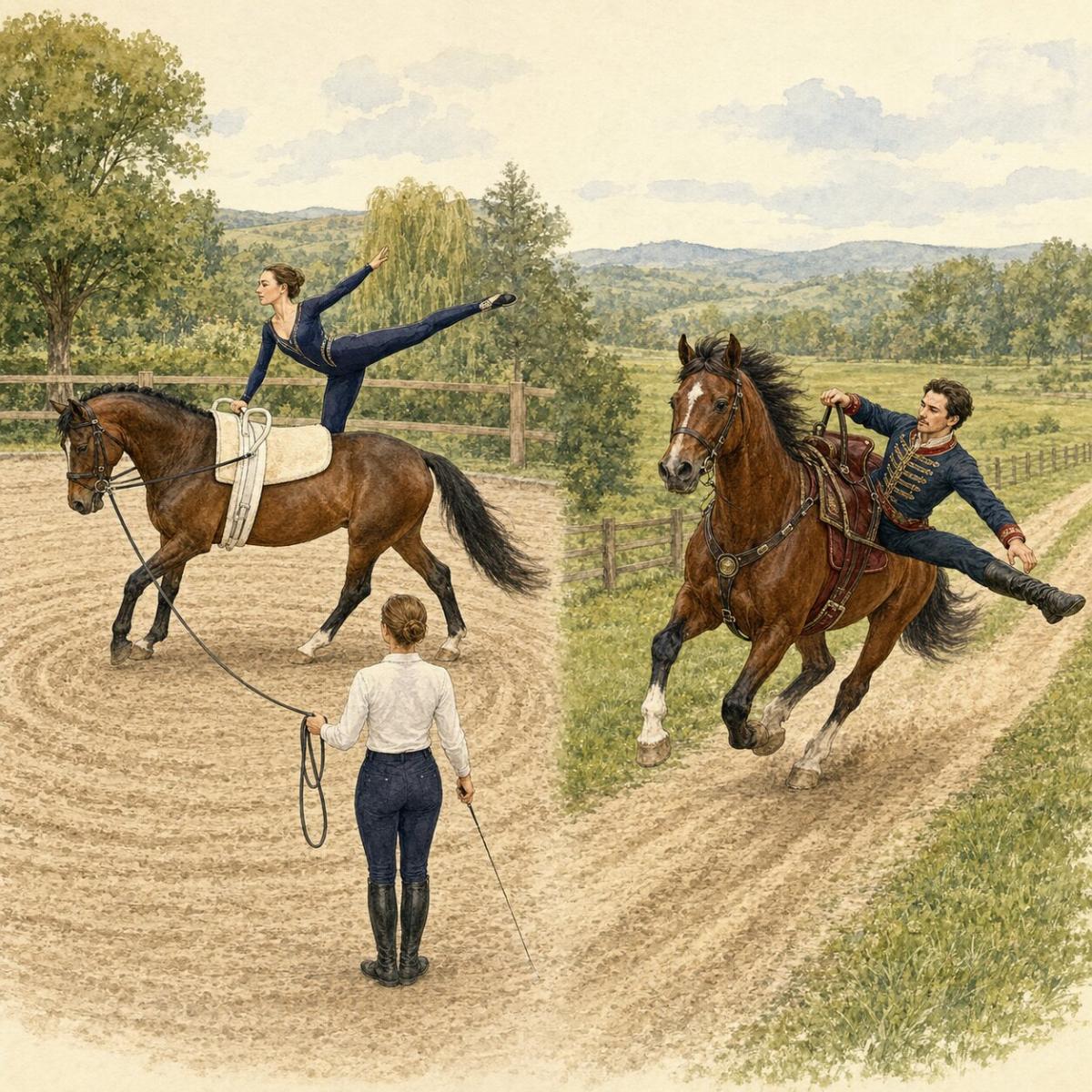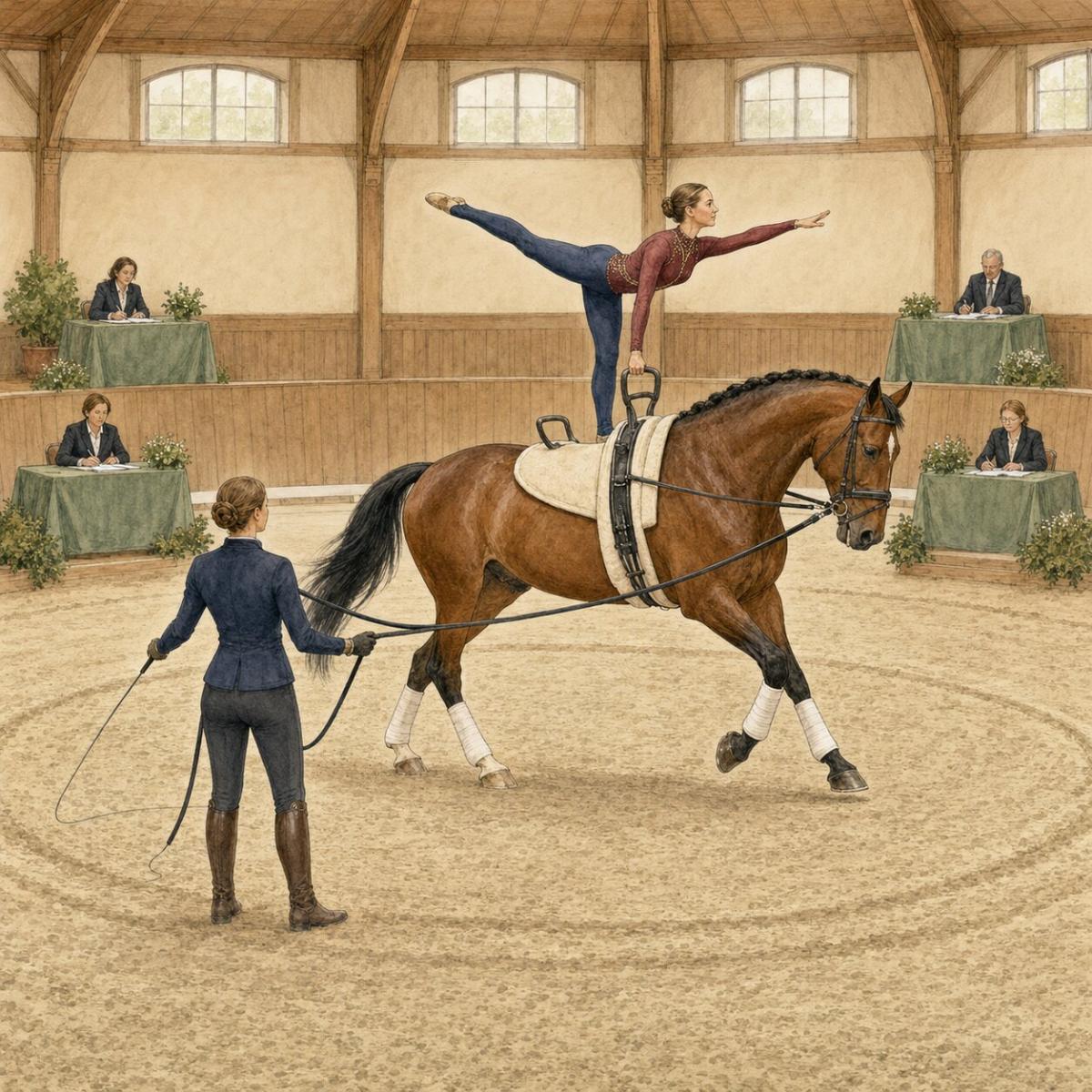
An equestrian vaulting competition is not simply about performing the most impressive figures possible. Vaulters present a specific programme on a horse moving in a circle under the control of a lunger, while several judges assess different aspects of the performance.
Depending on the category, a competition may include compulsory exercises, a freestyle programme and, at some levels, a technical test. The execution of the figures naturally contributes to the result, but it is not the only consideration: difficulty, artistic composition, and the performance of the horse and lunger can also influence the score.
In France, the exact format depends on the class entered. The 2026 French Equestrian Federation vaulting rules distinguish several Club and Amateur levels, with different requirements regarding gaits, programmes and scoring.
What types of vaulting competitions are there?
In France, competitive vaulting is organised into different levels designed to allow vaulters to progress through the sport.
The FFE rules include Preparatory, Club and Amateur classes. At international level, competitions are governed by the International Equestrian Federation (FEI).
The level entered can affect:
- age and qualification requirements;
- the gait required;
- the figures to be performed;
- the structure of the programmes;
- programme duration;
- the number of vaulters;
- scoring methods.
Competitors should therefore consult the rules for the current season rather than assume that competition formats remain unchanged from year to year.
Preparatory classes
Preparatory classes allow vaulters, horses and lungers to gradually gain competition experience.
They can be used to prepare for progression to a higher category or to introduce a team to competition conditions without immediately requiring the technical difficulty expected at more advanced levels.
Club competitions
Club classes form an important part of the French competitive system.
Depending on the class, programmes may be performed at walk or canter. The 2026 FFE rules, for example, provide for exercises at walk in some Club categories, while Club 1 and Club Élite perform the relevant exercises at canter.
These competitions progressively develop skills such as:
- balance;
- stability;
- coordination;
- compulsory exercises;
- transitions;
- freestyle composition;
- teamwork.
Amateur competitions
Amateur categories progressively increase the technical requirements.
At advanced levels, vaulters must master more complex movements and meet higher expectations in terms of execution, difficulty and programme composition.
Some advanced individual categories also include a technical test.
International competitions
At international level, vaulting is governed by the International Equestrian Federation (FEI).
International competition includes individual events, with separate male and female classes at the highest levels, as well as pas-de-deux and squad competitions. The programmes and scoring systems then vary according to the competitors' age category and competition level.
Who takes part in a vaulting competition?
Even when only one vaulter appears in the individual ranking, a vaulting performance always depends on several participants.
The vaulting horse
The vaulting horse moves in a circle under the control of the lunger.
It wears equipment including a vaulting surcingle with handles and a large pad designed for the discipline.
Its role is far from passive: the quality and regularity of its movement contribute directly to the performance.
The lunger
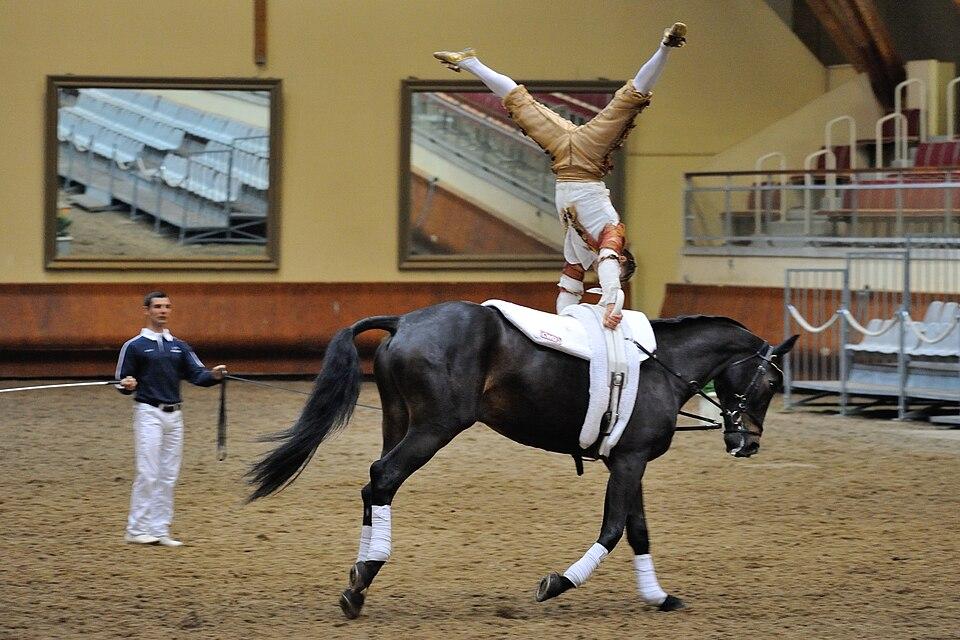
The lunger stands at the centre of the circle and controls the horse using a lunge line.
The lunger must manage aspects such as:
- trajectory;
- gait;
- rhythm;
- the horse's balance;
- its responsiveness throughout the programme.
A sudden change in rhythm can disrupt the vaulter's movements. The lunger's work is therefore an integral part of the performance.
The individual vaulter
In an individual competition, one vaulter performs exercises on the horse.
Depending on the level, the competitor may take part in compulsory, freestyle and, where applicable, technical programmes.
Although the ranking is individual, the performance remains the result of cooperation between the vaulter, horse and lunger.
Pas-de-deux
Pas-de-deux involves two vaulters performing on the same horse.
The partners build their performance around coordinated movements, simultaneous figures, transitions and two-person constructions.
The squad
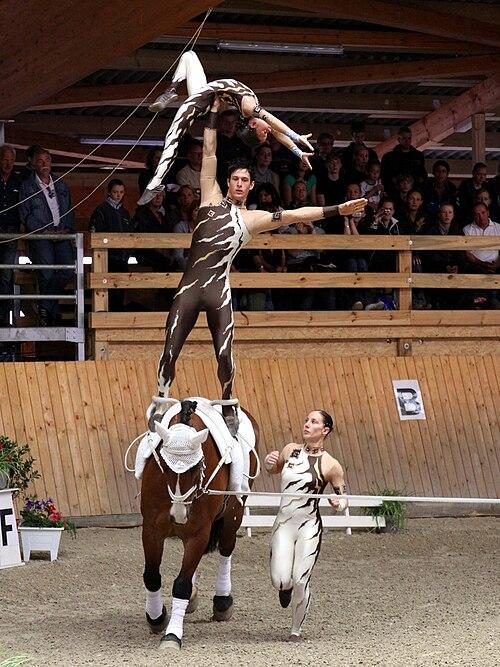
A vaulting squad consists of several vaulters working with the same horse and lunger.
The 2026 FFE rules specify the composition of teams according to the category. The number of competitors and the way they perform therefore vary between levels.
How do competitors prepare for a vaulting competition?
Competition begins well before entering the arena.
Participants must prepare their programme, horse, equipment and, where relevant, their music.
Entering the correct category
The class entered determines the rules competitors must follow.
Depending on the event, this may affect:
- age requirements;
- required qualifications;
- gait;
- compulsory exercises;
- programmes to be presented;
- programme duration;
- team composition.
The coach must therefore construct the programme according to the specific rules of the class entered.
Preparing the music
Music plays a particularly important role in freestyle and technical programmes.
It is not merely background sound. In programmes where artistic quality is assessed, the relationship between the movements and the musical composition contributes to the overall performance.
The audio file must also comply with the technical requirements set by the competition organiser.
Warming up the vaulters
As in any gymnastic activity, vaulters need to prepare their bodies progressively before competing.
A warm-up may focus on:
- joints;
- muscles used during the figures;
- balance;
- coordination;
- specific transitions.
Movements can also be practised on the ground or on a vaulting barrel before entering the competition arena.
Warming up the horse
The horse also needs an appropriate warm-up.
The aim is to prepare it progressively for the physical and mental demands of the performance rather than tire it before entering the arena.
The warm-up provides an opportunity to observe its movement, behaviour, response to the lunger and regularity of gait.
What happens when competitors enter the arena?
When called, the horse, lunger and vaulters enter the competition area according to the required procedure.
They present themselves to the judges before beginning the programme.
The lunger then establishes the horse on its circle and at the required gait. This also allows the judges to observe the horse before the exercises begin.
The judging panel gives the signal to start according to the applicable rules.
Timing and start procedures are also precisely regulated. They can vary depending on the programme, so there is no single rule such as "the clock always starts at this exact moment" that applies to every vaulting class.
What are compulsory exercises?
The compulsory programme allows competitors to be compared on the same technical basis.
Vaulters in the same category perform a series of exercises specified by the rules.
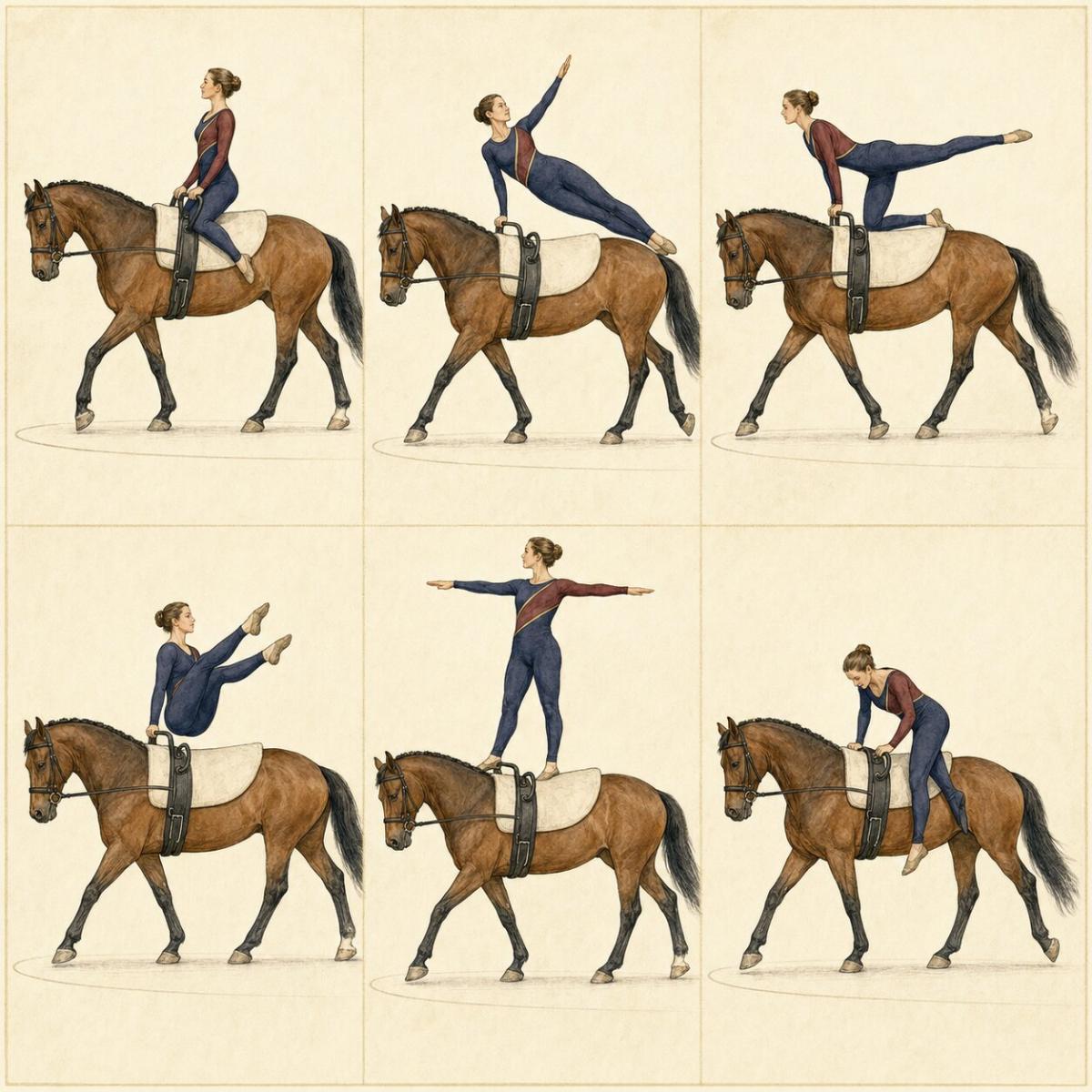
Depending on the level, these may include movements such as:
- the basic seat;
- the flag;
- the mill;
- scissors;
- standing;
- different swings;
- prescribed mounts and dismounts.
The exact content varies according to the category.
How are compulsory exercises scored?
Under the 2026 FFE rules, each compulsory exercise is scored from 0 to 10, with decimal scores permitted. The horse or pony and the lunger's performance also receive a score out of 10.
The technical assessment considers how accurately and correctly the required movement is performed.
An omitted figure, incorrectly performed exercise or movement carried out under conditions different from those required by the rules may result in a lower score, deduction or no points, depending on the circumstances.
Compulsories therefore primarily reward mastery of fundamental technique, rather than additional difficulty.
What is a freestyle programme?
The freestyle programme is a choreographed sequence of static and dynamic figures performed to music.
Unlike compulsories, the vaulter has considerably more freedom to select movements within the limits of the rules for their category.
The programme combines several dimensions:
- difficulty;
- quality of execution;
- transitions;
- use of the horse;
- choreographic composition;
- relationship with the music.
The 2026 FFE rules classify freestyle exercises according to different degrees of difficulty. Their classification takes into account criteria such as height above the horse, orientation, the complexity of dynamic movements and the number and stability of support points.
Individual freestyle
In an individual freestyle, the vaulter creates and performs the sequence alone.
The objective is not necessarily to include as many difficult figures as possible. A highly difficult movement performed poorly can create execution errors and reduce the overall quality of the performance.
The programme should therefore remain appropriate to the vaulter's actual abilities.
Pas-de-deux freestyle
In pas-de-deux, both partners create a shared choreography.
Synchronisation, transitions, balances and constructions must form a fluid whole without compromising the quality of the horse's movement.
Squad freestyle
A squad freestyle may involve several vaulters in different combinations.
Competitors alternate figures, transitions, changes of role and group constructions according to what is permitted in their category.
What is the technical test?
The technical test is used in certain advanced individual categories.
It lies somewhere between compulsories and freestyle: the vaulter must incorporate technical exercises specified by the rules into a more personal composition.
For the relevant categories, the 2026 FFE rules provide for assessment of technical exercises, artistic quality, execution, and the horse and lunger's performance.
The compulsory technical elements can be incorporated into the programme in the order chosen by the vaulter.
The technical test therefore assesses specific abilities while still leaving room for choreographic composition.
How is a vaulting performance scored?
The scoring system used in a vaulting competition depends on the programme and category.
There is therefore no single scoring formula that applies identically to every event.
Several major components nevertheless appear throughout the rules:
- execution;
- difficulty, where applicable;
- artistic quality;
- the horse and lunger's performance.
The weighting and way these scores are combined vary depending on the programme.
How is difficulty assessed?
Difficulty is particularly relevant in programmes where vaulters choose their own figures.
It does not simply refer to how spectacular a movement looks.
The FFE rules consider technical characteristics such as:
- height above the horse;
- orientation;
- complexity of dynamic movements;
- number of support points;
- stability of those support points.
A visually spectacular figure is therefore not automatically the one worth the most points.
Likewise, increasing difficulty without maintaining execution quality may ultimately work against the competitor.
How is execution assessed?
The execution score reflects the technical quality with which the programme is performed.
Judges assess the control of figures and transitions as well as errors made during their execution.
Losses of balance, poorly controlled movements, incorrect landings or harsh contact with the horse can affect the assessment.
The principle is important: performing a difficult figure is not enough — it also has to be performed well.
How is artistic quality assessed?
In programmes where it applies, the artistic score evaluates how the movements are organised into a complete composition.
It may consider aspects such as:
- programme structure;
- variety;
- transitions;
- use of the available space;
- relationship with the music;
- expression;
- overall coherence.
Music alone does not make a programme artistic. It should accompany choreography designed as a coherent whole.
Does the horse really receive a score?
Yes.
This is essential to understanding competitive vaulting: the horse is not simply a platform on which the exercises are performed.
Under the 2026 FFE rules, the horse or pony and the lunger's performance are assessed in the relevant compulsory, technical and freestyle programmes.
The quality of the performance depends in part on the horse's ability to maintain movement suited to the work being performed and on the lunger's ability to guide it correctly.
This component of the scoring reinforces the fact that vaulting remains an equestrian discipline.
What mistakes can be penalised?
Penalties vary according to the programme and category.
They may concern situations such as:
- an omitted figure;
- an error during a compulsory exercise;
- use of the wrong gait;
- a fall;
- exceeding the permitted time;
- unauthorised assistance;
- an incorrect resumption of the programme;
- non-compliant equipment;
- a situation creating a safety concern.
Not all faults have the same consequences.
The rules and scoring guidelines determine whether an error results in a deduction, a particular score, no points for an exercise or, in more serious circumstances, interruption or elimination.
What happens after a fall?
A fall does not necessarily have exactly the same consequences in every situation.
The rules determine whether and how the programme can be resumed and which deductions apply.
Safety remains the priority. If the vaulter cannot continue appropriately, or if the horse or participants are exposed to danger, the performance can be stopped.
Competition never justifies continuing a programme once conditions have become unsafe.
How is the final ranking calculated?
The final result depends on the programmes included in the class.
The different scores are combined using the coefficients specified for the relevant category.
Depending on the event, the final ranking may therefore incorporate different combinations of compulsory, freestyle and technical programmes.
This variation also explains why final scores from two different vaulting categories cannot necessarily be compared directly.
Tie-breaking procedures are likewise defined by the rules applicable to the competition.
What happens after the programme?
Once the performance is complete, the vaulters leave the horse and follow the required exit procedure.
The horse must then be allowed to recover appropriately. Its general condition and behaviour should continue to be monitored, particularly when it is scheduled to perform several times during the competition.
Scores are then calculated and published according to the organisation of the event.
For coaches and competitors, judges' score sheets can be particularly useful because they show where points were gained or lost and can help guide future training.
What role does horse welfare play in competition?
Horse welfare must remain a condition of performance rather than a secondary consideration.
Preparation should take into account the horse's level of training, physical condition, behaviour and previous workload.
Particular attention should be paid to:
- warm-up;
- recovery;
- arena surface;
- correct fitting of equipment;
- work on the circle;
- frequency and regularity of performances;
- signs of fatigue or discomfort.
This is especially relevant because the quality of the horse and lunger's performance contributes directly to competitive assessment.
A difficult figure does not turn a performance into a good one if it is achieved at the horse's expense.
How can spectators understand a vaulting competition?
For someone discovering the discipline, the highest figures and group constructions naturally attract attention.
But focusing solely on difficulty does not explain the final ranking.
It is also worth watching:
- the regularity of the horse;
- the vaulters' stability;
- precision of movement;
- transitions;
- mounts and dismounts;
- coordination between partners;
- programme composition;
- the relationship between music and movement;
- the lunger's work.
A less spectacular figure performed with excellent control can contribute more to the overall quality of a programme than a highly difficult movement containing several errors.
Frequently asked questions about vaulting competitions
Is a vaulting competition always performed at canter?
No.
The 2026 FFE rules still provide for exercises or programmes at walk in some categories. More advanced levels make greater use of canter.
How many vaulters compete on the same horse?
It depends on the event.
An individual competes alone, pas-de-deux involves two vaulters, and squad events include several participants. The exact number of competitors entered and permitted on the horse simultaneously depends on the category.
How long does a vaulting performance last?
Duration varies according to the programme and category. Exact time limits are defined by the rules for the relevant season and should not be generalised across the entire sport.
Does the horse receive a score?
Yes. The horse or pony and the lunger's performance contribute to the assessment specified by the rules. In the 2026 FFE compulsory programmes, this component is notably scored out of 10.
Do all difficult figures earn more points?
No. The rules determine which figures and levels of difficulty can be taken into account. A difficult movement that is poorly executed can also negatively affect the execution score.
Do you need to be an advanced vaulter to compete?
No. The French system includes several levels, including Preparatory and Club classes, allowing competitors to progress before reaching the most demanding Amateur categories.
A competition where acrobatics are only part of the performance
An equestrian vaulting competition combines gymnastic technique, horsemanship and artistic composition.
Compulsory exercises allow judges to compare competitors' technical fundamentals. Freestyle programmes provide greater freedom in terms of composition and difficulty, while the technical test used in certain advanced categories combines required elements with choreographic freedom.
But the final result never depends solely on the difficulty of the figures.
Execution quality, programme composition, the horse's regularity and the lunger's work all contribute to the performance.
This is precisely what distinguishes competitive vaulting from a simple acrobatic display: success belongs to the complete partnership formed by the horse, the lunger and the vaulters.
Sources and references
- French Equestrian Federation (FFE) – 2026 Circle Vaulting Competition Rules
- French Equestrian Federation (FFE) – Introduction to Vaulting
- International Equestrian Federation (FEI) – Vaulting Rules
- International Equestrian Federation (FEI) – Vaulting Guidelines