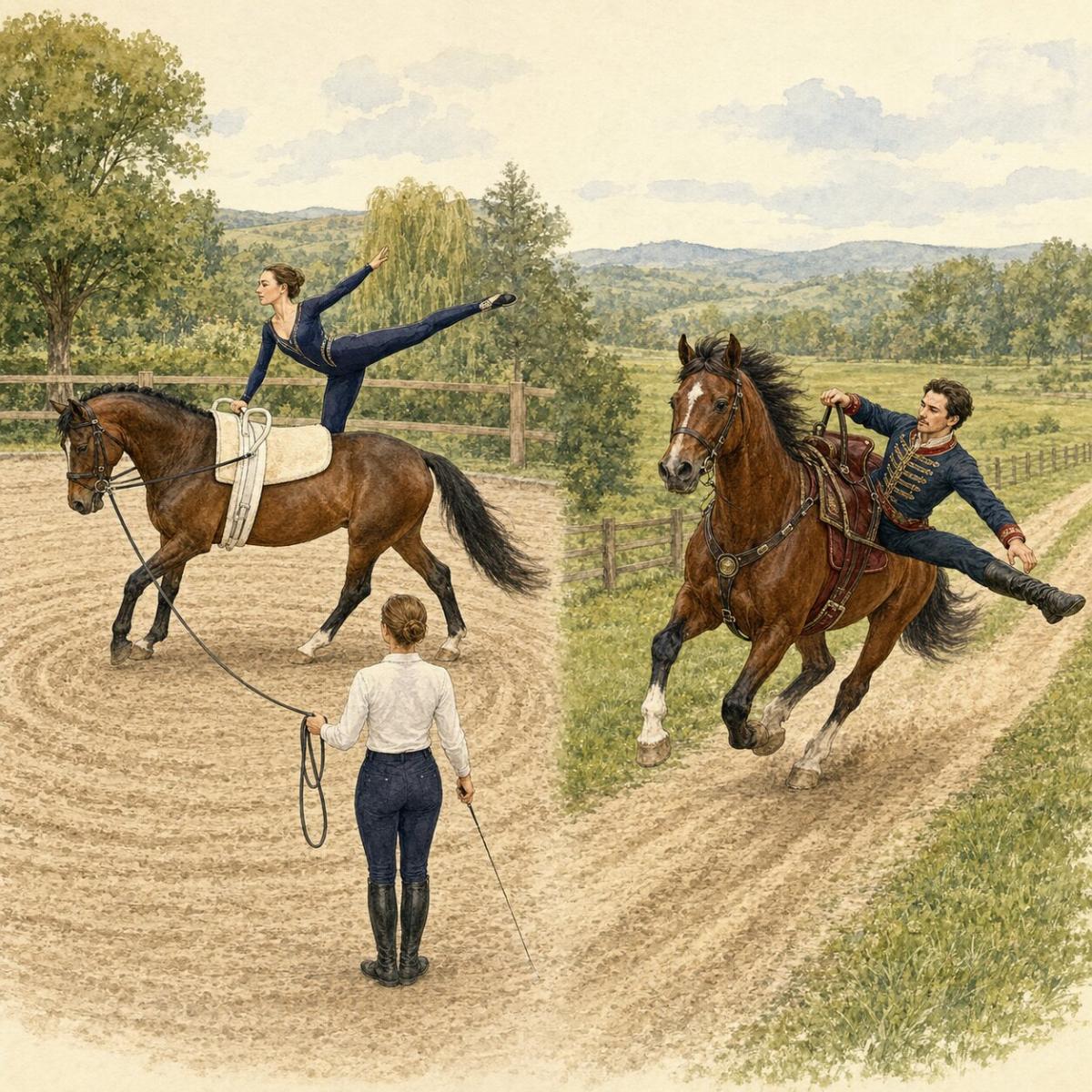
Circle vaulting and Cossack vaulting both belong to the broad family of equestrian acrobatics. In both cases, the performer executes movements on or around a horse in motion. Yet the two practices differ considerably in the horse's trajectory, speed, equipment, the rider's role and the context in which they are performed.
Circle vaulting is now a codified equestrian sport, performed on a horse controlled on a lunge line and included in competitions organised by the French Equestrian Federation (FFE) and the International Equestrian Federation (FEI). Cossack vaulting, often associated with straight-line vaulting and djiguitovka, relies more heavily on fast movements performed around the saddle, generally while the horse is galloping.
The history of both practices is complex. The term "Cossack vaulting" is associated in particular with equestrian traditions from the Caucasus, although comparable forms of horseback acrobatics have existed among other horse-riding cultures.
What is circle vaulting?
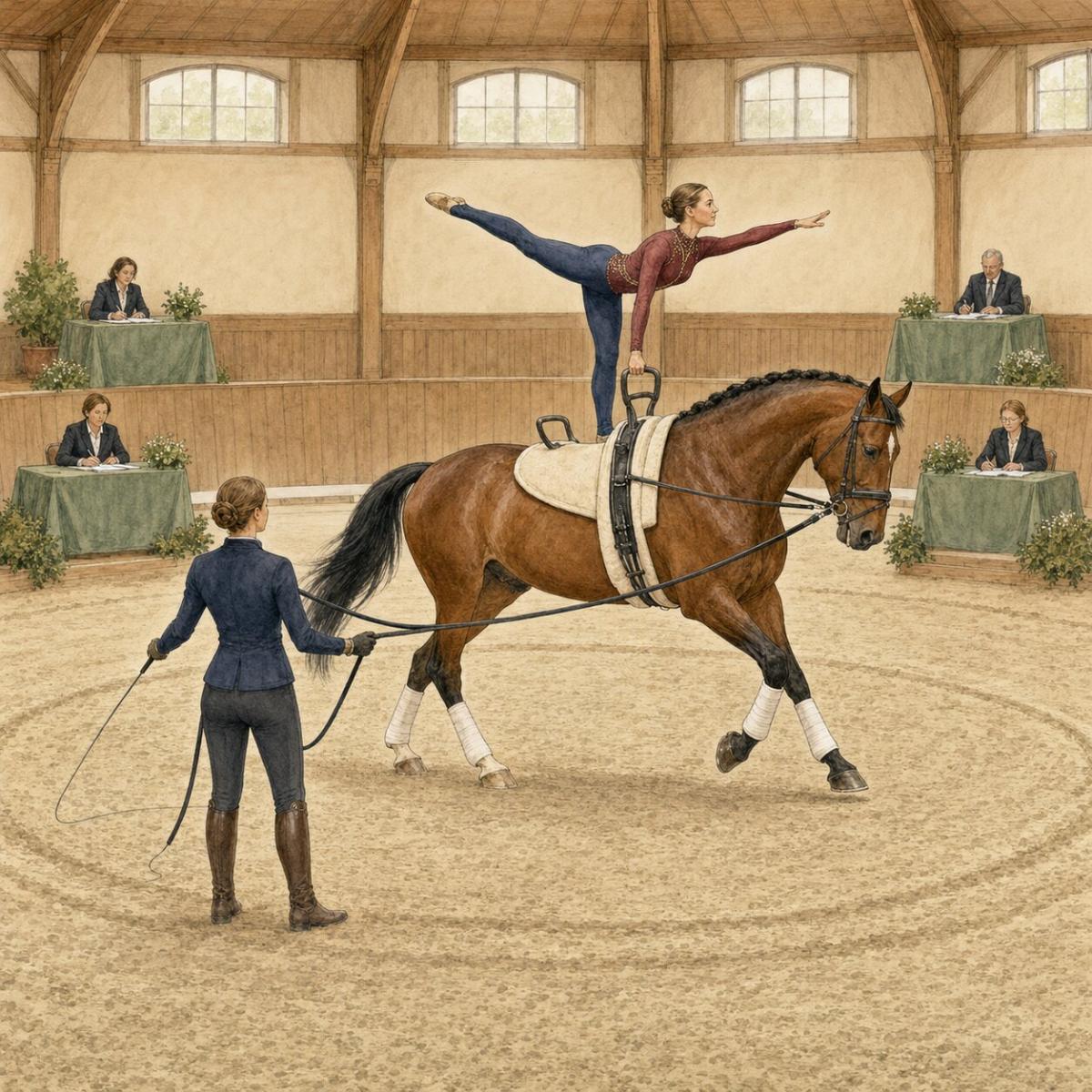
The French Equestrian Federation (FFE) describes circle vaulting as a practice in which one or more vaulters perform on a horse or pony at walk or canter while the horse is controlled on a lunge line.
The lunger stands at the centre and controls the horse's pace and trajectory. The horse wears a vaulting surcingle with handles and a large pad, providing the vaulters with the support needed to perform their exercises.
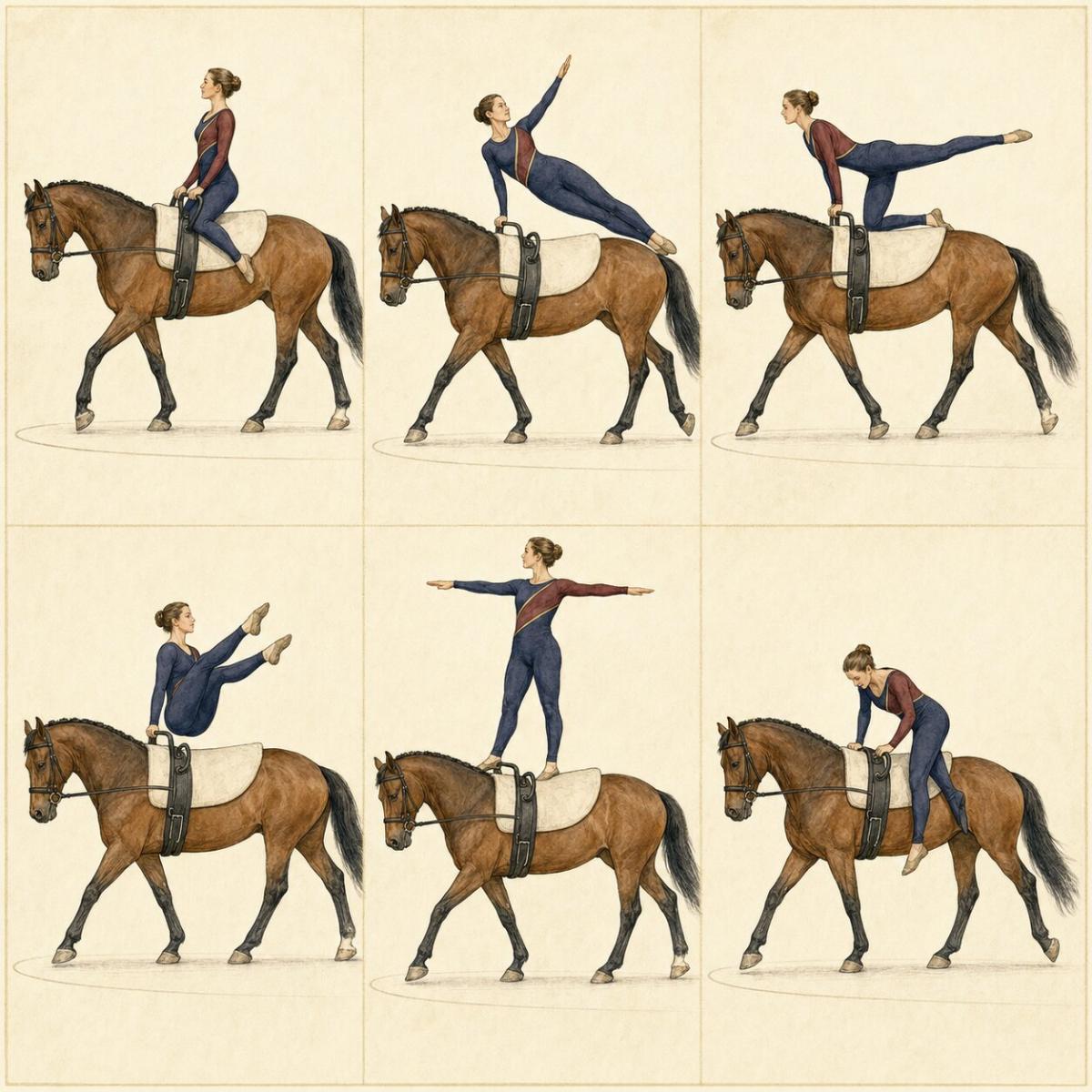
Figures can include:
- the basic seat;
- the flag;
- the mill;
- scissors;
- standing;
- different swings;
- mounts and dismounts;
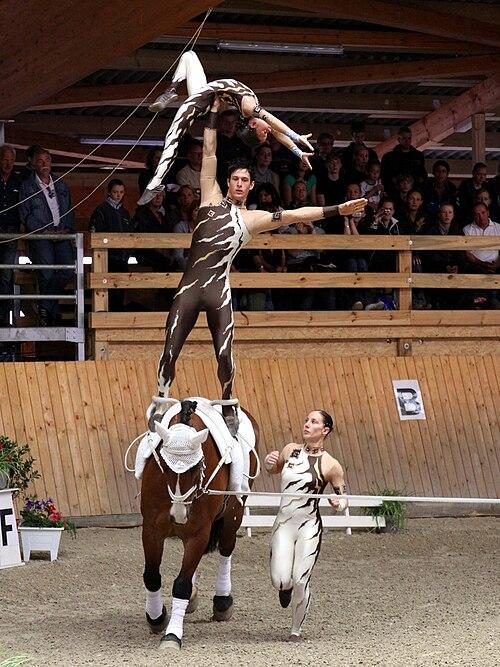
- figures involving several vaulters.
Vaulting can be practised as an introductory activity, recreationally or as a competitive equestrian sport.
A partnership between horse, lunger and vaulter
One of the defining characteristics of circle vaulting is that the vaulter does not directly control the horse.
The lunger manages its pace and trajectory, allowing the vaulter to concentrate on movement, balance and coordination.
The performance therefore depends on three partners:
- the horse;
- the lunger;
- the vaulter.
This partnership is particularly important in competition, where the horse's performance also contributes to the overall assessment.
A fully codified sport
Circle vaulting has detailed rules, competition categories and scoring systems.
For the 2026 World Championships, the FFE lists four international categories: men, women, pas-de-deux and squad. Depending on the event, vaulters perform compulsory, technical or freestyle programmes set to music.
The discipline therefore combines gymnastic ability and balance with coordination with the horse and the artistic dimension of the performance.
What is Cossack vaulting?
Cossack vaulting generally refers to a fast form of equestrian vaulting in which the rider performs figures around the saddle while the horse is galloping.
Unlike circle vaulting, the horse is not normally controlled on a lunge line during the performance. It generally follows a straight trajectory, which explains the association with straight-line vaulting.
The rider may move down the side of the horse, stand up, lower themselves towards the ground or temporarily disappear behind the horse's body before returning to the saddle.
Today, this form of vaulting is mainly encountered in:
- equestrian shows;
- stunt riding;
- demonstrations;
- some historical reenactments;
- film and other equestrian performing arts.
It should therefore not be regarded simply as a faster version of competitive vaulting: its organisation and technical repertoire follow a different approach.
Djiguitovka and Cossack vaulting: what do these terms mean?
The history requires some care.
The Bibliothèque nationale de France and Centre national des arts du cirque associate djiguitovka with equestrian practices from the Caucasus, particularly those of the Terek and Kuban Cossacks.
These riders performed exercises requiring considerable skill, such as dismounting and remounting a moving horse, picking objects up from the ground, standing upright or moving beneath the horse's neck or belly.
However, such techniques were not exclusively Cossack. The same source draws parallels with movements found among other horse-riding peoples, including Mongolian and Ossetian traditions and those of the North American plains.
It would therefore be an oversimplification to claim that all forms of fast horseback vaulting originated with the Cossacks.
Today, the French expression voltige cosaque refers to a range of performance practices strongly influenced by this tradition of equestrian virtuosity.
First difference: circle versus straight line
This is the most immediately visible difference between the two disciplines.
The horse circles the lunger in competitive vaulting
In competitive vaulting, the horse travels around the lunger in a circle. The aim is to maintain a sufficiently regular trajectory and rhythm to give the vaulters a predictable movement to work with.
At international competition level, the FEI describes vaulting as being performed while the horse canters on a 15-metre circle, controlled on a lunge line.
The horse therefore follows the same general trajectory throughout the performance.
The straight line dominates in Cossack vaulting
In Cossack vaulting, the horse is generally sent along a straight track.
This gives the rider enough space to perform a fast figure and return to position before reaching the end of the track.
A French presentation of the practice published on an FFE-affiliated website describes figures most commonly performed at a fast gallop along a straight line.
Not every demonstration is strictly linear, however. The available space and staging of a performance can alter the horse's trajectory.
Second difference: who controls the horse?
The lunger in competitive vaulting
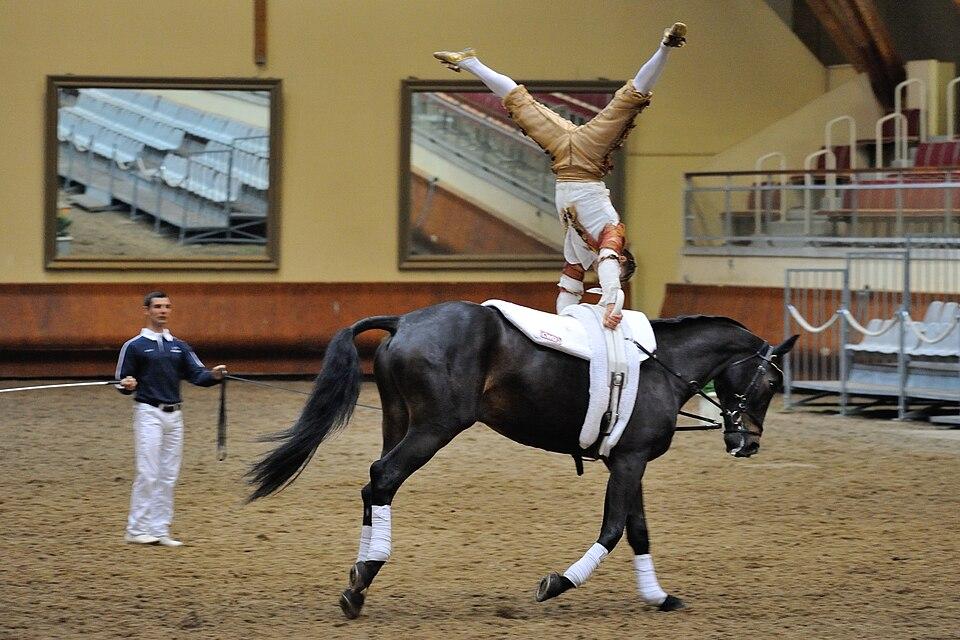
In circle vaulting, the roles are clearly divided: the lunger controls the horse while the vaulter performs the figures.
The vaulter therefore does not need to hold reins during the programme.
This arrangement allows the lunger to monitor the horse's rhythm, trajectory and behaviour while the vaulter changes position.
The rider in Cossack vaulting
The situation is very different in Cossack vaulting.
The rider prepares the horse's departure and needs a sufficiently stable trajectory before performing a figure. Once hanging from the horse's side, lying along its neck or standing, however, the rider obviously cannot use the same aids as when seated normally in the saddle.
The horse must therefore learn to maintain its movement despite major changes in the rider's position.
This apparent independence is the result of prior training. The horse is not simply left to run while the rider performs a trick.
Third difference: speed
The two disciplines do not seek the same type of movement.
Regularity before speed in circle vaulting
In competitive vaulting, the horse may work at walk in some forms or categories, while canter plays a central role at higher levels of competition.
Speed itself is not the objective.
The lunger aims for a regular gait that allows the vaulters to anticipate the movement of the horse's back. A sudden change in rhythm or gait can disrupt an entire figure.
A faster gallop in Cossack vaulting
Cossack vaulting, by contrast, is strongly associated with a fast gallop.
Speed contributes to the dynamics and spectacular appearance of the figures. The rider may descend very low along the horse's side, return to the saddle or move rapidly from one position to another.
Greater speed also increases the potential consequences of an error. The length of the track, the horse's preparation and the vaulter's technical ability therefore become particularly important.
Fourth difference: equipment
The equipment used makes the two practices easy to distinguish.
A surcingle for circle vaulting
In competitive vaulting, the horse does not wear a conventional riding saddle.
Instead, it is equipped with a vaulting surcingle with handles and a large pad. The FFE specifically identifies these pieces of equipment in its official presentation of the discipline.
The handles provide support for many movements, while the pad provides an appropriate surface for the vaulters.
The complete equipment used will vary according to the level of practice and the applicable rules.
Specialised equipment for Cossack vaulting
Cossack vaulting instead relies on a saddle adapted to movements performed around the horse.
Depending on the school, equipment and figures being performed, different support or securing points may be used.
The rider may need these points of support to move down the horse's side, hang from the saddle or return quickly to position.
This equipment should not be improvised by modifying an ordinary saddle. Some Cossack vaulting figures place very different demands on the equipment from conventional riding, making correct fitting and inspection particularly important.
Fifth difference: the figures
The technical repertoire of each discipline reflects its different objectives.
Codified gymnastic figures in circle vaulting
Circle vaulting places particular emphasis on:
- balance;
- strength;
- flexibility;
- stability;
- coordination;
- quality of transitions;
- movements involving several vaulters;
- artistic interpretation in freestyle programmes.
Some figures form part of a recognised technical vocabulary shared by competitors.
Competition rules make it possible to compare performances and define the exercises expected in different categories.
Movements around the horse in Cossack vaulting
Cossack vaulting makes much greater use of the space around the saddle and the horse's body.
Its repertoire may include figures in which the rider:
- stands upright;
- lies along the horse's neck;
- moves down one side of the horse;
- hides behind the horse's body;
- descends towards the ground and returns to the saddle;
- picks up an object without stopping;
- moves rapidly from one side to the other.
The BnF and CNAC document several such movements in the history of djiguitovka, including picking objects up from the ground, standing and moving beneath the horse's belly or neck.
Modern names and exact forms of individual figures can nevertheless vary between performers, schools and traditions.
Sixth difference: codified sport versus performing art
Circle vaulting has an organised competitive structure
Circle vaulting is recognised by the FFE in France and the FEI internationally.
It has formal rules, categories, judges and championships.
A vaulter may therefore begin with introductory sessions at an equestrian centre and eventually progress through a genuine competitive pathway.
Cossack vaulting remains closely associated with performance
Today, Cossack vaulting is primarily seen in equestrian shows and performing arts.
In France, it is not organised through the same federal competition structure as circle vaulting. Training is more often provided by performers, stunt riders and specialised organisations.
This does not mean that Cossack vaulting lacks technique or structured training. Rather, its transmission does not rely on the same standardised sporting system.
Where did these two forms of vaulting come from?
The history of equestrian vaulting is considerably more complex than a simple opposition between a "modern sport" and a "Cossack tradition".
Ancient forms of equestrian acrobatics
Displays of agility on horseback are not unique to a single civilisation.
The FEI notes that the distant history of vaulting includes ancient representations and equestrian exercises performed during Roman games.
The BnF also documents how different equestrian cultures developed their own forms of horseback virtuosity.
It is therefore more accurate to speak of multiple origins of equestrian acrobatics than to search for a single inventor of vaulting.
From martial techniques to equestrian performance
Some movements that are spectacular today once had more practical purposes.
Hiding behind the horse, picking something up without stopping or changing position very quickly could have been useful in a military context.
The BnF and CNAC explain how a vocabulary of movements originating partly in martial equestrian practices was later transferred to the arena and equestrian performance.
From the 18th century onwards, horseback acrobatics became an important part of the development of the modern circus.
Circle vaulting becomes an international sport
Circle vaulting followed a different path, gradually becoming structured around defined exercises, rules and competitions.
The FEI states that vaulting was officially recognised as a discipline in 1983.
This codification largely explains the difference between the two practices today: one developed into an international competitive sport, while the other remained strongly associated with demonstrations of horsemanship and equestrian performance.
Can the same horses practise both disciplines?
There is no specific horse breed reserved for vaulting.
The qualities required depend mainly on the work being performed, the individual horse and its training.
Horses used for circle vaulting
A circle-vaulting horse must learn to:
- work correctly on a lunge line;
- maintain a regular gait;
- accept movement on its back;
- remain attentive despite the presence of several vaulters;
- maintain its balance on a circle.
A regular gait is particularly important because vaulters use the rhythm of the horse's strides to coordinate their movements.
Horses used for Cossack vaulting
A Cossack-vaulting horse faces different demands and must be prepared to:
- maintain its trajectory without constant aids;
- accept rapid changes in the rider's position;
- remain calm when the rider moves alongside its flank or neck;
- maintain its gait during a figure;
- respond correctly before and after the movement.
In both disciplines, individual temperament, education and training matter more than belonging to a particular breed.
A horse that is calm during conventional riding is not automatically prepared for acrobatic movements performed on its back or around its body.
Which type of vaulting is more dangerous?
It is difficult to rank the risks universally. The vaulter's experience, the difficulty of the figures, speed, the horse and training conditions all have a major influence.
The nature of the risks is nevertheless different.
In circle vaulting, falls can occur during mounts, dismounts, swings or figures performed above the horse.
Cossack vaulting generally adds greater speed and positions in which the rider's body comes much closer to the ground or the horse's limbs.
It therefore requires specialised training.
Why these figures should not be improvised
The movements performed by experienced vaulters are the result of progressive technical training.
Watching a figure in a show or online video does not provide enough knowledge to reproduce it safely.
Training generally begins with groundwork and stationary equipment before movements are gradually transferred to a properly prepared horse.
Cossack vaulting figures should therefore not be attempted:
- on a horse that has not been prepared for them;
- with improvised equipment;
- without competent instruction;
- on unsuitable ground;
- simply by copying a movement seen in a video.
Circle vaulting vs Cossack vaulting: the essential differences
The distinction between the two disciplines goes far beyond the shape of the track.
Circle vaulting involves a horse controlled on a lunge line, a lunger and one or more vaulters. It prioritises a regular gait that allows codified gymnastic and artistic movements to be performed. It has an established national and international competition structure.
Cossack vaulting generally favours a straight trajectory and a faster gallop. The rider uses specialised equipment to move around the horse and perform rapid figures. Today, it is mainly associated with equestrian shows, stunt riding and the performing arts.
The main differences can therefore be summarised without reducing them to a simple question of speed: circle vaulting is built around the lunger, a circular trajectory, regular movement and codified sporting exercises, whereas Cossack vaulting is characterised by straight-line movement, greater speed, specialised saddle work and a strong connection with equestrian performance traditions.
Frequently asked questions about circle and Cossack vaulting
Is Cossack vaulting really Cossack?
The name refers to djiguitovka traditions associated particularly with the Terek and Kuban Cossacks. However, comparable techniques existed among other horse-riding peoples. It would therefore be inaccurate to attribute every form of straight-line vaulting exclusively to the Cossacks.
Is circle vaulting always performed at canter?
No. The FFE also provides for vaulting at walk, particularly in some categories and during training. Canter becomes central at higher levels of competitive vaulting.
Is Cossack vaulting always performed in a straight line?
No, although the straight line is its most characteristic format. Demonstrations can be adapted to the available space.
Is a saddle used for circle vaulting?
Competitive vaulting primarily uses a vaulting surcingle with handles and a large pad, rather than a conventional riding saddle.
Are there Cossack vaulting competitions?
Demonstrations, gatherings or competitive formats may exist depending on the tradition and organisation. In France, however, Cossack vaulting does not have the same codified federal competition structure as circle vaulting.
Can you learn Cossack vaulting at an equestrian centre?
Circle vaulting is offered by various equestrian centres. Learning Cossack vaulting generally requires finding a professional or organisation specialising in equestrian performance, straight-line vaulting or stunt riding.
Two forms of equestrian acrobatics, but two different worlds
Circle vaulting and Cossack vaulting share the same fundamental requirement for coordination between horse and human, but their modern objectives are very different.
The first has become a codified sport in which the horse moves in a circle under the control of a lunger. The second retains more of the heritage of demonstrations of equestrian virtuosity: speed, spectacular changes of position and movements around the saddle.
Describing them simply as "slow vaulting" and "fast vaulting" would therefore be misleading. Trajectory, control of the horse, equipment, figures, history and sporting organisation are what truly distinguish the two practices.
Sources and references
- French Equestrian Federation (FFE) – What is vaulting?
- French Equestrian Federation (FFE) – Vaulting at the 2026 World Championships
- International Equestrian Federation (FEI) – History of Vaulting
- Bibliothèque nationale de France / Centre national des arts du cirque – Origins of equestrian acrobatics
- Bibliothèque nationale de France / Centre national des arts du cirque – Equestrian vaulting
- Écurie du Lac / FFE website – Presentation of Cossack vaulting