
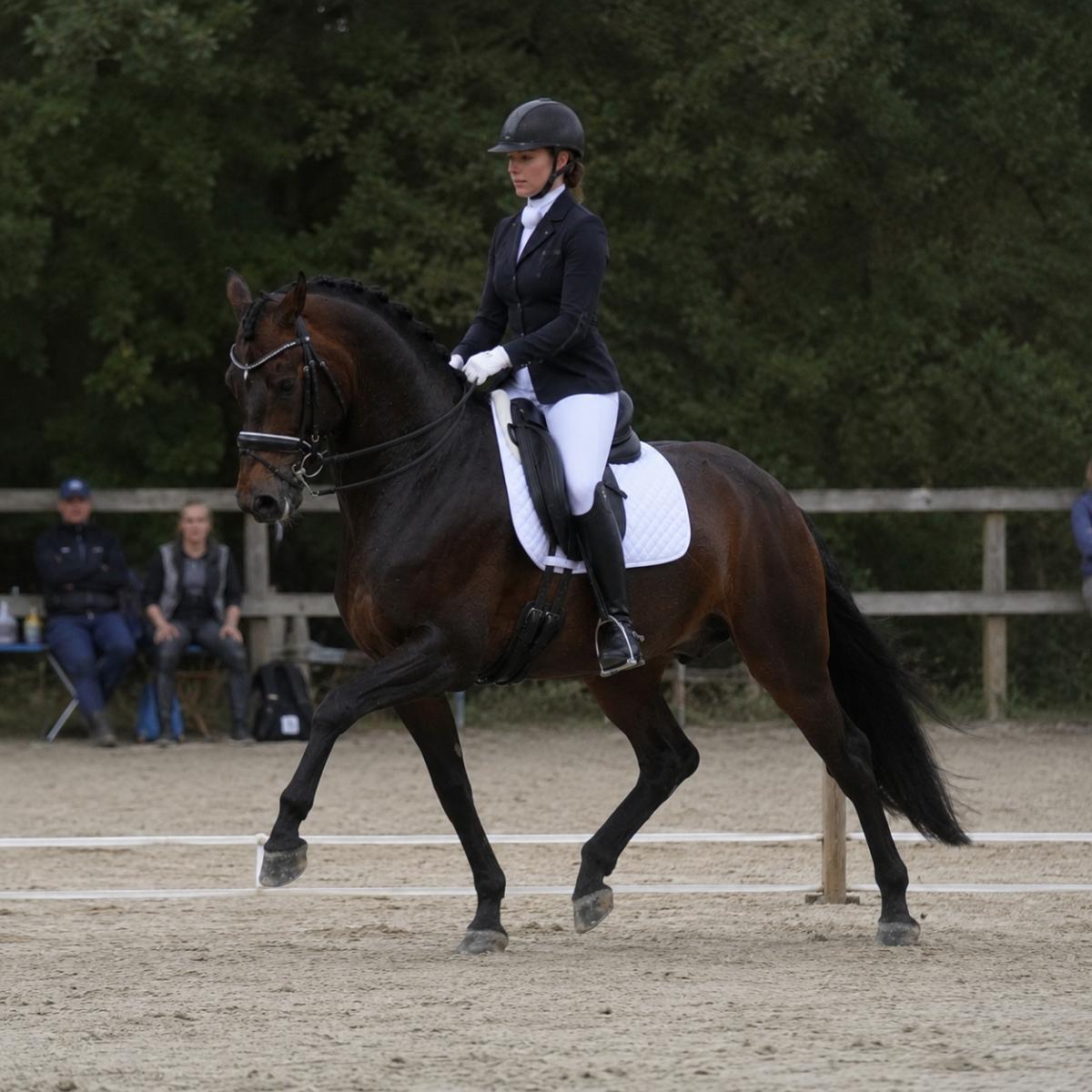
To many spectators, some dressage horses appear to dance. This impression is particularly striking in highly collected movements: the strides become slower and more elevated, the horse seems to bounce above the ground, and the rider's aids can become difficult to perceive from the stands.
The passage illustrates this impression particularly well, with its highly collected and expressive trot. The piaffe, performed with very little forward movement, creates a different but equally unusual visual effect.
These movements are not choreography learned in the human sense of the word. Their appearance results from a combination of the horse's natural gaits, the way dressage training modifies them, collection, coordination, the mechanical properties of the limbs and interaction with the rider.
Dressage progressively transforms locomotion
Dressage is not simply about teaching a horse a succession of movements.
Training progressively modifies how the horse performs certain movements and responds to the rider's requests.
At the highest levels, the differences become particularly visible between ordinary trot, collected trot, passage and piaffe.
A biomechanical study of Grand Prix horses compared trot in hand, working trot, collected trot, passage and piaffe. As collection increased, speed and stride length decreased while stance duration increased. The stifle and hock also showed greater flexion in passage and piaffe. (pubmed.ncbi.nlm.nih.gov)
The horse is therefore not simply performing the same stride while lifting its legs higher. The mechanical organisation of the movement changes.
This transformation contributes to the distinctive visual impression created by advanced dressage.
Rhythm creates an impression of choreography
Trot is a diagonal gait: the opposite forelimb and hindlimb work together in diagonal pairs.
This organisation naturally creates a regular sequence of movements.
When a horse is trained to maintain this regularity while changing its stride length, balance or degree of collection, the result can become particularly rhythmic.
Transitions between movements reinforce the effect.
The spectator no longer sees only a succession of strides, but a horse whose rhythm, direction and changes of movement appear to be precisely organised.
This regularity partly explains the spontaneous comparison with dance.
Passage produces a distinctive bounce
Passage is one of the movements most likely to create this impression.
It remains biomechanically related to trot, but its execution differs considerably from ordinary trot.
A study of six Grand Prix horses found that during passage, compared with trot, the horses moved approximately 43% more slowly and had a stride frequency around 24% lower. Stride duration increased and vertical impulse was greater. (pubmed.ncbi.nlm.nih.gov)
The movement therefore combines reduced forward progression with considerable vertical activity.
Other measurements in elite dressage horses have also shown that passage produces greater vertical impulses than collected trot, together with increased propulsive impulse from the hindlimbs. (pubmed.ncbi.nlm.nih.gov)
Visually, more of the movement appears to be directed upward rather than simply forward.
This contributes to the impression that the horse bounces with each stride.
Suspension does not explain everything
The apparent lightness of passage is sometimes explained simply by a long period of "suspension" during which the horse seems to float above the ground.
The biomechanics are more complex.
In the study comparing trot and passage, the relative duration of suspension did not increase significantly. Instead, the total stride duration increased and the horse's vertical displacement became more pronounced. (pubmed.ncbi.nlm.nih.gov)
The spectacular appearance of passage therefore does not simply come from the horse spending much longer in the air.
It results from an overall modification of locomotion: lower speed, longer stride duration, increased vertical activity and distinctive limb mechanics.
This helps explain why a correctly performed passage is not merely a slowed-down and exaggerated trot.
Collection modifies the horse's balance
Collection is one of the central principles of advanced dressage.
It is often summarised by saying that the horse "carries more weight on the hindquarters". This provides a useful mental image, but it simplifies a much more complex biomechanical phenomenon.
Collection involves, among other changes, a reduction in stride length while maintaining the activity and energy of the movement.
Measurements obtained during passage do indeed show changes in the distribution of impulses between the forehand and hindquarters.
In the study by Weishaupt and colleagues, the proportion of impulse supported by the forelimbs decreased by 4.8% during passage compared with the trot examined, indicating a relative shift towards the hindlimbs. (pubmed.ncbi.nlm.nih.gov)
This does not mean that the forelimbs cease to support a substantial proportion of the forces.
Even in piaffe, ground-reaction-force measurements show that the forelimbs continue to play a major role. A study of seven trained horses found higher peak vertical forces in the forelimbs, despite a relative redistribution of some forces towards the hindlimbs compared with other diagonal gaits. (pubmed.ncbi.nlm.nih.gov)
Collection is therefore a reorganisation of locomotion and balance, rather than a simple transfer of all the horse's weight towards the rear.
The hindlimbs contribute to the spring-like effect
The characteristic bounce of a dressage horse also depends on the mechanical function of its limbs.
During passage and piaffe, the hindlimbs undergo greater compression than during ordinary trot.
A review of the biomechanics of collected trot, passage and piaffe describes the hindlimbs as behaving increasingly like springs, with greater compression in the more collected movements. (pubmed.ncbi.nlm.nih.gov)
Earlier research also demonstrated the importance of storing and releasing elastic energy in the quality of dressage-horse gaits. (pubmed.ncbi.nlm.nih.gov)
Part of what spectators interpret as "lightness" therefore comes from very real mechanical phenomena: joint flexion, limb compression, elastic energy return and vertical movement of the body.
Piaffe creates a different illusion
Piaffe is often described as a "trot on the spot".
This comparison helps visualise the movement, but does not describe it completely.
Piaffe retains diagonal coordination similar to trot while being performed with very little forward movement.
This near absence of forward speed substantially changes the mechanics of locomotion.
A biomechanical review proposed considering piaffe as a hybrid gait: its kinematics display some characteristics associated with walking, while ground-reaction forces and centre-of-mass movements retain more characteristics associated with running gaits. (pubmed.ncbi.nlm.nih.gov)
The horse must also maintain its balance with almost no forward progression.
Ground-force measurements have shown considerable step-to-step variability in some horizontal components, which researchers have associated partly with the difficulty of maintaining balance over the diagonal pairs without the momentum of normal forward movement. (pubmed.ncbi.nlm.nih.gov)
The visual result is unusual: the rhythm of trot appears to remain while forward movement almost disappears.
High leg action is not the same as collection
A horse lifting its legs very high is not necessarily performing a correctly collected movement.
This distinction is important because the spectacular appearance of dressage can easily lead to confusion between limb elevation and biomechanical quality.
Collection concerns the organisation of the entire body: balance, hindlimb activity, trunk function, rhythm and coordination.
The height reached by a forelimb during its swing phase is therefore only one visible element among many.
Two horses may display very different limb action while both performing the same exercise correctly.
Conversely, pronounced elevation can be visually impressive without demonstrating by itself that the horse is functioning correctly through the rest of its body.
Muscular development accompanies years of training
High-level dressage horses develop the physical capacity to repeatedly perform exercises requiring strength, coordination and control.
These abilities develop progressively through training.
It would, however, be too simplistic to explain the appearance of a dressage horse solely through the development of a few isolated muscle groups such as the "abdominals", "back" or "hindquarters".
Locomotion results from the coordinated action of many structures: muscles, tendons, joints and the skeleton all contribute to movement.
In passage and piaffe, the measured changes simultaneously involve joint angles, stance times, forces applied to the ground and displacement of the centre of mass.
The elevated appearance of a Grand Prix horse is therefore the result of a global adaptation to training rather than the simple development of a particular group of muscles.
Genetics also influences movement
Not all horses naturally move in the same way.
Sport-horse breeding has long selected characteristics related to conformation, gaits and performance.
Among dressage-oriented Swedish Warmbloods, one genetic study reported heritability estimates ranging from 0.42 to 0.56 for several gait traits assessed in young horses. (pubmed.ncbi.nlm.nih.gov)
Another study using linear descriptions of young Swedish Warmbloods found particularly high heritability for trot elasticity, estimated at 0.54 in that population. (pubmed.ncbi.nlm.nih.gov)
Selection can therefore progressively change the frequency of certain locomotor characteristics within a population.
This contributes to differences observed between individual sport horses and bloodlines, without allowing the movement or future career of an individual horse to be predicted from breed alone.
Warmbloods and Iberian horses: different types of locomotion
International dressage horses do not all display exactly the same locomotor pattern.
European Warmbloods occupy an important place in modern dressage, while the Pura Raza Española (PRE) and Lusitano are also represented in the discipline and have different breeding histories.
A study comparing four Dutch Warmbloods and four Lusitanos during collected trot and passage found some differences in measured forces between the two groups, including lower vertical impulses in the Lusitanos during collected trot. (pubmed.ncbi.nlm.nih.gov)
The sample was very small and clearly cannot be used to establish a general rule applying to every horse.
It nevertheless illustrates an important point: there is no single way for a dressage horse to produce high-quality locomotion.
The impression of "dance" can take different forms depending on the individual's conformation, natural locomotion, breeding and training.
The rider is part of the movement
The appearance of dressage also depends on the interaction between horse and rider.
At high levels, the rider aims to communicate through aids precise enough that changes in movement may appear almost spontaneous to an observer.
The rider, however, is not motionless.
The pelvis, trunk and the rest of the rider's body move in relation to the horse's movement.
Kinematic analyses of high-level dressage horse-and-rider combinations have shown that rider movement changes according to the degree of collection. Between free trot, different degrees of collected trot and passage, the position and movement of the rider's pelvis and back change. (pubmed.ncbi.nlm.nih.gov)
During passage, researchers also observed changes in the synchronisation between horse and rider movement, consistent with more active use of the rider's seat.
The impression of horse and rider moving "together" therefore also has a mechanical basis: the movements of horse and rider are closely interconnected.
The aids become difficult to see
With training, responses to the aids can become increasingly precise.
The spectator may then see the horse move from one exercise to another without clearly identifying the request that produced the transition.
A change in the rider's seat, leg or hand may be subtle enough to be almost invisible from the stands.
The horse is not anticipating a choreography on its own.
It is responding to signals learned during training, while the rider organises their sequence according to the test being performed.
When this communication becomes difficult to perceive, it strongly reinforces the impression that the horse is performing the movements by itself.
Music makes the resemblance to dance even stronger
The comparison becomes especially obvious in Grand Prix Freestyle, also known as freestyle to music.
The rider creates a test incorporating the movements required at that level while arranging their presentation around music selected to accompany the horse.
The natural rhythm of the gaits, changes of direction, transitions and highly collected movements can therefore be associated with musical structure.
The horse is not dancing to the music in the sense that a human dancer consciously follows a composition.
For the spectator, however, the combination of regular locomotion, sporting choreography and musical accompaniment greatly reinforces the perception of dance.
Aesthetic impact is not the same as dressage quality
Visual appeal is clearly part of what makes dressage attractive to spectators, but a spectacular movement is not automatically a correct one.
A horse may naturally possess great scope or particularly expressive limb action without having developed the collection required for Grand Prix.
Conversely, some essential qualities are far less spectacular from the stands: regularity, balance, precision of transitions, stability of locomotion and quality of response to the aids.
It is therefore important to distinguish the aesthetic effect perceived by the spectator from the technical characteristics of the movement.
This distinction becomes particularly important when high leg action or a highly expressive posture is used as a shortcut for judging the overall quality of the work.
Spectacle and the debates surrounding modern dressage
The evolution of competitive dressage has also been accompanied by debates about how horses are trained and presented.
Some criticism concerns imposed postures, visible tension, excessive use of the aids or certain forms of hyperflexion.
These questions cannot be reduced to an opposition between "artistic" and "artificial" dressage.
It is necessary to distinguish between the biomechanics sought in the movements, the criteria established by competition rules and the way an individual horse is actually trained and ridden.
Highly elevated limb action is not, by itself, proof of good training, nor is it automatically evidence of poor training.
The horse and its movement need to be considered as a whole.
An impression of dance created by complex biomechanics
When some dressage horses appear to dance, it is not because they are reproducing human dance.
The impression emerges when several phenomena come together.
The natural rhythm of the gaits provides the first structure. Dressage progressively modifies balance, stride length and stride frequency. Collection changes the organisation of movement. In passage and piaffe, the mechanics of the limbs and centre of mass create particularly visible vertical activity.
To this are added genetic selection, years of training and synchronisation with the rider.
The result can appear extraordinarily light and spontaneous even though it is actually based on a highly complex biomechanical organisation.
That contrast contributes greatly to the aesthetics of dressage: making a movement that requires a very high degree of coordination and control from both horse and rider appear fluid and almost effortless.
Sources and references
- Holmström, Fredricson & Drevemo – Biokinematic effects of collection on the trotting gaits in the elite dressage horse
- Weishaupt et al. – Kinetics and kinematics of the passage
- Clayton & Hobbs – A Review of Biomechanical Gait Classification with Reference to Collected Trot, Passage and Piaffe in Dressage Horses
- Ground reaction forces of elite dressage horses in collected trot and passage
- Ground Reaction Forces of Dressage Horses Performing the Piaffe
- Effects of trot quality and collection on the angular velocity in the hindlimbs of riding horses
- Differences in rider movement pattern between different degrees of collection at the trot in high-level dressage horses
- Consequences of specialized breeding in the Swedish Warmblood horse population
- Genetic analyses of linear profiling data on 3-year-old Swedish Warmblood horses