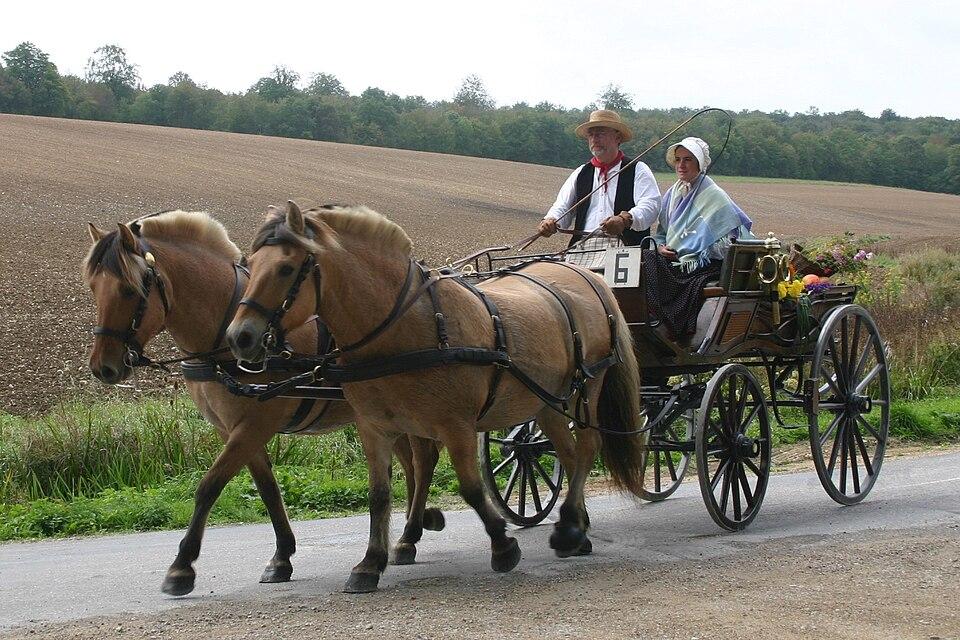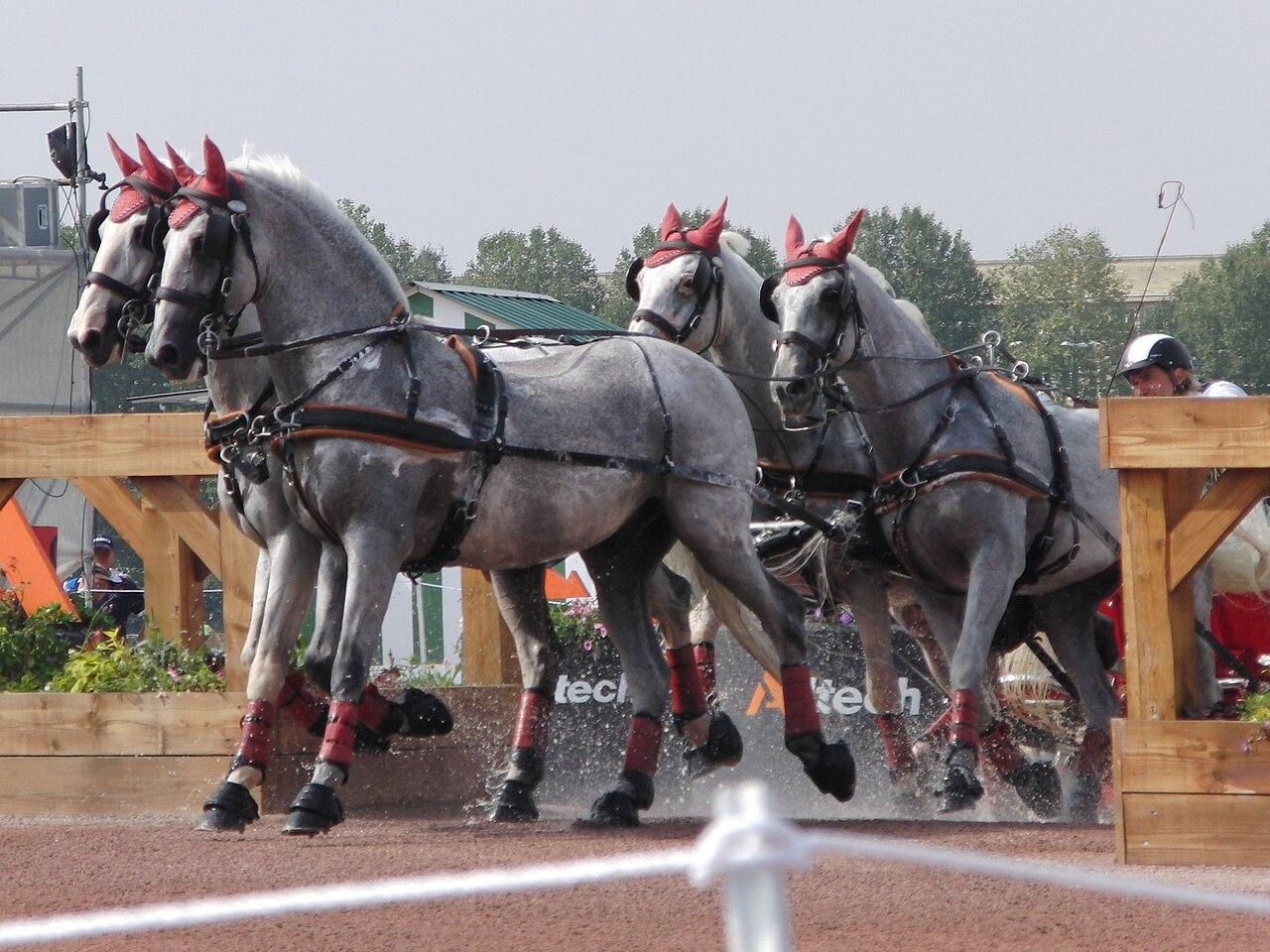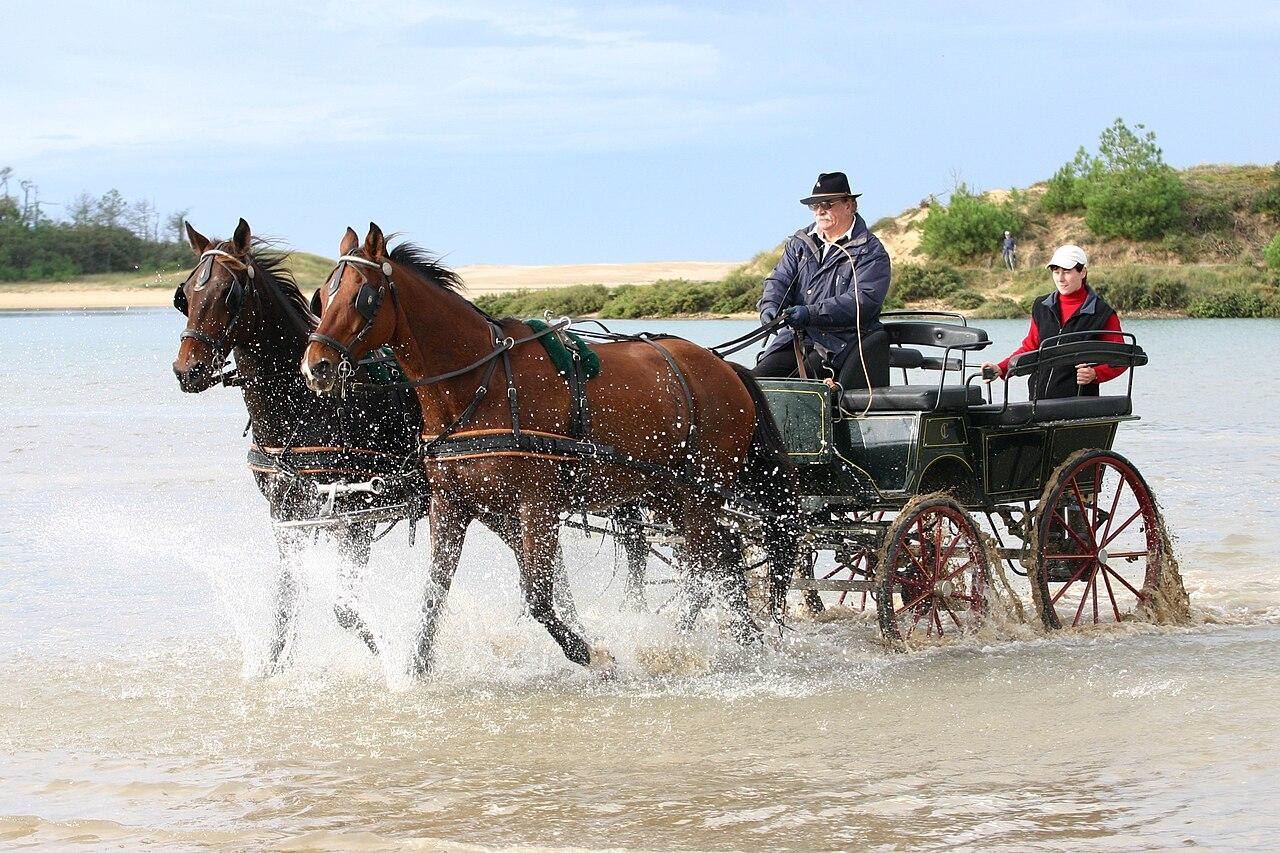
Horse driving is an equestrian activity in which one or more equines pull a vehicle to which they are connected by a harness. The person controlling the turnout, known as the driver, directs the horse or horses using reins, voice commands and a driving whip used as an aid.
Today, horse driving encompasses a wide variety of activities, including leisure driving, long-distance driving, competition, traditional carriage driving, working horse traction and tourism. A turnout may be driven with a horse or pony, but donkeys and mules can also be used in appropriate forms of driving.
Modern horse driving is the descendant of a much older history in which equines played important roles in human mobility, warfare, transport, agriculture and other forms of work. Mechanisation dramatically reduced many of these uses without eliminating them completely.
What exactly is horse driving?
The term driving can refer both to the activity itself and to the practice of controlling one or more horses harnessed to a vehicle.
A complete turnout generally includes:
- one or more equines;
- a suitable harness;
- driving reins;
- a carriage or another horse-drawn vehicle;
- a driver;
- depending on the activity, one or more grooms or team members.
The French Equestrian Federation (FFE) describes competitive driving as a discipline in which a carriage is drawn by one or more horses or ponies. French competitions include configurations with one, two or four equines.
Unlike mounted riding, the driver does not communicate with the horse from the saddle. The driver sits on the vehicle and must control the horse or team from a distance.
This fundamental difference accounts for much of the technical complexity of driving.
How does horse driving work?
The basic mechanical principle is traction.
The horse pushes against a breastcollar or full collar. The resulting pulling force is transmitted through the traces to the vehicle.
Not every part of the harness serves this purpose.
Some components are used to direct the horse, others support the shafts, while others help control the vehicle when it slows down or tends to move forward towards the horse.
The French Institute for Horses and Riding (IFCE) therefore identifies four main functions within a driving harness: direction, support, traction and holding back.
The horse does not directly "pull with" the shafts or pole. A driving turnout is a mechanical system in which different harness components perform specific functions.
How does the driver control the horses?
The driver primarily uses three types of aids:
- the reins;
- the voice;
- the driving whip.
The reins perform a role comparable to the reins used in mounted riding. They act through the horse's bit and allow the driver to influence direction, pace and transitions.
Voice commands also play an important role in training and driving.
The whip is likewise a technical driving aid. Because the driver cannot use their legs as a mounted rider would, the whip can be used to communicate an appropriate signal to a horse at a distance. Correct use should not be confused with punishment.
When several horses are driven together, communication becomes considerably more complex because the rein system must allow the driver to influence horses positioned side by side or in successive rows.
A history spanning several millennia
The history of horse driving is closely connected with the domestication of the horse, although very early dates need to be treated cautiously.
Archaeological and genetic research has substantially changed our understanding of the first domestic horses and how humans used them.
The first horse-drawn chariots
The strongest evidence for horses pulling light, spoked-wheel chariots appears around the beginning of the second millennium BC.
Archaeological research published in Antiquity places some of the earliest evidence within the Sintashta-Petrovka cultural complex in the southern Ural region, around 2000 BC. Archaeological finds combine horses, harness-related material and evidence associated with chariots. Research into the chronology of Eurasian chariots suggests their emergence may extend back into the closing centuries of the third millennium BC.
Genetic evidence provides a complementary perspective. A major study published in Nature found that the lineage responsible for the overwhelming majority of modern domestic horses spread rapidly across Eurasia from approximately 2200–2000 BC, alongside major changes in horse-based mobility.
It is therefore important to distinguish between horse domestication, the earliest human uses of horses and the development of horse-drawn chariots. They do not necessarily represent the same event or date.
From ancient chariots to horse-drawn vehicles
Chariots subsequently acquired important military, ceremonial and social roles in several ancient societies.
The history of horse-drawn transport, however, extends far beyond the war chariot.
Over the centuries, horses and other draught animals were increasingly used to transport people and goods. Harness systems, roads, vehicle construction and suspension systems gradually evolved.
Coaches, stagecoaches, breaks, omnibuses, carts and private carriages were developed for very different purposes.
Before the widespread adoption of motor vehicles, animal traction was consequently a major component of land transport.
From transport to equestrian discipline
Railways and later motor vehicles progressively reduced the importance of horse-drawn transport in everyday life.
Driving did not disappear.
Knowledge of driving technique, harnessing and historic vehicles survived through traditional carriage driving, while driving also developed into a leisure activity and competitive equestrian sport.
Animal traction also continues to have professional uses in certain contexts.
What are the different forms of horse driving?
There is no single form of driving.
Equipment, horses, vehicles and required skills vary according to the purpose of the turnout.
Leisure driving
Leisure driving includes recreational outings, pleasure drives and longer journeys undertaken outside competitive sport.
Distances and terrain can vary considerably.
Some outings last only a few hours, while longer-distance carriage driving requires careful preparation of the route, horses and equipment.
France also has competitive forms inspired by the skills required for outdoor and long-distance driving, including TREC en attelage.
Competitive driving
Competitive driving is organised nationally and internationally.
In France, competitions can include up to three main tests: dressage, marathon and cones. This structure is described by the FFE in its official introduction to driving.
At international level, the Fédération Équestre Internationale (FEI) regulates Driving and its different competitive categories.
Traditional carriage driving
Traditional carriage driving focuses on preserving horse-drawn transport heritage and the skills associated with it.
Historic or traditional-style vehicles, the presentation of the turnout, harness and quality of driving all play important roles.
Traditional driving is therefore not simply a matter of using an old carriage. It contributes to preserving a technical and equestrian culture developed during the period when horse-drawn transport was a central part of everyday life.
Working animal traction
Equine traction is not exclusively a sporting or heritage activity.
Horses, donkeys and mules can still be employed in some agricultural, forestry, land-management and tourism activities.
Whether animal traction is appropriate depends heavily on the circumstances. It should not automatically be described as more efficient or environmentally friendly than mechanised alternatives: working efficiency, terrain, animal care, equipment and organisation all need to be considered.
How does a driving competition work?
The classic format of combined driving includes three complementary tests.
Not every competition necessarily includes all three. The FFE states that driving competitions may contain up to three tests, with different formats available according to level and category.
Dressage
Dressage involves performing a prescribed test containing specific movements and figures.
Judges assess elements including the quality and regularity of the paces, accuracy and overall execution.
The objective is therefore not merely to follow a prescribed route. The driver must present a well-trained, responsive and regular turnout.
Marathon
The marathon takes place over an outdoor course.
Competitors negotiate technical sections and obstacles containing a number of gates or routes.
The French 2026 regulations define the marathon as an outdoor course containing obstacles.
The test challenges the horses' physical condition as well as the ability of the driver and grooms to manage speed, lines and carriage balance.
Cones
The cones phase is primarily a test of precision.
The course includes gates formed by cones, usually topped with balls. Dislodging a ball results in penalties.
The driver must therefore combine accurate lines with the requirements of the competition.
The width of the carriage and the configuration of the turnout become particularly important in this phase.
Can you drive one, two or four horses?
Yes, but the mechanics of the turnout change according to the configuration.
Single driving
With a single, one horse generally works between two shafts.
Single driving is practised both recreationally and competitively and should not be regarded solely as a beginner configuration.
Pair driving
A pair consists of two horses working side by side.
They work on either side of a central pole and each horse has its own traction components.
The driver must maintain coherent movement between the two horses and adjust the reins accordingly.
Tandem driving
In a tandem, two horses are positioned one behind the other.
The rear horse works close to the carriage while the leader works in front.
The tandem harness has a specific arrangement, particularly to allow the leader's reins to pass back towards the driver.
Tandem driving is now less common than singles or pairs.
Four-in-hand
A four-in-hand consists of two horses working closest to the carriage with another pair positioned ahead of them.
The horses closest to the vehicle are the wheelers, while the front pair are the leaders.
Driving becomes substantially more technical because of the number of horses, the length of the turnout and the management of four reins.
What equipment is used in horse driving?
Although equipment varies according to the configuration and type of driving, three elements are fundamental: the harness, the driving system and the vehicle.
The harness
A driving harness consists of numerous components with different functions.
Depending on the type of harness, these can include:
- a bridle;
- a breastcollar or full collar;
- traces;
- a saddle or pad;
- a crupper;
- breeching and associated straps where required;
- reins.
The harness must be selected and adjusted to suit both the horse and the vehicle.
The British government's Code of Practice for Horse-Drawn Vehicles likewise stresses that harness should fit correctly, be suitable for its intended purpose and be checked regularly for strength and safety.
The reins
The reins connect the driver's hands to the horse's bit.
The arrangement is relatively straightforward with a single horse but becomes more elaborate with pairs and four-horse teams.
Their adjustment is therefore an integral part of the functioning of a turnout.
The carriage
The term driving carriage covers a wide variety of vehicles.
A modern training or sport carriage is subject to different requirements from a traditional horse-drawn vehicle.
International competition rules can even specify characteristics of vehicles according to the test. FEI regulations distinguish requirements applying to carriages used in dressage, marathon and cones.
In every case, the vehicle should be appropriate for the size and number of horses and the intended activity.
What breeds are used for driving?
There is no single driving horse breed.
Riding horses, draught breeds, breeds historically selected for harness work and ponies can all be encountered in driving.
Friesians, Norman Cobs, Percherons, Comtois, Hackneys, Welsh ponies and Shetlands, among many others, may be driven, but such a list is neither a ranking nor a guarantee that an individual animal will be suitable.
At high levels of competitive driving, other types of horses are also selected according to the qualities sought by individual drivers.
Breed alone therefore cannot determine whether a horse is suitable for driving.
Can donkeys and mules be driven?
Yes.
Driving is not restricted to horses.
Donkeys and mules also have a long history of animal traction and can be driven using equipment suited to their conformation and intended work.
The general mechanical principles of traction remain comparable, but equipment designed for a horse should not automatically be assumed to fit a donkey or mule.
The IFCE also distinguishes pack equipment, traditionally associated particularly with donkeys and mules carrying loads, from traction harness: a pack animal carries a load, whereas a harnessed animal pulls it.
What qualities make a good driving horse?
There is no universal temperament that defines the "ideal driving horse".
The qualities required depend on the type of driving, but a horse must be capable of learning to work confidently in front of a vehicle and respond reliably to the driver's aids.
Training and experience are therefore fundamental.
A horse needs to become progressively accustomed to:
- the harness;
- the reins;
- traction;
- the sound of the vehicle;
- movement behind it;
- shafts or a pole, depending on its position;
- its working environment.
Physical conditioning must also match the work required.
A powerful horse is not necessarily a good driving horse, just as an animal that is quiet under saddle is not automatically ready to be put to a carriage.
Breed, individual temperament, training, experience, physical condition and working conditions all need to be considered together.
Is driving only for draught horses?
No.
The association between draught horses and driving is understandable because of the history of animal traction, but modern driving involves a much broader range of equines.
Lighter horses and ponies participate in competitions, leisure driving and longer-distance outings.
The FFE, for example, provides competitive categories involving one, two or four ponies, as well as one, two or four horses.
The appropriate type of horse therefore depends more on the intended activity and vehicle than on whether the animal belongs to a draught breed.
Is horse driving accessible to people with disabilities?
Some forms are.
Para driving is a recognised and regulated equestrian discipline. In France, the FFE describes para driving as an activity for drivers with physical or sensory disabilities, with competition potentially including dressage, marathon and cones.
Para driving demonstrates one particular characteristic of carriage driving: some people for whom mounted riding is difficult or impossible may be able to participate in an equestrian activity from an appropriately adapted vehicle.
This does not mean that every carriage or facility is automatically accessible. Necessary adaptations depend on the individual, turnout and type of activity.
How do you start horse driving?
Driving requires specific training.
Experience in mounted riding can be useful, but knowing how to ride does not mean knowing how to drive.
A beginner needs to learn how to:
- identify and correctly fit the harness;
- check its adjustment;
- handle the reins;
- use the driver's aids;
- put to and unhitch safely;
- understand the behaviour of the vehicle;
- anticipate the horse's reactions;
- manage situations encountered while driving.
For vehicles used on public roads, the British code for horse-drawn vehicles provides a useful illustration of the level of preparation involved. It includes checks of the horse, harness, wheels, axles, shafts, brakes and vehicle as a whole before taking to the road.
Learning at a specialist driving establishment with an experienced horse therefore allows a beginner to discover both driving technique and the particular mechanics of a horse-drawn vehicle.
Is horse driving dangerous?
Like any activity involving horses, driving carries risks.
The presence of a vehicle creates additional constraints because its mass and momentum do not disappear simply because the horse slows down.
Harness failure, a defective vehicle component or loss of control can therefore have serious consequences.
Safety depends on factors including:
- the horse's training;
- the driver's competence;
- the condition of the harness;
- the suitability of the vehicle;
- checks before setting off;
- awareness of the surrounding environment.
The objective is not simply to make a carriage as light as possible, but to create a suitable, balanced and properly maintained turnout.
Why is horse driving such a distinctive equestrian discipline?
Driving sits at the intersection of several different worlds.
It is an equestrian discipline because it depends on training, physical conditioning and communication with horses.
It is also highly technical, because the driver needs to understand the mechanics of both harness and vehicle.
Driving has an important historical and cultural dimension, inherited from centuries during which horse-drawn vehicles played a major role in transport and work.
Finally, modern driving is an international sport. Current regulations define vehicles, harness requirements, competition categories and tests in detail, making the discipline far more complex than simply placing a horse in front of a carriage.
Frequently asked questions about horse driving
What is the difference between driving and riding?
In mounted riding, the rider sits on the horse.
In driving, the driver sits on a vehicle and communicates with the horse or horses primarily through the reins, voice and driving whip.
What is the person driving a horse-drawn carriage called?
The usual English term is driver.
In French, the person is called a meneur or meneuse.
What are the reins called in horse driving?
In English, they are generally called reins or driving reins.
Their arrangement varies depending on whether the driver is controlling a single, pair or multiple-horse team.
How many horses can be driven together?
Many configurations have existed historically.
In the competitive driving categories presented by the FFE, the main configurations involve one, two or four horses or ponies. Other arrangements, including tandem driving, also exist outside this structure.
What is the difference between marathon and cones?
The marathon takes place over an outdoor course containing technical obstacles.
Cones involves negotiating a course of gates, usually formed by cones topped with balls, where accuracy is a central part of the test.
Do you need a particular breed for driving?
No.
Breed can influence certain physical or sporting characteristics, but the individual horse, its training, physical condition and suitability for the intended activity are more important.
Can a donkey or mule pull a carriage?
Yes.
Donkeys and mules can be used for driving with harness and vehicles appropriate to their conformation and intended work.
A discipline combining heritage, technique and sport
Reducing horse driving to a horse pulling a carriage does not reflect the complexity of the discipline.
A turnout is a complete system in which the equine, harness, vehicle and driver constantly interact. The quality of training matters just as much as correct equipment and technical driving skills.
Driving also carries several millennia of history. The earliest well-documented horse-drawn chariots appeared around the beginning of the second millennium BC; since then, the uses of harnessed horses have changed profoundly, from warfare and transport to leisure, heritage preservation and modern equestrian sport.
Today, driving a single horse, a pair or a four-in-hand therefore preserves an ancient body of knowledge within a thoroughly modern discipline, where precise driving, safety and correctly fitted equipment remain fundamental.
Sources and references
- French Equestrian Federation – Horse driving
- French Equestrian Federation – 2026 Driving Regulations
- Fédération Équestre Internationale – Driving Rules
- IFCE Equipedia – The different parts of a driving harness
- IFCE Equipedia – Different types of harness
- UK Department for Transport – Code of Practice for Horse-Drawn Vehicles
- Lindner, S. – Chariots in the Eurasian Steppe, Antiquity (2020)
- Librado et al. – The origins and spread of domestic horses from the Western Eurasian steppes, Nature (2021)