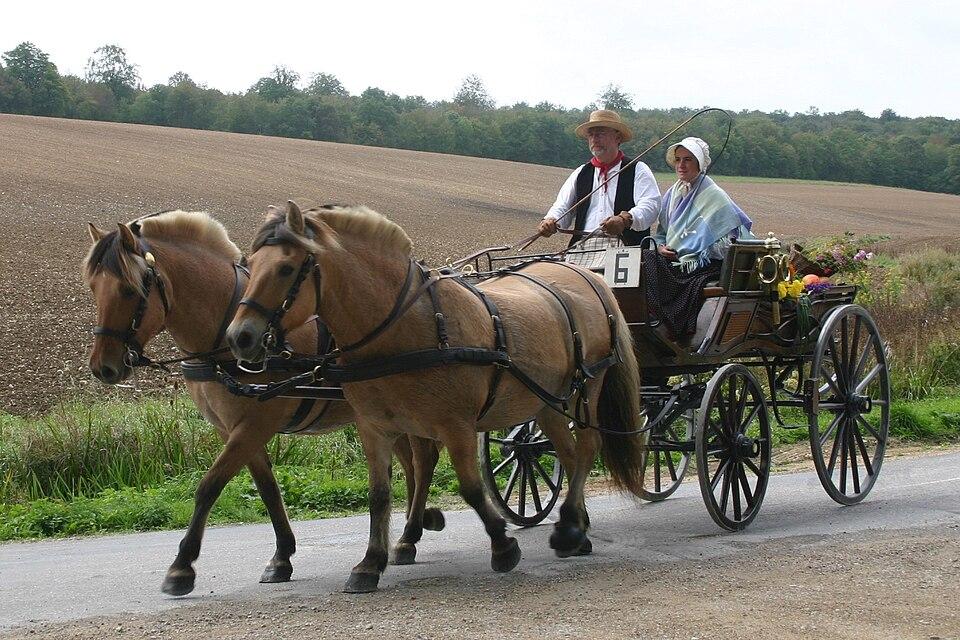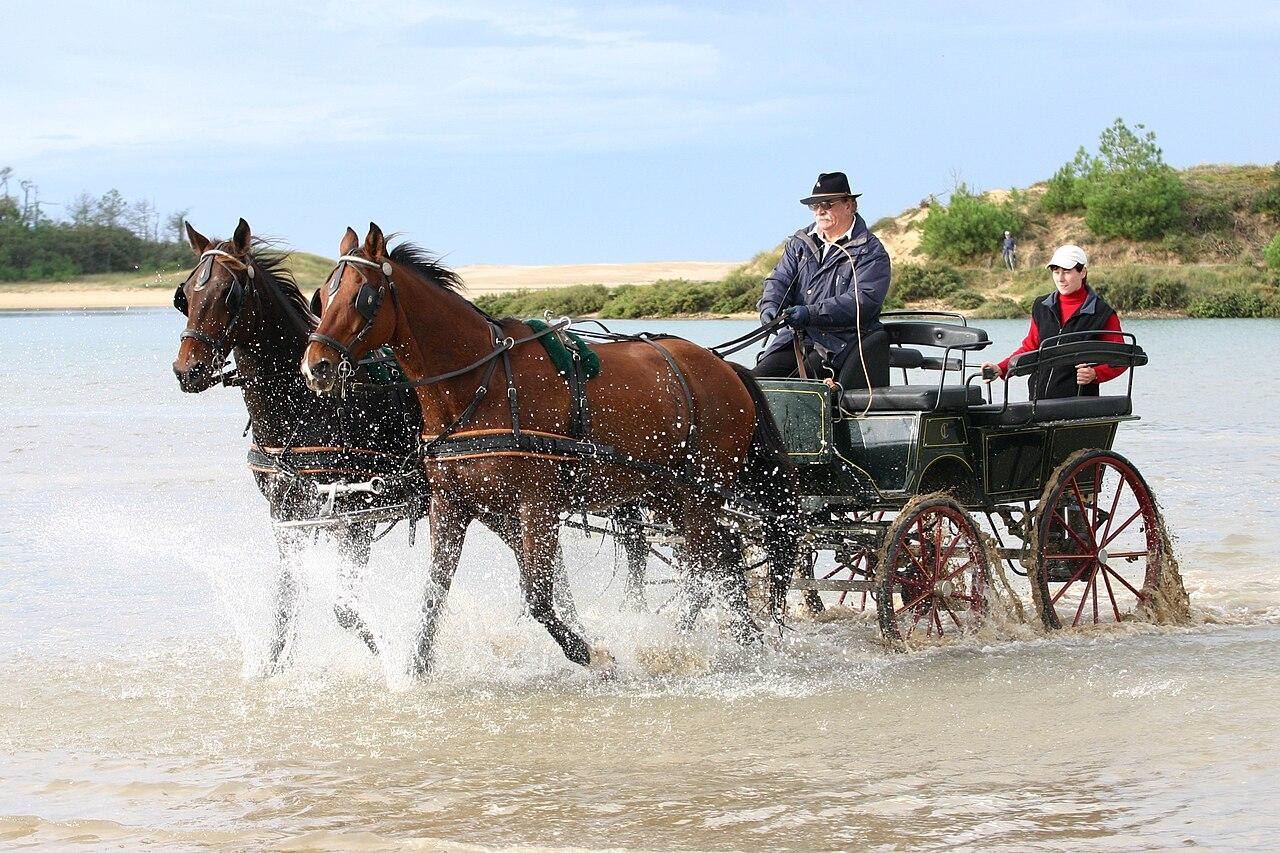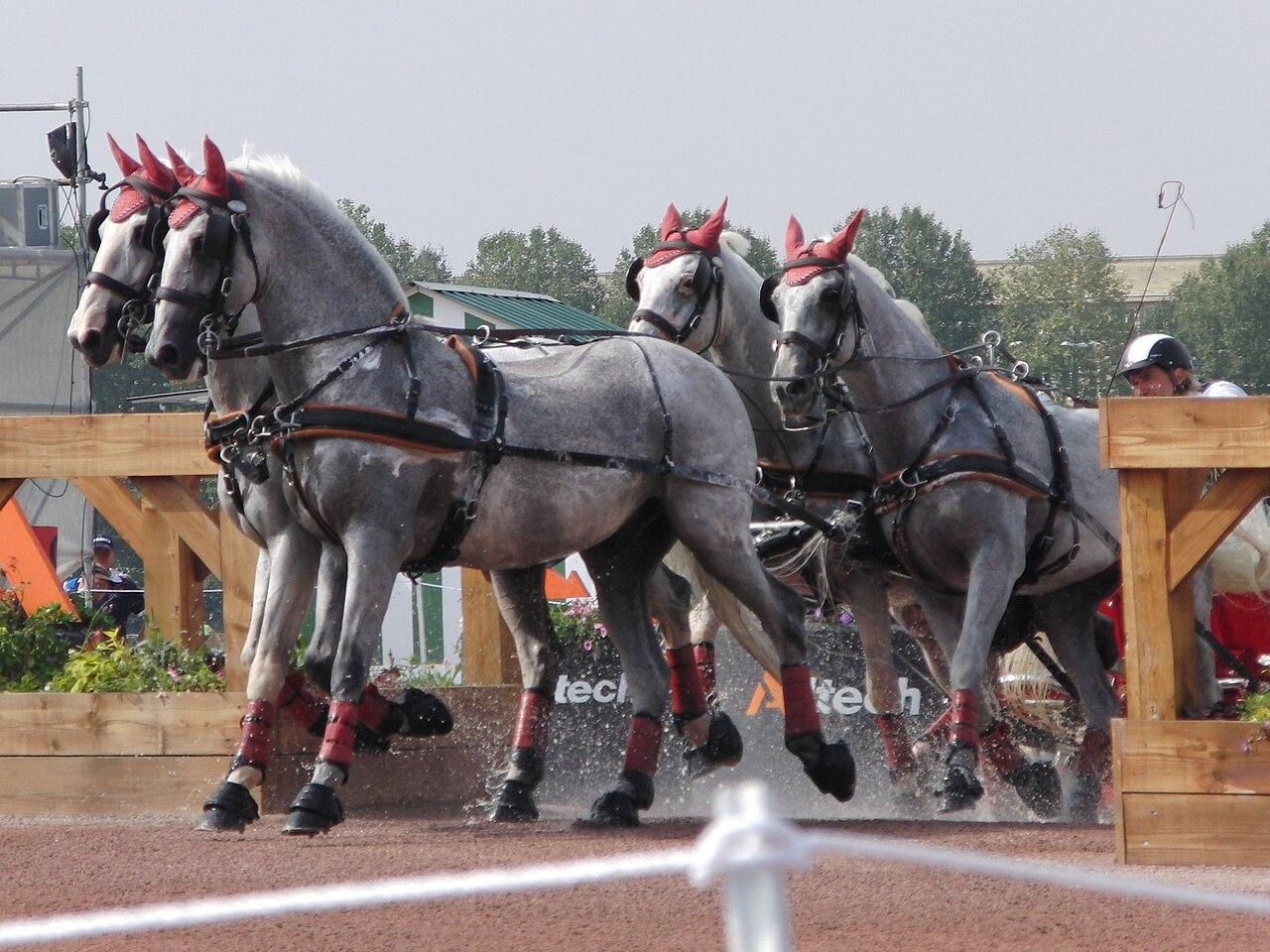
Horse driving involves one or more equines pulling a horse-drawn vehicle. Depending on the configuration, one horse may work alone, two horses may be driven side by side as a pair, while a four-horse team, or four-in-hand, combines two wheelers with two leaders.
All three configurations are based on the same general principle: the horses transmit their pulling effort to the vehicle through the harness, while the driver controls their pace and direction using the reins, voice and other driving aids.
However, moving from one to two and then four horses is not simply a matter of adding more pulling power. The way the horses are connected to the vehicle, the harness arrangement and the driving technique all change with the configuration.
How does traction work in horse driving?
A horse does not pull the vehicle through the shafts or pole.
The pulling force is transmitted primarily through a breastcollar or full collar, and then through the traces, which connect the harness to the vehicle's traction system.
The IFCE identifies four main functions of a driving harness: direction, support, traction and braking or holding back.
The bridle, bit and reins are involved in direction and control. The breastcollar or full collar and traces transmit the pulling force. Other parts of the harness support the shafts or help keep the horse connected to the vehicle when slowing down or travelling downhill.
This distinction explains an important part of driving mechanics: not every component connecting the horse to the vehicle is used for pulling.
What does the driver do?
The driver controls the turnout from the vehicle.
Unlike a mounted rider, the driver cannot use their legs to communicate directly with the horse. The main aids are:
- the reins;
- the voice;
- the driving whip.
The reins are connected to the bit and allow the driver to influence direction, transitions, pace and the overall balance of the turnout.
Voice commands are also an important part of communication with driving horses.
The whip is likewise a driving aid. When used correctly, it allows the driver to give an individual signal to a horse at a distance; its purpose is not to punish the animal.
When several horses are driven together, the same principles apply, but the rein system and its handling become considerably more complex.
How does a single-horse turnout work?
A single-horse turnout, usually shortened to single, is the most direct configuration.
The horse generally works between two shafts connected to the vehicle.
It applies its pulling force through the breastcollar or full collar and the traces. The shafts have a different function: they form part of the connection between the horse and vehicle and help keep the carriage correctly positioned behind the horse.
The harness must also allow the horse to manage the movement of the vehicle when slowing down or travelling downhill.
What are the shafts for?
The shafts run along either side of the horse and connect the vehicle to the harness.
They must not be excessively short, long or narrow.
Their dimensions and position affect the horse's freedom of movement as well as the behaviour of the vehicle. They therefore need to suit both the horse's conformation and the carriage.
The importance of matching horse, harness and vehicle is not specific to French driving practice. The British Code of Practice for Horse-Drawn Vehicles also requires harness to be properly fitted and suitable for its intended use and provides for checks of wheels, axles, shafts, brakes and other parts of the vehicle.
A carriage is therefore not suitable for a particular horse simply because that horse is physically strong enough to move it.
How is a single horse steered?
With a single, the driver has a left rein and a right rein connected to the same horse.
Communication is relatively direct compared with a multiple-horse turnout.
That does not make single driving easy: the driver must simultaneously control the horse and the trajectory of an entire horse-and-vehicle combination.
Single driving is also a competitive discipline in its own right rather than simply a beginner's stage before moving on to multiple horses. International driving distinguishes categories such as Single Horse, Horse Pairs and Horse Four-in-Hand, terminology also used by British Carriagedriving.
How does a pair work?
In a pair, two horses are driven side by side.
The connection between the horses and vehicle differs from a single turnout.
Rather than each horse working between two shafts, the pair is positioned on either side of a central pole extending forward from the vehicle.
Each horse has its own traction system and applies its pulling effort through its traces.
The pole has a different function: it forms part of the connection between the pair and the vehicle and contributes to controlling the vehicle.
It is therefore incorrect to imagine that the horses "pull through the pole". The pulling force is transmitted through the traces.
How can two horses be controlled at the same time?
Pair driving does not simply involve holding two completely independent sets of reins.
The rein system uses coupling reins, allowing the driver's reins to act appropriately on both horses.
The IFCE describes how these coupling reins work: the left reins of the two horses are connected, as are the right reins.
Their adjustment helps establish appropriate contact with each horse.
This is important because two horses in the same pair do not necessarily respond identically. They may differ in their way of going, posture, stride or sensitivity.
Correct adjustment should allow both horses to remain as straight and coordinated as possible without requiring one horse to compensate continually for the other.
Do the two horses in a pair have to be identical?
No.
A visually matched pair may be desirable in traditional driving and presentation classes, but two horses do not need to be genetically identical or even belong to the same breed to work together.
Their compatibility in work is more important.
Their size, movement, level of training, physical condition and behaviour need to allow them to work as a coherent unit.
Two horses that look extremely similar may form a poor pair if they struggle to work together. Conversely, horses with some physical differences may work successfully together when their movement and training are compatible.
How does a four-horse team work?
A four-horse team, or four-in-hand, consists of two pairs positioned one behind the other.
The two horses closest to the vehicle are called the wheelers.
The two horses in front are the leaders.
This arrangement is also used by the French Equestrian Federation when describing four-in-hand competition at the 2026 World Championships, with the front pair identified as the leaders and the pair closest to the carriage as the wheelers.
The rear pair works on either side of the pole, while the leaders work ahead of them.
What is the role of the wheelers?
The wheelers are positioned immediately in front of the vehicle, one on either side of the pole.
Their position gives them a direct mechanical relationship with the movements of the carriage.
They contribute to traction, but their role should not be simplified to "providing most of the pulling power".
Their harness also helps manage the relationship with the vehicle, particularly when it slows down or tends to move forward towards the horses on a descent.
This is one reason why the harness arrangement of the wheelers differs in some respects from that of the leaders.
The pole itself must also be correctly adjusted. Its length, height and position need to suit the horses so that it does not interfere with their movement.
What is the role of the leaders?
The leaders work in front of the wheelers.
They are also connected to the traction system through their traces and therefore contribute to pulling the vehicle.
Their forward position, however, gives them a different relationship with the rest of the turnout.
They are farther away from the driver and do not work directly on either side of the carriage pole. Precise rein adjustment therefore becomes particularly important.
The IFCE notes, for example, that the bits and rein arrangements used for leaders traditionally provide additional adjustment possibilities because these horses are farther from the driver.
It would nevertheless be too simplistic to say that "the wheelers pull and the leaders steer". All four horses contribute to the functioning of the turnout, but their different positions create different mechanical roles and constraints.
Do all four horses actually pull the carriage?
Yes. In a correctly configured four-in-hand, all four horses are incorporated into the traction system.
The exact distribution of effort, however, is not fixed.
It can vary according to:
- trace adjustment;
- terrain;
- pace;
- the vehicle;
- the horses' conformation and training;
- the situation encountered.
The position of the wheelers also gives them a particular mechanical relationship with the vehicle because they work immediately in front of it and on either side of the pole.
It is therefore more accurate to describe the two pairs as having complementary functions than to assign an arbitrary percentage of the pulling effort to each pair.
How does a driver control four horses?
This is one of the main technical challenges of the four-in-hand.
The driver must control two wheelers and two leaders using a system of four reins, arranged so that the two pairs can be managed appropriately.
Adjustment needs to be very precise.
An action intended to modify the way one horse or pair is going should not unnecessarily disturb the others.
Distance makes communication even more demanding: the leaders may be several metres in front of the driver.
Driving a four-in-hand therefore depends as much on the individual and collective training of the horses as it does on the dexterity of the driver.
Why is a pole used with a pair or four horses?
With a single horse, two shafts can run along either side of the animal.
The same arrangement is no longer suitable when two horses work side by side.
A central pole is therefore positioned between the two horses immediately in front of the vehicle.
In a pair, it runs between the two horses.
In a four-in-hand, it runs between the two wheelers.
The leaders are positioned farther forward and are therefore not located on either side of the pole.
The geometry of this connection matters. A pole that is incorrectly sized or positioned can interfere with the horses' movement, so its length and height need to suit both the horses and the vehicle.
How does the harness help control the vehicle when slowing down?
A driving horse must do more than simply move a vehicle forward.
It must also help control the vehicle when slowing down or when the vehicle's weight tends to push forward towards the horse.
The harness therefore contains components designed for holding back.
The IFCE identifies the breeching and associated straps among the parts that perform this function.
This becomes particularly important when travelling downhill. Without an appropriate connection, the vehicle could move dangerously towards the horse's hindquarters.
This is another reason why horse driving cannot be understood solely in terms of traction.
What does the groom do?
The driver may be accompanied by one or more grooms or team members.
Their role becomes particularly visible during the marathon phase of combined driving.
They can move their body weight to help balance the carriage through turns and technical sections. The FFE specifically mentions this balancing role for the grooms accompanying four-in-hand teams at the World Championships.
They also contribute to safety and perform various practical tasks around the turnout.
The required number of grooms and their precise responsibilities depend on the configuration and competition rules.
Why does carriage balance matter?
A driving carriage is not simply a passive load following the horses.
Its weight, suspension, geometry and behaviour through turns influence the entire turnout.
With a sport carriage, these forces become particularly significant during rapid changes of direction.
The position and movement of passengers and grooms can help limit body roll and keep the wheels in contact with the ground.
This is particularly visible during the marathon phase of combined driving, where teams negotiate technical obstacles at speed.
What is tandem driving?
Two horses do not necessarily have to work side by side.
In a tandem, they are positioned one behind the other.
The horse closest to the vehicle works between the shafts and is the wheeler. The horse in front is the leader.
The harness arrangement must allow the leader's reins to reach the driver despite the presence of the wheeler.
The IFCE description of tandem harness presents this as a particularly technical configuration to drive. The rear horse's bridle arrangement includes components that allow the leader reins to pass correctly towards the driver.
Tandem driving illustrates an important principle: the number of horses alone does not define a turnout; their arrangement matters just as much.
Can horses be driven in teams of three, six or eight?
Yes.
The history of horse-drawn transport has produced many different configurations.
Three horses can, for example, work abreast or be arranged as a pair with another horse in front. The Russian troika is a well-known example using three horses abreast.
Teams of six or eight horses also exist.
Today, these larger teams are particularly associated with traditional displays, ceremonies, demonstrations and the preservation of carriage-driving heritage.
As the number of horses increases, the length of the turnout, number of reins and complexity of the adjustments naturally make driving more demanding.
Single, pair or four-in-hand: what actually changes?
With a single, the system is relatively direct: one horse, two shafts and two reins.
With a pair, two horses work side by side on either side of a pole. Coupling reins allow the driver to communicate appropriately with both animals.
With a four-in-hand, two leaders are added in front of the wheelers. The driver must then manage two rows of horses, a more complex rein system and a much longer turnout.
The difference is therefore not merely numerical.
Each additional horse changes the geometry of the turnout, the harness arrangement and the way the entire team is driven.
Is single driving necessarily easier?
It is less complex than driving a four-in-hand, but that does not mean it is easy.
Driving requires simultaneous control of the horse, vehicle and trajectory.
The horse also needs specific training. Being calm under saddle does not automatically make a horse suitable for driving.
A driving horse must learn to accept:
- the harness;
- the reins;
- traction;
- the presence of shafts or a pole;
- the sounds and movements of the carriage;
- slowing down and the movement of the vehicle behind it;
- the different situations encountered while driving.
This preparation explains why a properly trained driving horse possesses skills that extend far beyond physical strength.
Why is correct equipment adjustment so important?
Horse, harness and vehicle form a complete mechanical system.
Incorrect adjustment can interfere with the horse's movement even when every individual piece of equipment is of good quality.
The height of the breastcollar, length of the traces, position of the breeching, dimensions of the shafts or height of the pole can all affect how forces are transmitted.
Vehicle safety is equally important. The British Department for Transport provides detailed inspection guidance for horse-drawn vehicles and recommends regular checks of harness to ensure that it remains strong and safe.
The code explicitly covers vehicles driven with a single horse, a pair or a team.
A successful turnout therefore depends less on raw pulling power than on the suitability and coordination of the entire system.
Frequently asked questions about horse-driving configurations
What is a one-horse driving setup called?
It is generally called a single, a single-horse turnout or single driving.
What is a two-horse driving setup called?
Two horses working side by side form a pair.
Two horses positioned one behind the other form a tandem instead.
What is a four-horse driving team called?
A team consisting of two successive pairs is called a four-in-hand.
What are the four horses in a four-in-hand called?
The two horses closest to the carriage are the wheelers.
The two horses in front are the leaders.
Do horses pull through the pole?
No. The pulling effort is primarily transmitted through the breastcollar or full collar and the traces.
The pole performs other functions in the mechanical connection between the horses and vehicle.
Why do wheelers and leaders have different roles?
The wheelers work immediately in front of the carriage and on either side of the pole. The leaders work in front of them.
Their different positions alter their relationship with the vehicle, harness and reins.
Do all four horses contribute to traction?
Yes, but the distribution of effort varies according to the situation and the adjustment of the turnout.
It is therefore more accurate to regard the two pairs as complementary than to claim that one pair systematically provides most of the pulling power.
Is driving four horses more difficult?
Yes.
The driver must control four horses arranged in two rows using a considerably more complex rein system. The length of the turnout and the distance between the driver and the leaders add to the difficulty.
One horse, a pair or four: three different systems
The fundamental principle of horse driving remains the same whatever the configuration: the harness transmits the horses' effort to the vehicle while the driver controls their movement.
The mechanics, however, change considerably.
In a single, one horse generally works between two shafts. In a pair, two horses work on either side of a pole. In a four-in-hand, two leaders are added in front of the wheelers.
These differences affect traction, the connection with the vehicle, the rein system and driving technique.
A driving turnout should therefore be understood as a complete system rather than simply a collection of horses: the vehicle, harness, adjustments, driver and horses all need to function together as one coordinated team.
Sources and references
- IFCE Equipedia – The different parts of a driving harness
- IFCE Equipedia – Choosing and adjusting bits and reins for driving
- IFCE Equipedia – Choosing a sport-driving carriage and performance factors
- IFCE Equipedia – Different types of driving harness
- Department for Transport / GOV.UK – Code of Practice for Horse-Drawn Vehicles
- French Equestrian Federation – Driving at the 2026 World Championships
- British Carriagedriving – International Squads and Teams