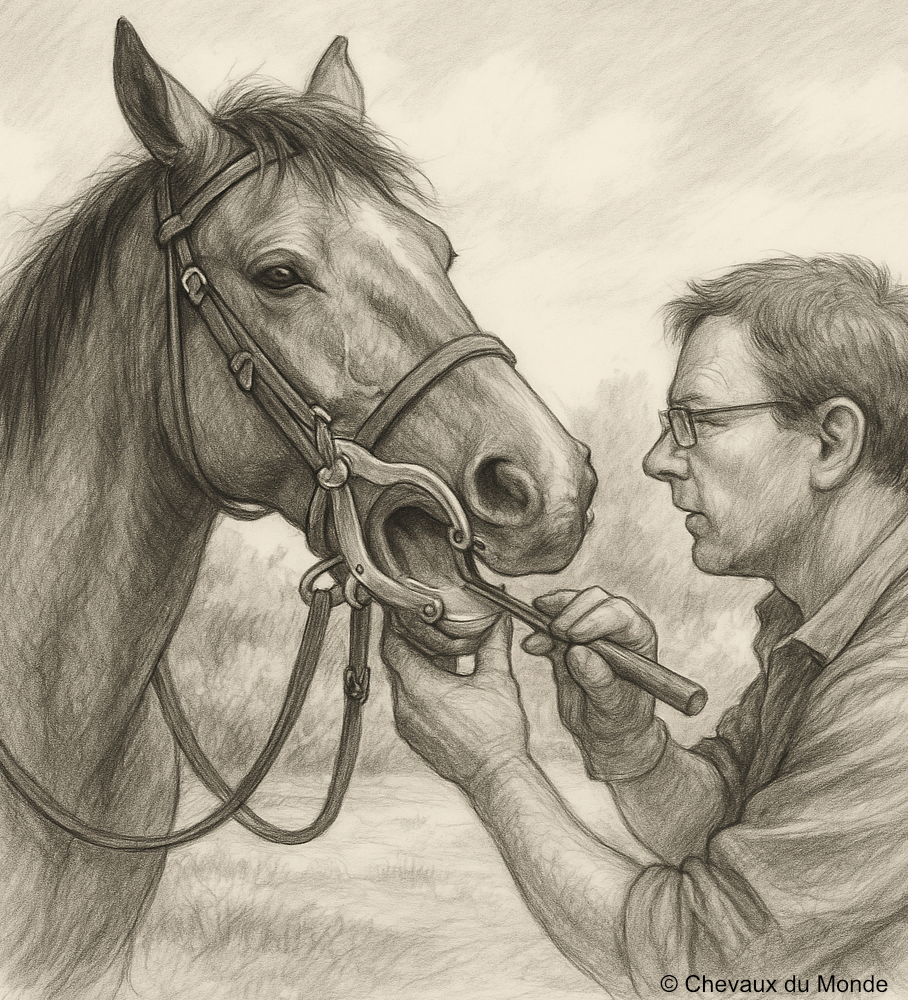
The horse’s mouth is a complex and constantly evolving area, shaped by chewing, age, and work. With teeth that grow continuously, a powerful jaw, and feeding conditions very different from those in the wild, regular dental care is essential. Calling an equine dentist is not a luxury: it is a key element of well-being, performance, and safety for both horse and rider.
1. Why call an equine dentist?
1.1 A horse’s teeth grow continuously
Unlike humans, a horse’s teeth wear down and regrow throughout its life.
If the wear is uneven, sharp points can develop, causing:
- pain
- chewing difficulties
- injuries to the cheeks or tongue
1.2 Proper dental balance improves chewing
Efficient chewing is essential for:
- breaking down fibre
- preventing colic
- maintaining good body condition
- educing wasted forage and grain
A horse that eats slowly, drops grain, or sorts its food may be experiencing dental discomfort.
1.3 Dental balance affects locomotion
The mouth, poll, jaw, and back are closely connected.
Dental pain can lead to:
- resistance in the contact
- stiffness in the poll
- difficulty bending
- tension in the back
- reduced engagement
A dental issue can easily be mistaken for a “training problem”.
1.4 Bit comfort depends on dental health
Even a perfectly fitted bit (with or without bit-fitting) becomes uncomfortable if:
- sharp points irritate the cheeks
- wolf teeth cause pain
- the jaw is blocked
Regular dental care ensures a steadier, more comfortable contact.
2. Common dental problems in horses
The most frequent issues include:
- sharp enamel points
- wolf teeth
- hooks and ramps
- broken teeth
- diastemas (abnormal gaps between teeth)
- malocclusions
- gum infections
- uneven wear linked to asymmetrical work
These issues never resolve on their own.
3. Signs that should alert you
A horse can express dental pain in many ways:
Feeding signs
- drops grain
- chews slowly
- wastes forage
- plays with food
- unusual chewing motions
- excessive salivation
Behavioural signs
- opens the mouth under saddle
- headshaking
- refuses contact
- sudden resistance on the bit
- tension in the poll
General signs
- weight loss
- bad breath
- repeated colic
- wads of chewed hay spat out (quidding)
Horses hide pain well; early intervention is best.
4. When should you call an equine dentist?
4.1 Healthy adult horses
Every 12 months for a full exam.Some horses need a check every 6 months.
4.2 Young horses (2 to 5 years)
A critical period: shedding baby teeth and bit introduction.
Recommended rhythm: every 6 months.
4.3 Senior horses (17+ years)
Higher risk of loose, broken, or lost teeth.
Recommended rhythm: every 6 months, sometimes more.
4.4 Before backing or starting work
Essential to:
- avoid resistance on the bit
- ensure a positive learning experience
- establish healthy contact from the beginning
4.5 After any sudden behavioural change
Any abrupt change in the contact or chewing requires a dental exam.